




Predictive Maintenance in Qatar
Condition monitoring for your chillers, pumps, motors and fans: sensors that spot wear weeks before a breakdown, and a work order raised before anyone has to call you about it.
Last updated
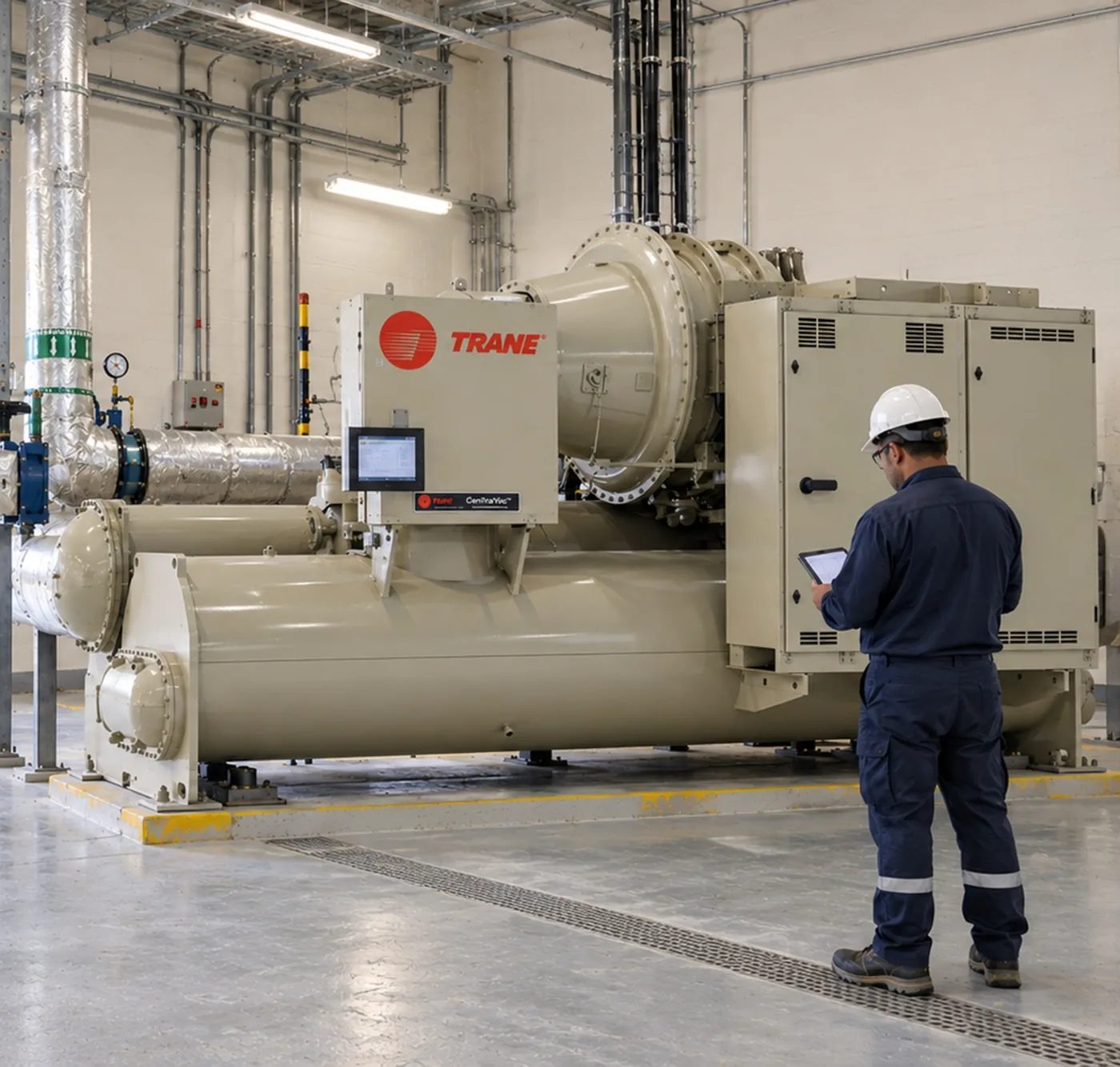
What is predictive maintenance?
Predictive maintenance uses live readings from your machines, such as vibration, temperature, current and pressure, to spot the early signs of failure and fix the problem at a planned stop instead of after a breakdown.
Condition monitoring is the measuring half: sensors and systems that track each machine's health. Predictive maintenance is acting on it, with an alert to the right person and a work order at the right time. Quoriam does both on one platform.
Reactive
Fix it after it breaks. No planning, but the costliest repairs and downtime at the worst moment.
Preventive
Service on the calendar. Replaces healthy parts and still misses the failure that starts between visits.
Predictive
Service when the data says so. Parts replaced when they need it, failures caught while they're still cheap.
Sound familiar?
What maintenance and facilities teams in Qatar tell us before we start.
"The chiller trips on the hottest afternoon of the year."
From June to September plant rooms run near full load in 45 to 50 °C outside air. That's when worn equipment gives out, tenants feel it within the hour and hire chillers are hardest to find.
"We service on the calendar, not on condition."
Planned maintenance replaces parts that had years left and still misses the bearing that starts failing a week after the visit.
"We find out when it stops."
Nobody watches the plant room or the remote pump station between rounds. The first sign is a call from an operator or a tenant.
What it catches, and how early.
Each fault changes a machine's readings in its own way. These are the ones we set alerts for first.
| Fault | Early signal | Measured by |
|---|---|---|
| Bearing wear | Rising high-frequency vibration, then bearing temperature | Vibration and temperature sensors |
| Imbalance and misalignment | Vibration at once and twice running speed, high axial readings | Vibration sensor |
| Pump cavitation | Broadband high-frequency vibration with falling discharge pressure | Vibration sensor and existing pressure transmitter |
| Motor overheating and electrical faults | Winding temperature climbing, current unbalanced between phases | Temperature and current sensors |
| Chiller performance drift | Approach temperatures creeping up, more kW for each ton of cooling | Chiller controller over BACnet or Modbus |
| Belt and coupling wear | Vibration at belt frequency, fan or pump speed dropping | Vibration sensor |
How it works on Quoriam.
From the sensor on the machine to the work order closed, on one platform.
Connect
Fit vibration and temperature sensors on critical machines, and read what you already measure from PLCs, the BMS and chiller controllers.
Learn
Alarm limits start from the ISO vibration zones for each machine's type and class (ISO 20816-3, or ISO 10816-7 for pumps), then tighten to each machine's own normal over the first weeks.
Alert
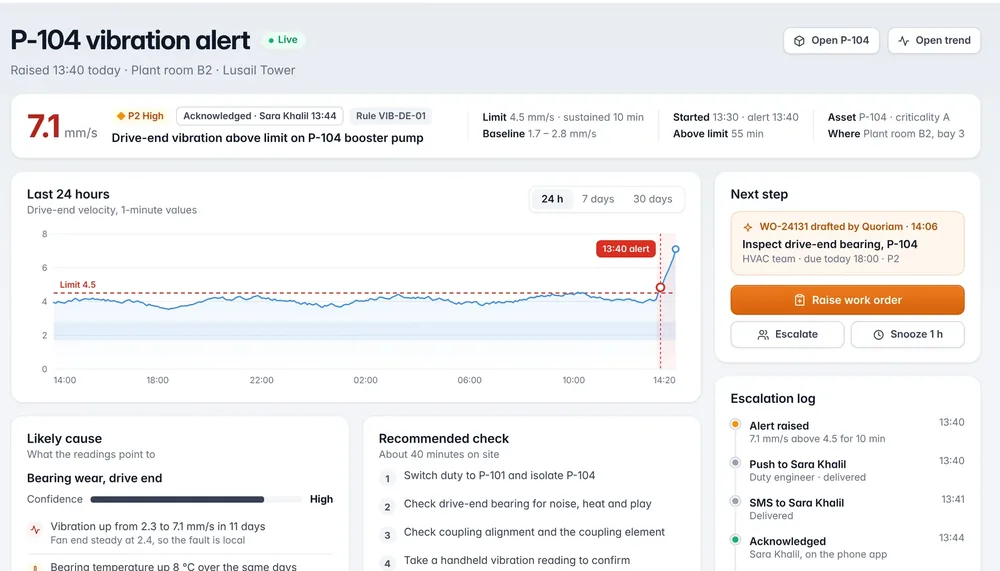
When a reading drifts or crosses a limit, the duty engineer gets an alert in the app, by SMS or by email, with the trend and the likely fault.
Act
Raise a work order in Quoriam or your CMMS, fix it at the next planned stop and close it with the reading back in range.
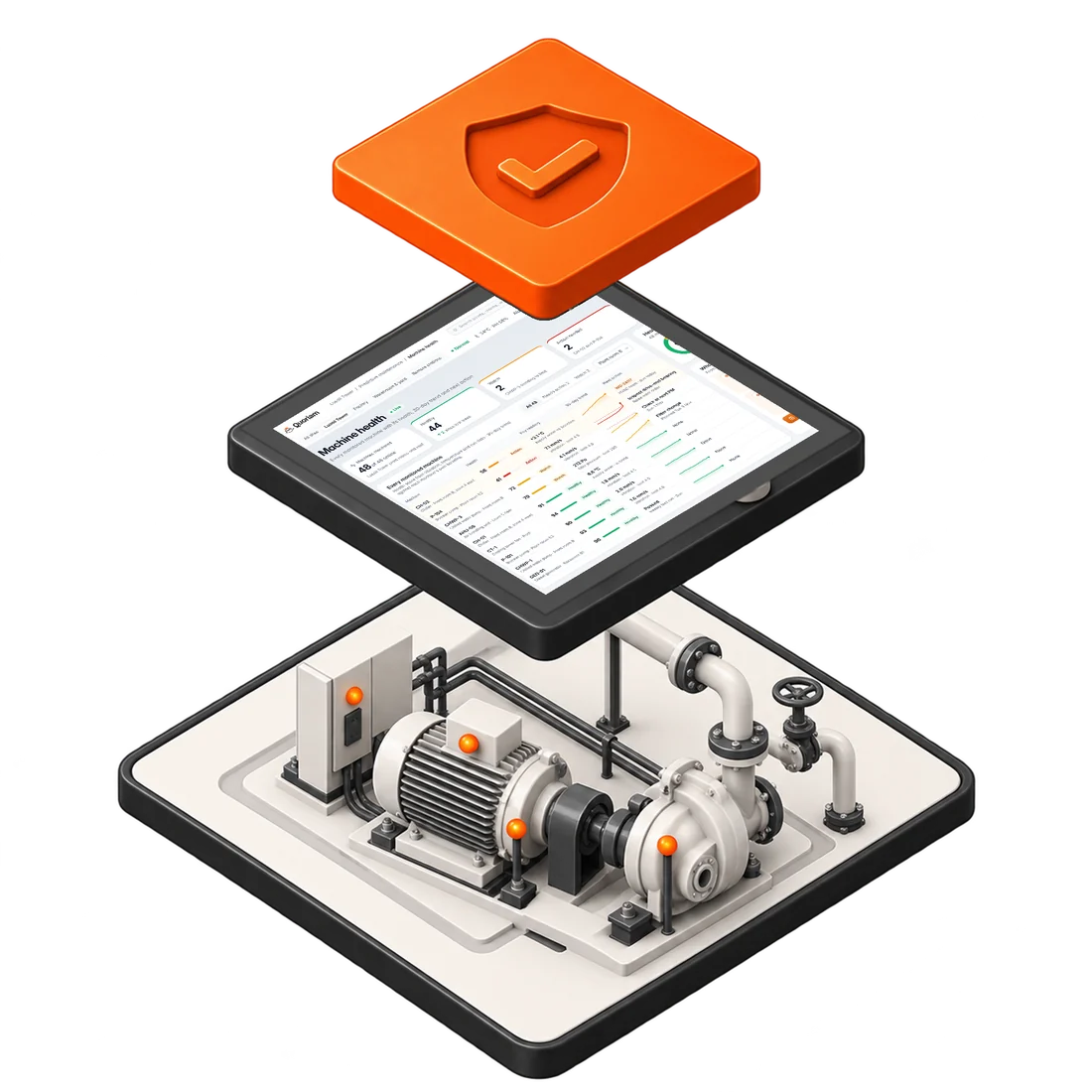
System view
For IT, OT and security reviewers: where the data goes, and how.
- On the machineVibration, temperature and current sensors on critical machines
- In the plant roomLoRaWAN gateway for the sensors; edge gateway reading PLCs, the BMS and chiller controllers
- NetworkSite LAN or cellular, encrypted and kept apart from the control network
- Quoriam platformOn your premises or cloud hosted in Qatar
- Your team and systemsApp, SMS and email alerts; work orders to your CMMS; data back to the BMS
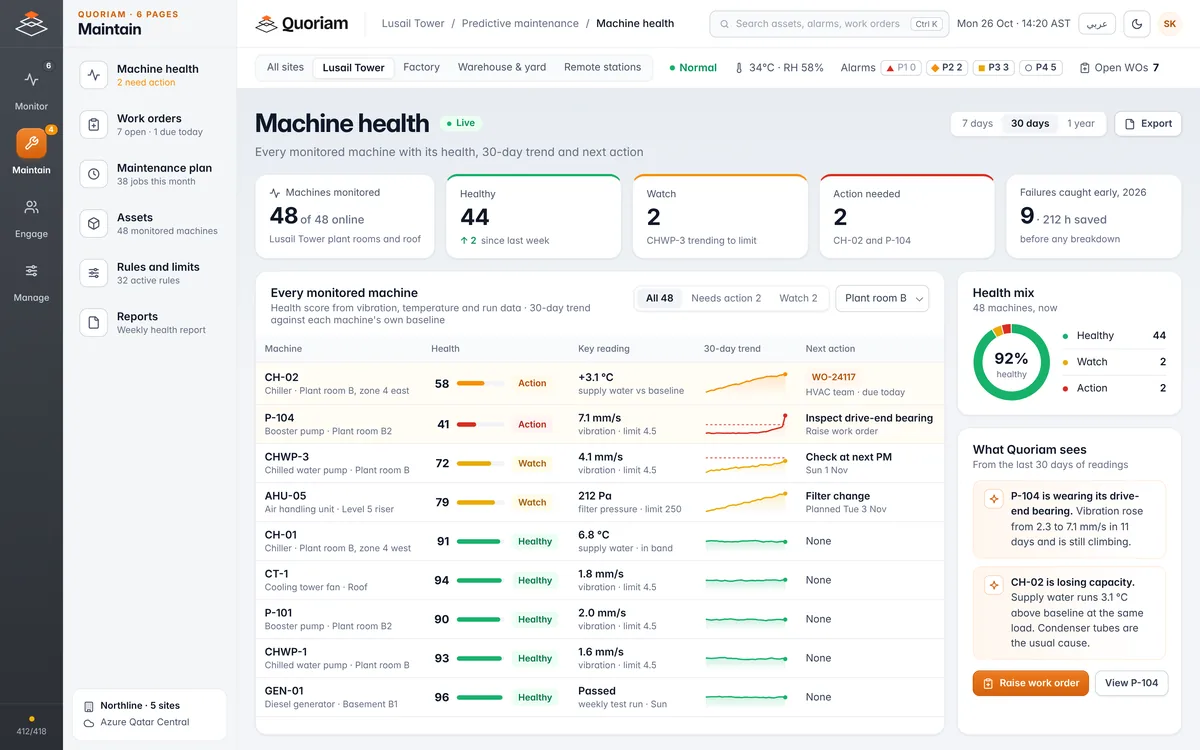
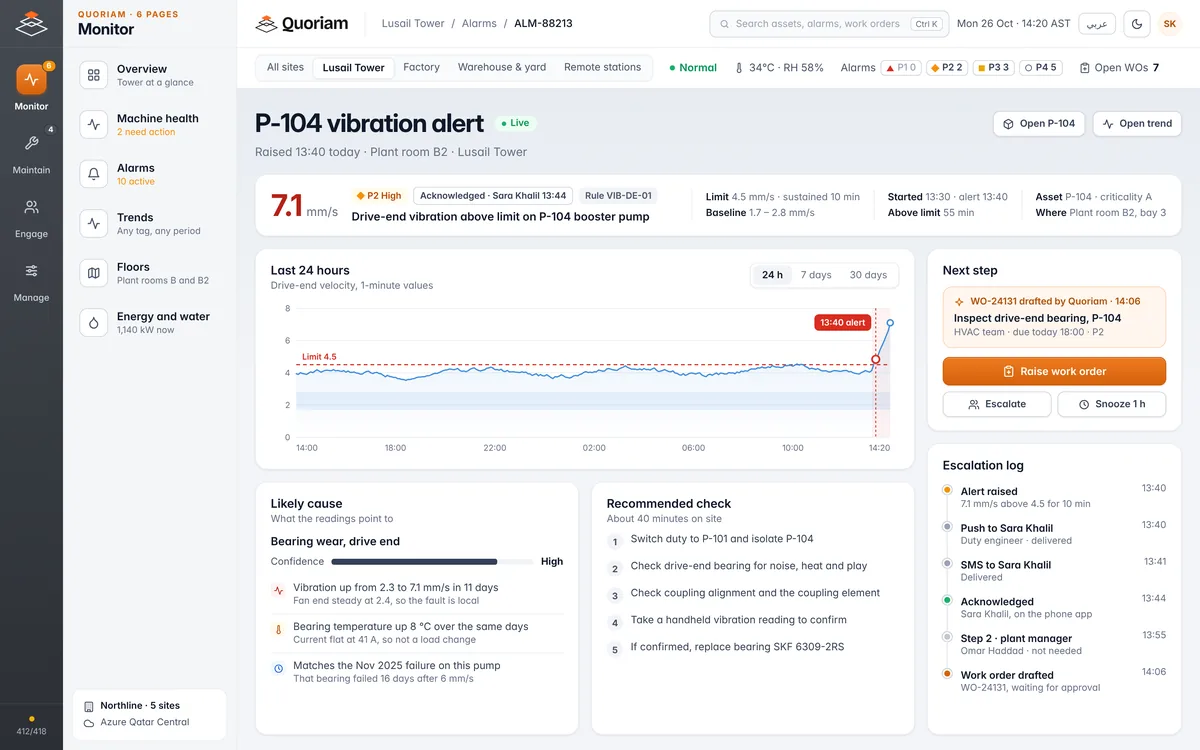
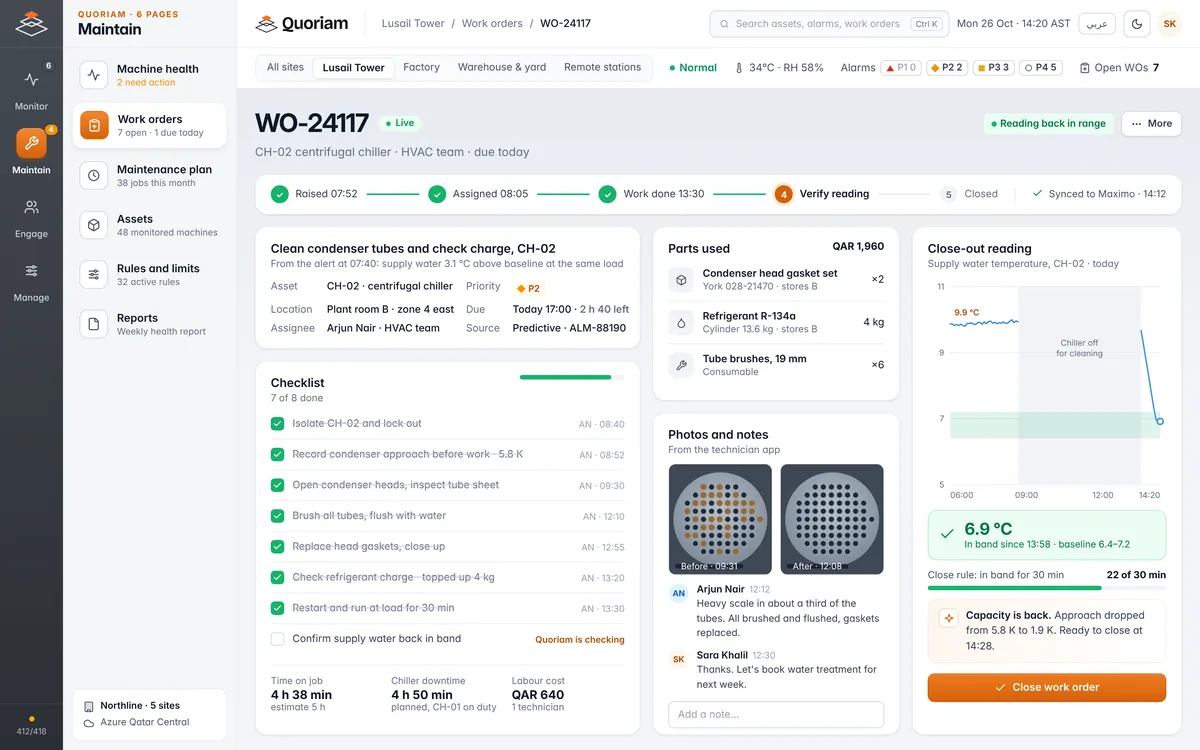
What your team sees.
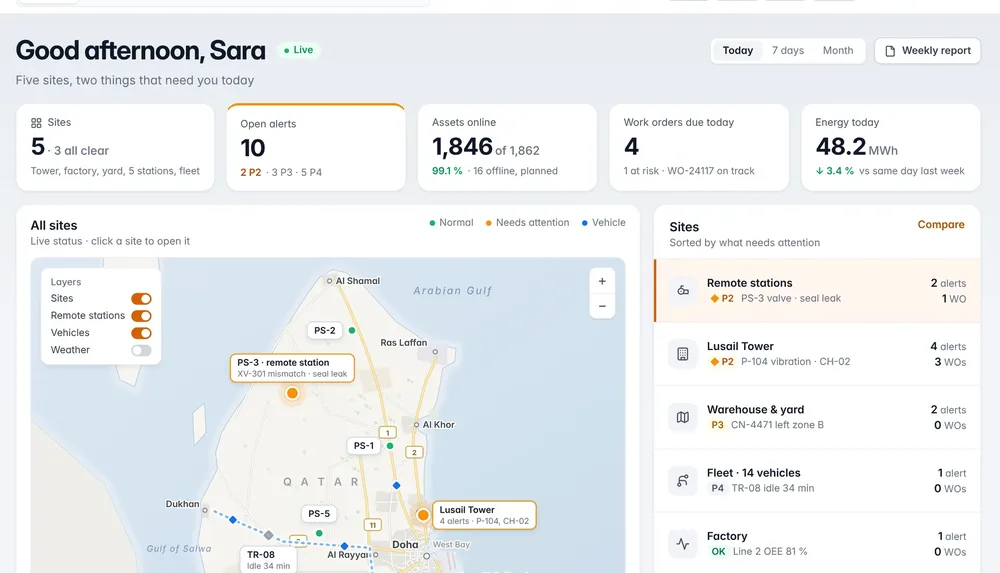
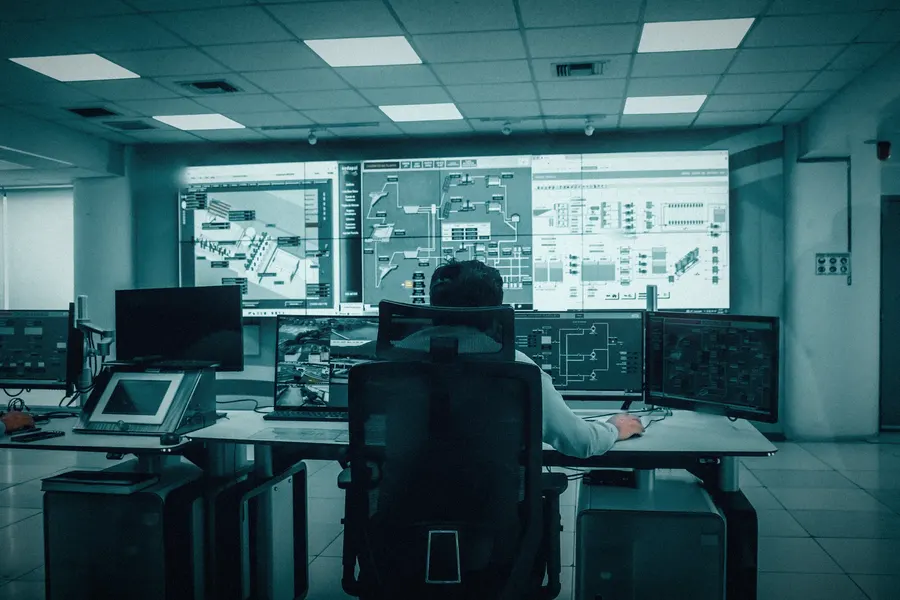
One view of every monitored machine, with the evidence behind each alert.
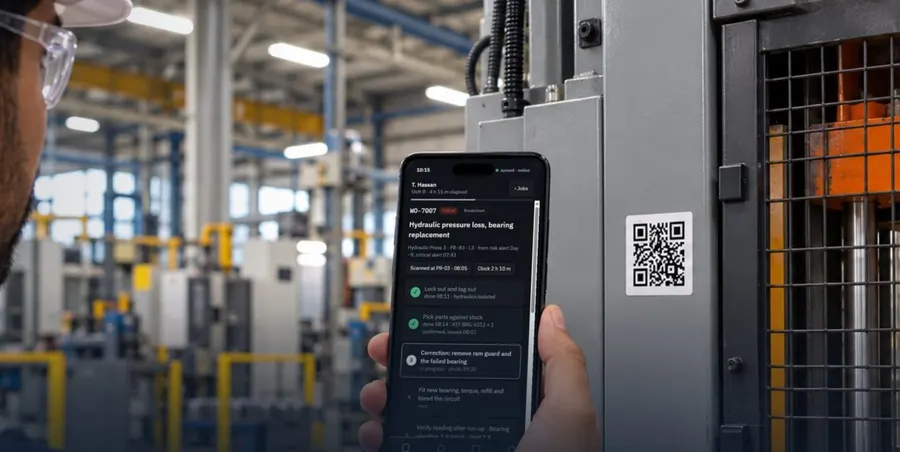
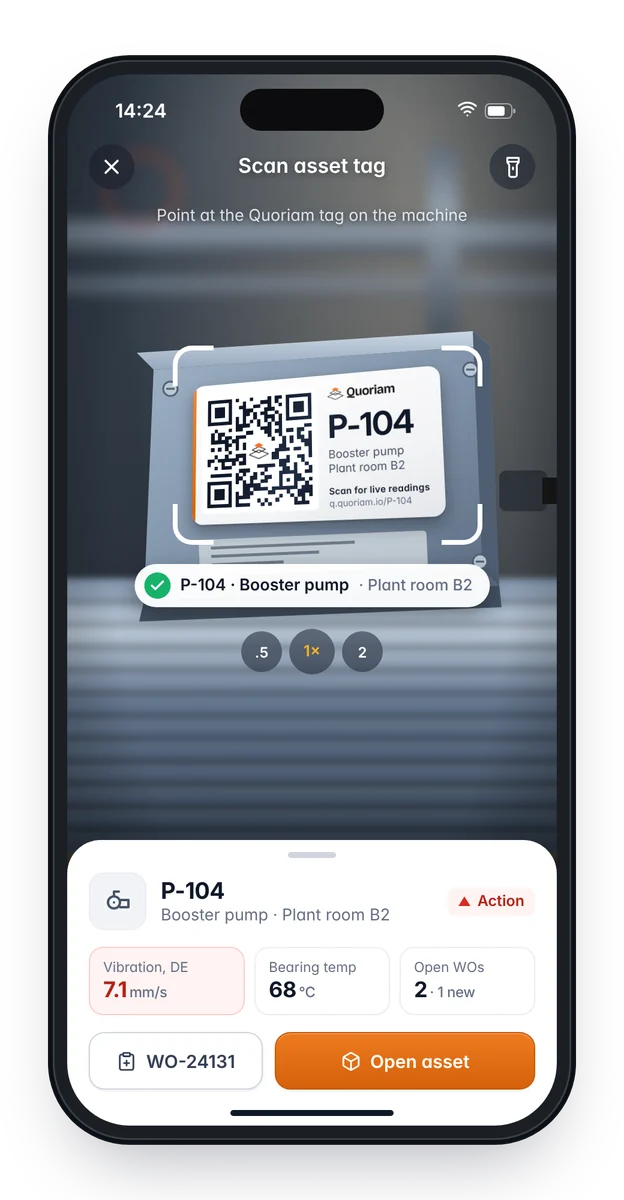
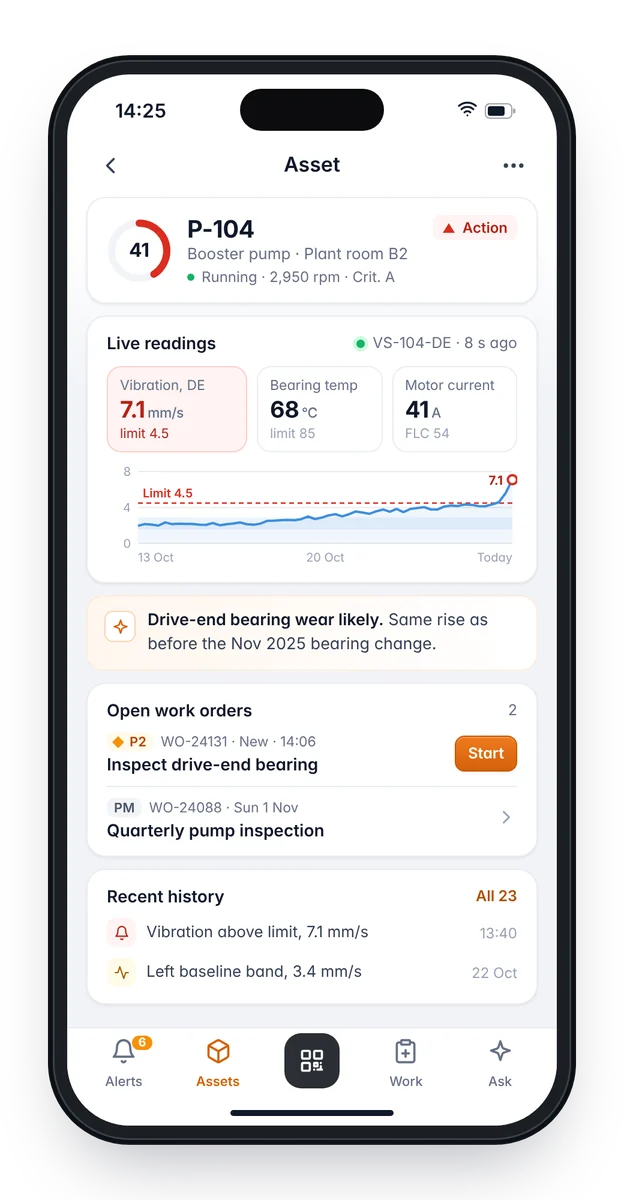
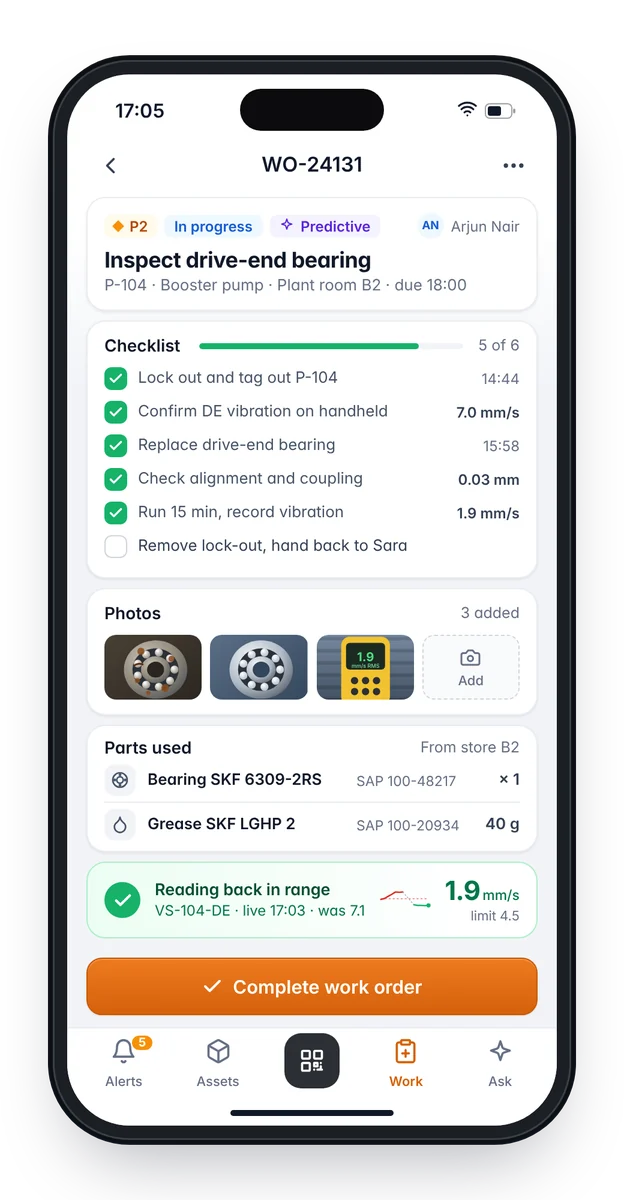
On the plant floor.
Technicians scan the QR label on the machine to open its profile, see the live readings and history, and work through the order on their phone.
Or just ask.
Quoriam AI answers questions about your machines in plain language and turns the answer into an action.
Predictive maintenance use cases.
Start with the machines that cost you most when they stop.
- Condition monitoring
Vibration, temperature, current and pressure read around the clock on the machines that matter.
- Vibration monitoring
Bearing wear, imbalance and misalignment on pumps, motors, fans and compressors.
- ATEX and hazardous area monitoring
Certified wireless sensors for Zone 1 and Zone 2 areas at LNG, oil, gas and chemical sites.
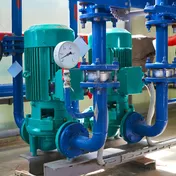
- Pump and motor monitoring
Vibration, temperature and current on the pumps that keep water and cooling moving.
- Chiller monitoring
Compressor health and plant efficiency from sensors and the chiller's own controller.
- Generator monitoring
Run hours, fuel, battery and alarms on standby gensets, so they start when needed.
- Current and power monitoring
Motor load and phase imbalance from clamp-on current sensors.
Hardware and integrations.
We fit the sensors where nothing is measured and read the systems you already run.
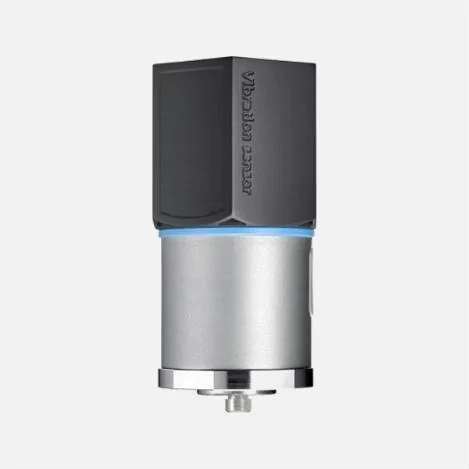
- Vibration sensorsTriaxial, on the bearing housing
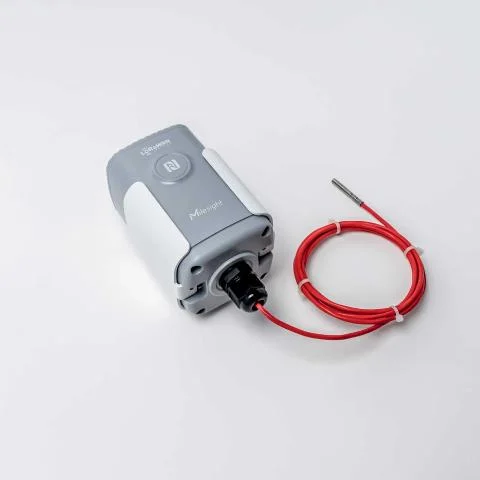
- Temperature sensorsBearings, windings, surfaces
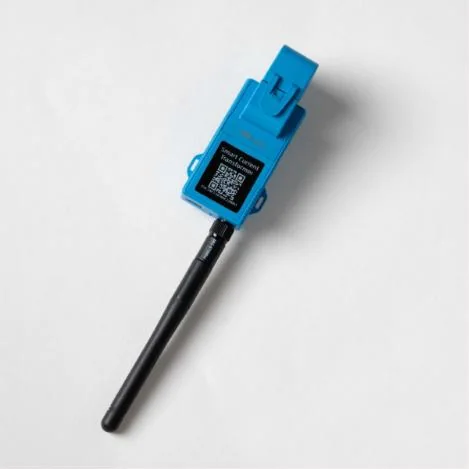
- Current sensorsClamp-on, no rewiring
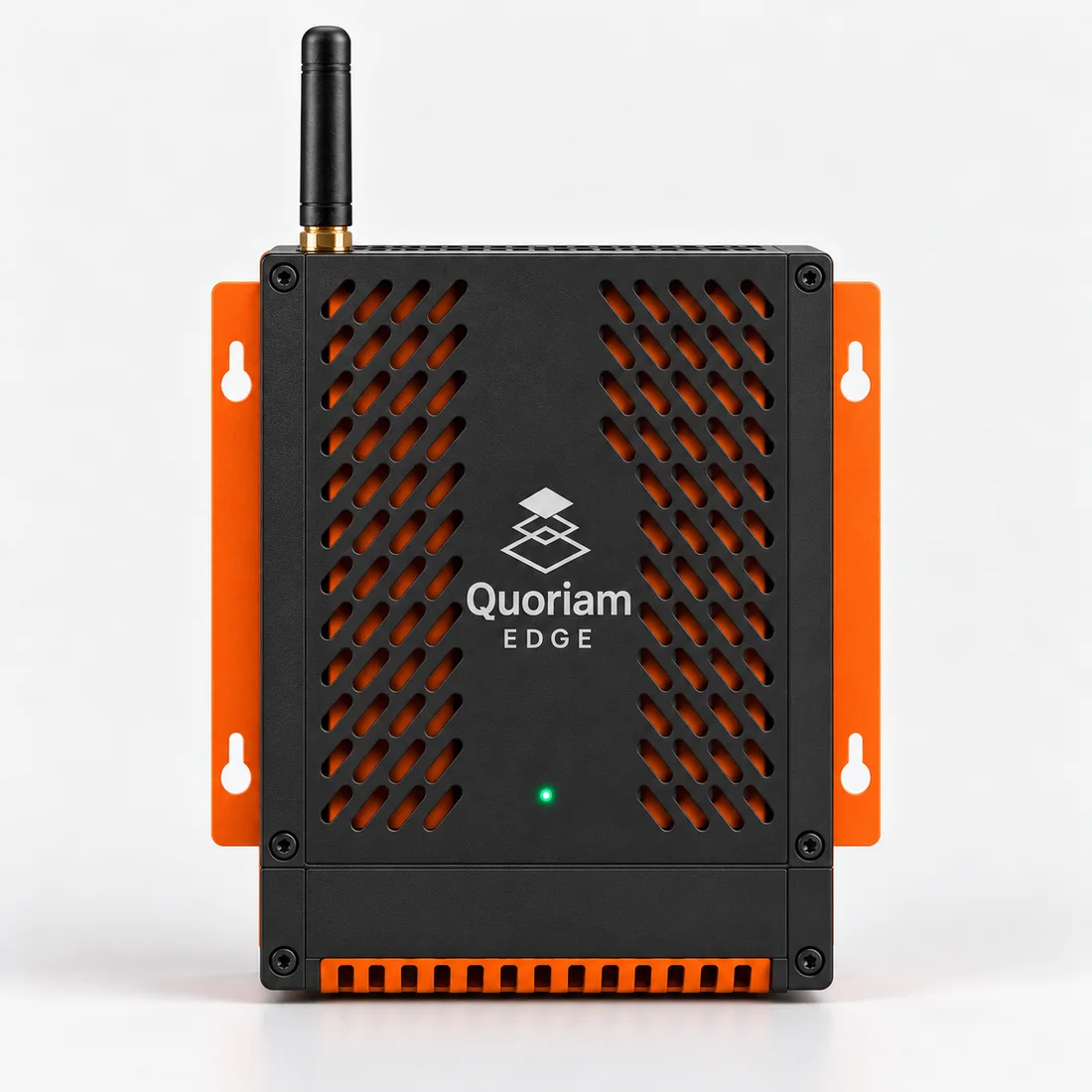
- GatewaysQuoriam Edge QE35, LoRaWAN or cellular
- Reads from
- Chiller controllers and BMS over BACnet and Modbus; PLCs and SCADA over OPC UA
- Work orders to
- Quoriam's own work orders, or IBM Maximo, SAP and other CMMS
- Alerts by
- Quoriam app, SMS and email, with escalation if nobody responds
Hardware agnostic. Makes we fit includeMilesightFootfallCamTeltonikaAdvantechWe can work with any maker and choose the device for each site. The platform reads them all.
Where it's used.
The same platform, set up in each industry's terms.
- Oil, gas and energy
Valve line-ups, rotating equipment, hazardous areas and solar assets.
- Manufacturing
Line status, OEE and machine health.
- Facilities and smart buildings
Chillers, energy, occupancy and air quality.
- Utilities and district cooling
BTU metering, tenant billing and leak detection.
- Healthcare
Critical equipment, cold chain and assets on the move.
Questions buyers ask.
Something else? Ask us during the free assessment.
What's the difference between preventive and predictive maintenance?
Preventive maintenance follows a calendar: the same service every few months whatever the machine's condition. Predictive maintenance follows the machine: sensors show when a part is actually wearing, so you replace it then, and leave healthy parts alone.
Which machines should we monitor first?
The ones whose failure stops cooling, water or production and have no standby: usually chillers, main pumps, compressors and large fans. The free assessment ranks your machines by what a failure would cost you.
How many sensors does a site need?
Only as many as your critical machines need. A critical pump or fan typically takes one or two vibration sensors, a chiller adds readings from its own controller, and one gateway usually covers a plant room. The free assessment counts it for your site.
Do we have to replace our BMS or existing sensors?
No. Quoriam reads what you already have from the BMS, PLCs and chiller controllers, and adds sensors only where nothing is measured today.
How soon will we get useful alerts?
Sensors and connections go in during the first five weeks. Fixed limits work from the first day; alerts based on each machine's own baseline need a few weeks of normal running to learn from.
Will the sensors cope with summer in Qatar?
We specify each sensor for where it goes. Rooftop and outdoor equipment runs far hotter than a plant room in summer, so we check the rated temperature range and dust and water protection for every location before we fit anything. For hazardous areas we fit ATEX or IECEx certified devices; see ATEX and hazardous area monitoring.
Does it work with our CMMS?
Quoriam can raise and track work orders itself, or send them to your existing CMMS, such as IBM Maximo or SAP, so your team keeps working in the system they know.
What does it cost?
It depends on how many machines you monitor and how they connect. The free three-week assessment ends with a scope and a fixed price for your site.
Add next on the same platform.
Every solution plugs into the one you start with. One login, one set of alarms.
 PS-3 Pump 2 running, 4.2 bar
Remote operations monitoring
Valves, tanks, pumps and solar arrays across remote sites on one screen, with alarms on any change.
 BTU-17 +22% on last month
Smart metering and sub-metering
Meter electricity, water and chilled water by tenant or line, and settle every bill on evidence.
 Line 2 OEE 81%
Factory intelligence
Live line status, OEE and downtime reasons from the PLCs you already run.
Start with a pilot.
Prove it on your own machines before you commit to the whole site.
- Critical machines chosen with your team in the assessment
- Sensors and a gateway supplied, fitted and commissioned by our engineers
- How long it runs is agreed with you, typically around eight weeks
- The results to look for are agreed at the start and reviewed with you at the end
Find your weakest machines first.
A free three-week assessment. You give us read-only access to the data you already have; we deliver a report on your riskiest machines and a plan to monitor them.
We take on two assessments a month.Quoriam is designed to pay back within six months. How we calculate payback