



- Home
- Solutions
- Predictive maintenance
- Generator monitoring
Generator Monitoring in Qatar
Battery, fuel, coolant, run hours and test runs for every standby generator, so you know each one will start before the power goes.
Last updated
What is a generator monitoring system?
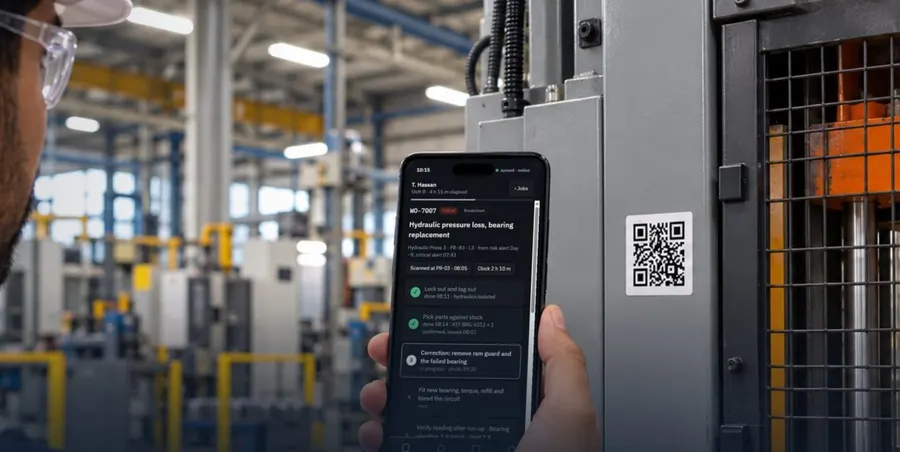
A generator monitoring system watches a standby generator between runs as well as during them. It tracks battery and charger, fuel level, coolant heater, controller mode, run hours and alarms, and logs every test run. It catches what stops a genset starting, such as a weak battery, low fuel or a switch left off auto.
A standby generator spends almost all its life stopped, so its faults build up unseen: a battery losing charge, a failed coolant heater, fuel drawn off or left to age. The weekly walk-round catches some of them. Monitoring watches every hour in between and records each test run as evidence.
Battery problems top the list of generator service calls; fuel, coolant and controls left out of auto also feature (EC&M). Generator monitoring is part of predictive maintenance on Quoriam.
What stops a generator starting.
Six common faults, the early sign of each and where the reading comes from.
| Fault | Early signal | Measured by |
|---|---|---|
| Weak battery or failed charger | Battery voltage sagging at rest or dipping hard while cranking; charger output lost | Battery voltage and the charger fail contact |
| Low or missing fuel | Tank level below the run time you need, or dropping while the set is stopped | Tank level sensor; see tank level monitoring |
| Coolant heater failure | Engine block cooling down while the set is on standby | Temperature sensor on the block, or a current clamp on the heater |
| Not in auto | Controller switched to off or manual after service and never put back | Generator controller status |
| Missed or light test run | No run logged this week, or a monthly run under 30 minutes or under 30% load | Run signal and current on the output |
| Engine alarms and service due | Low oil pressure, high coolant temperature, fail to start; run hours past the interval | Generator controller |
The test routine, by the standard.
NFPA 110 is the usual reference for emergency and standby power testing. Quoriam logs each run against it.
| Check | How often | What NFPA 110 asks |
|---|---|---|
| Inspection | Weekly | Fuel levels, oil, coolant and jacket water heater, battery and charger, belts, hoses and leaks |
| Exercise under load | Monthly | At least 30 minutes at no less than 30% of nameplate kW, or at the maker's minimum exhaust temperature, from a cold start through the transfer switch |
| Fuel quality test | Annually | Stored fuel tested using appropriate ASTM standards |
| Extended run | Every 36 months | Level 1 systems: a continuous run of up to 4 hours at no less than 30% of nameplate kW |
Summary of NFPA 110 (2010 edition); check which edition and clauses your consultant or authority applies. Quoriam records tests and alarms for your maintenance file and does not certify compliance with NFPA 110, which stays with your consultant or authority. Sources: Minnesota Department of Health, generator testing summary; Bell Performance, NFPA 110 fuel testing.
How it works.
Connect
Where the set's controller has a Modbus port, an edge gateway reads its mode, alarms, run hours and readings. Where it doesn't, we wire its run and common alarm contacts.
Fill the gaps
Battery voltage, a level sensor on the day tank, a temperature sensor on the engine block, and clamp-on current sensors on the output where the controller doesn't report load.
Alert and record
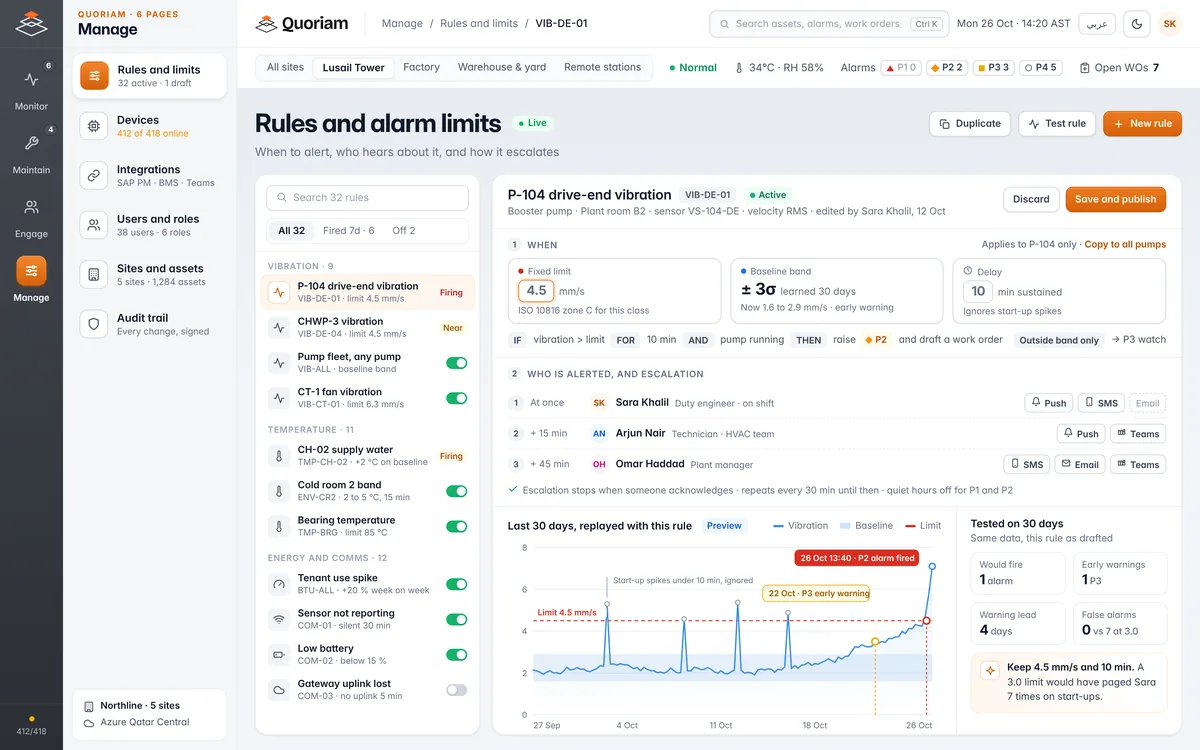
Alerts go to the electrical team by app, SMS or email and escalate if nobody acknowledges. Each test run is logged with its duration and load.
System view
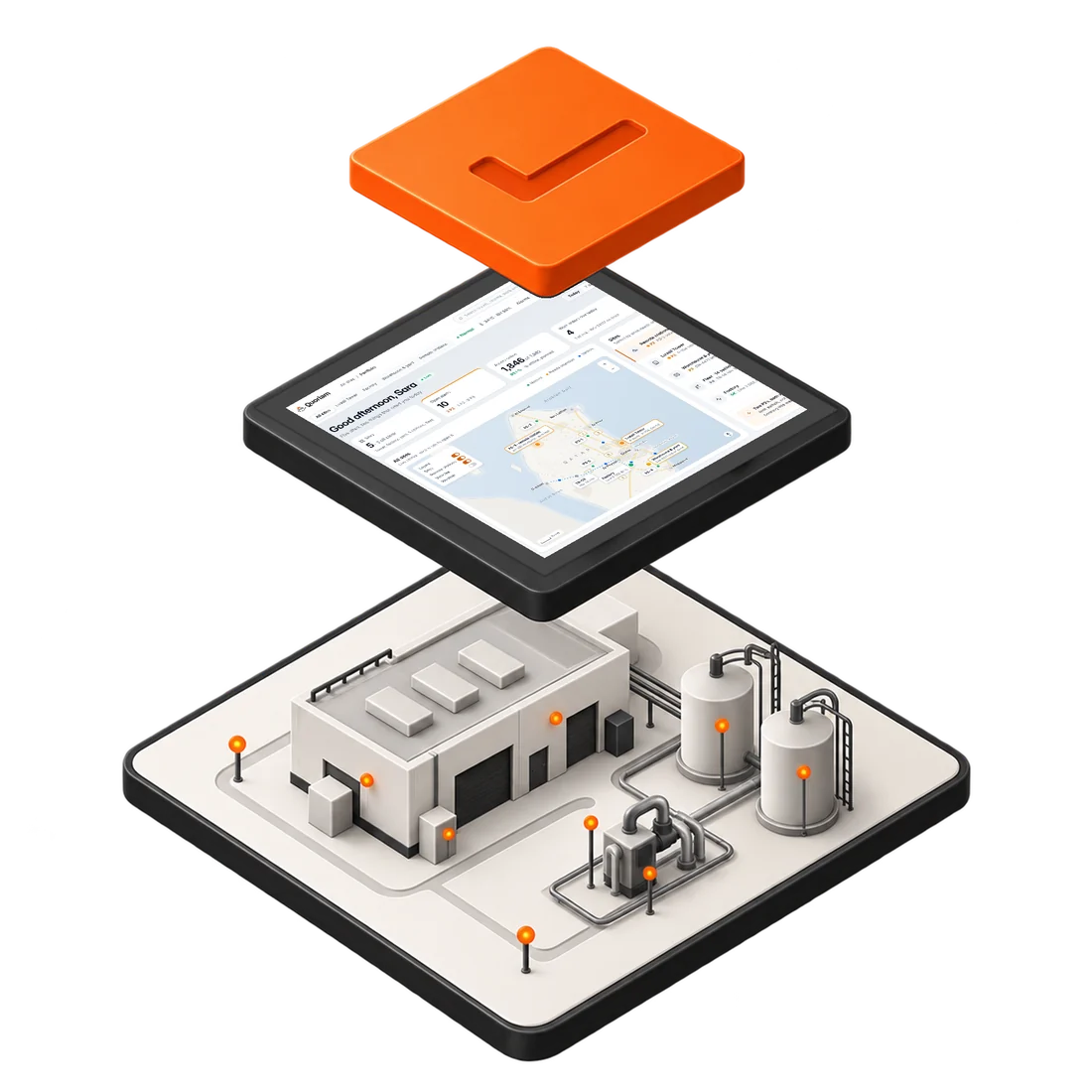
For IT, OT and security reviewers: where the data goes, and how.
- On the generatorController, battery voltage, block temperature and output current
- At the tankLevel sensor on the day or bulk tank
- NetworkSite LAN or cellular, encrypted and kept apart from the control network
- Quoriam platformOn your premises or cloud hosted in Qatar
- Your team and systemsAlerts, a test run log and work orders to your CMMS
What your team sees.
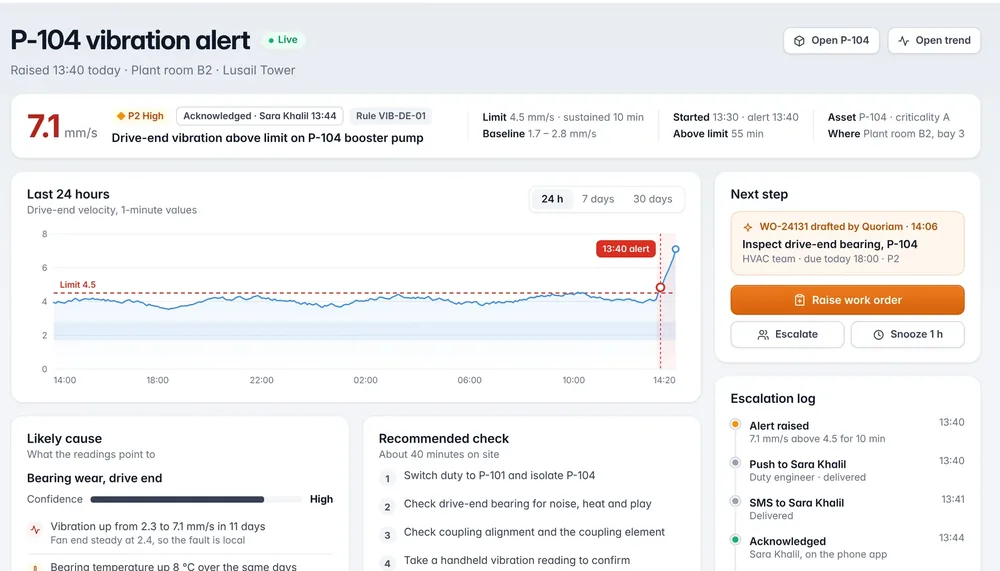
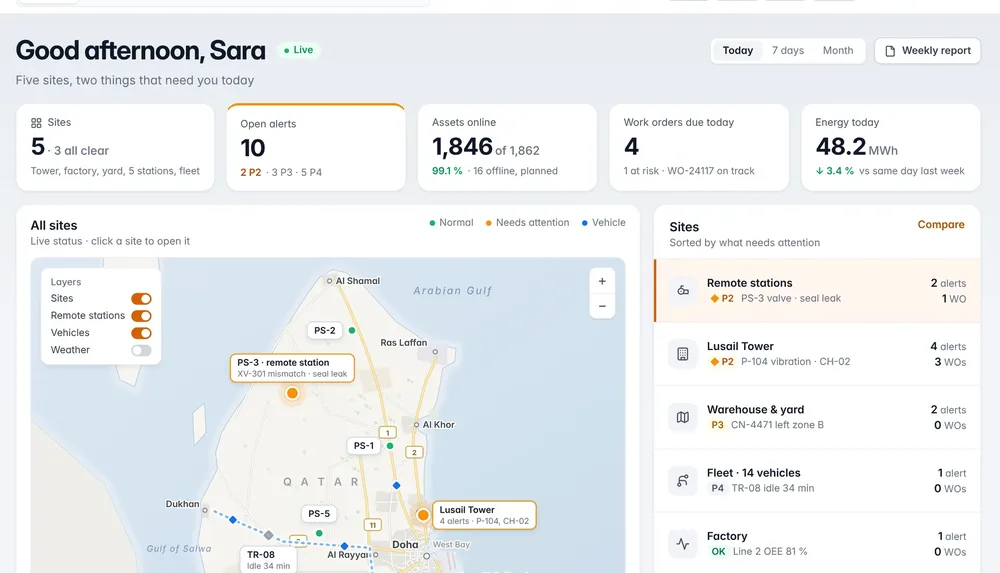
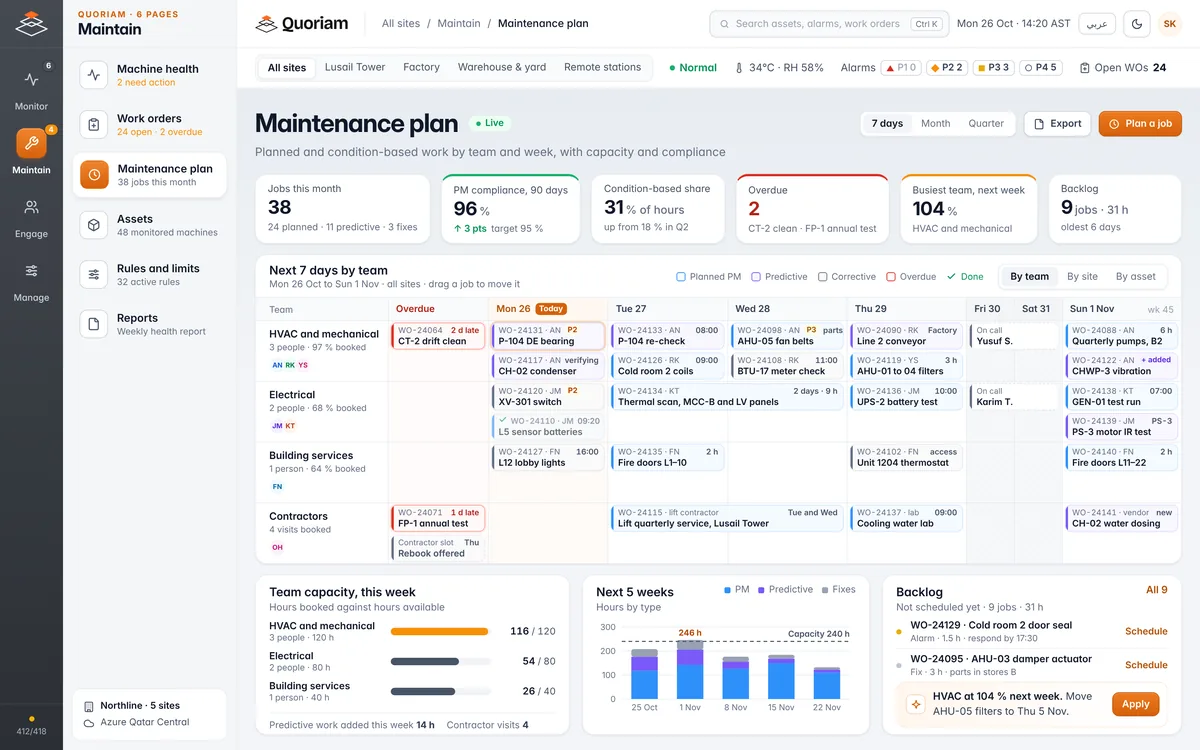
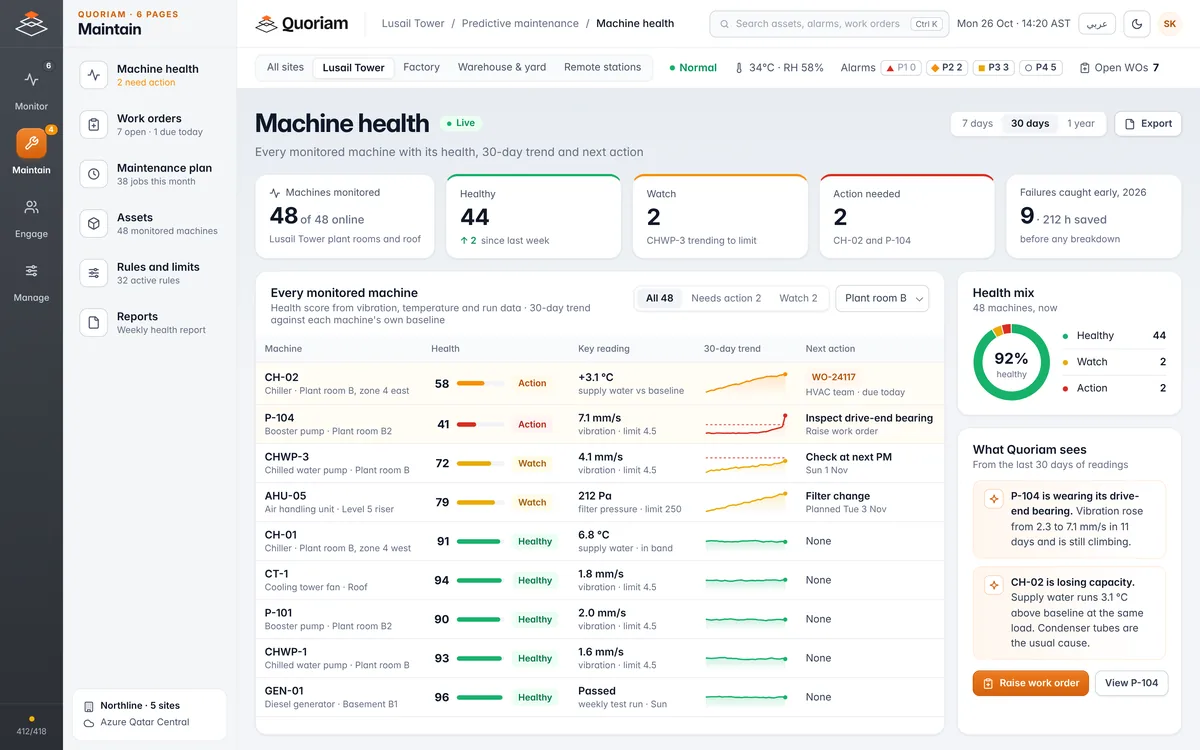
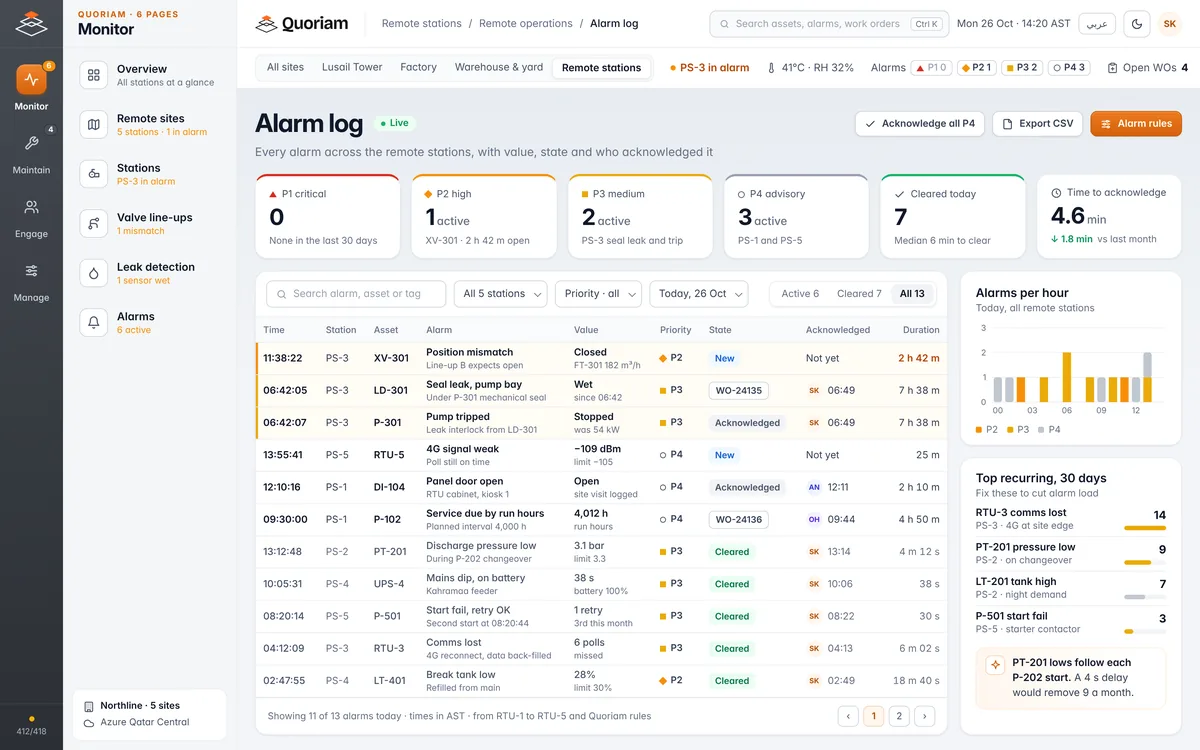
Each generator's state, its alarms and who acts on them.
Where it's used in Qatar.
Wherever losing power for an hour costs more than the generator.
Hospitals and clinics
Sets that must pick up theatres, wards and cold stores within seconds.
HealthcareTowers, malls and data rooms
Basement sets for life safety, lifts and IT, tested weekly and rarely used.
Facilities and smart buildingsRemote stations
Pump stations and telecoms sites where nobody hears the alarm.
Remote operations monitoringOil, gas and energy
Emergency power for control rooms, fire systems and process safety.
Oil, gas and energy
Questions buyers ask.
Something else? Ask us during the free assessment.
Why do standby generators fail to start?
Mostly for simple reasons: a flat or sulphated battery, a charger switched off, a failed coolant heater, low or contaminated fuel, air in the fuel line or a controller left out of auto after service, according to EC&M and Generator Source. Most of them show up in the readings well before you need the set.
How often should a standby generator be tested?
NFPA 110 asks for a weekly inspection and a monthly run of at least 30 minutes under load, at no less than 30% of nameplate kW or the maker's minimum exhaust temperature, as summarised by the Minnesota Department of Health. Quoriam logs each run so a missed or light test is flagged.
Can you read our generator controller?
Usually. Where the controller has a Modbus port, an edge gateway reads its mode, alarms, run hours and engine readings, read-only. On older sets without one, we wire the run and common alarm contacts instead.
What sensors does generator monitoring need?
For each set: battery voltage, a level sensor on the day tank, a block temperature sensor and, if the controller doesn't report load, clamp-on current sensors on the output. One gateway covers a plant room or several sets nearby. The free assessment gives the exact list.
Can it check diesel fuel quality?
It watches the level; quality needs a lab test. Stored diesel collects water at the bottom of the tank, where microbes grow and plug filters, so NFPA 110 asks for an annual fuel quality test using ASTM methods, as Bell Performance explains. Quoriam schedules the sample and keeps the result with the set's record.
What does generator monitoring cost?
It depends on how many sets you have and whether their controllers can be read. The free three-week assessment ends with a scope and a fixed price for your site, and a pilot on your most critical sets is available.
Related.
Generator monitoring is part of predictive maintenance on the Quoriam platform.
- Predictive maintenance
Catch bearing wear, overheating and imbalance weeks before a pump, motor or chiller fails.
- Tank level monitoring
Water, diesel and chemical tank levels read remotely, with low-level and leak alarms.
- Fire pump monitoring
Fire pump status, test runs and alarms recorded for the fire safety file.
- Current and power monitoring
Motor load and phase imbalance from clamp-on current sensors.
Know your generators will start.
A free three-week assessment. We review your standby sets, their test records and the data you already have, then recommend what to monitor first.
We take on two assessments a month.Quoriam is designed to pay back within six months. How we calculate payback