


1. Home
  2. Solutions
  3. ATEX and hazardous areas

ATEX Sensors in Qatar

Certified sensors for the pumps, compressors, valves and tanks inside hazardous areas, matched to your zone, gas group and temperature class, with readings on the same platform as the rest of your site.

Zone 1 and Zone 2Gas, vapour, mist and dust zonesATEX or IECExCertified to your site's specificationVibration, temperature, position, levelWireless where new cable is costly

Last updated

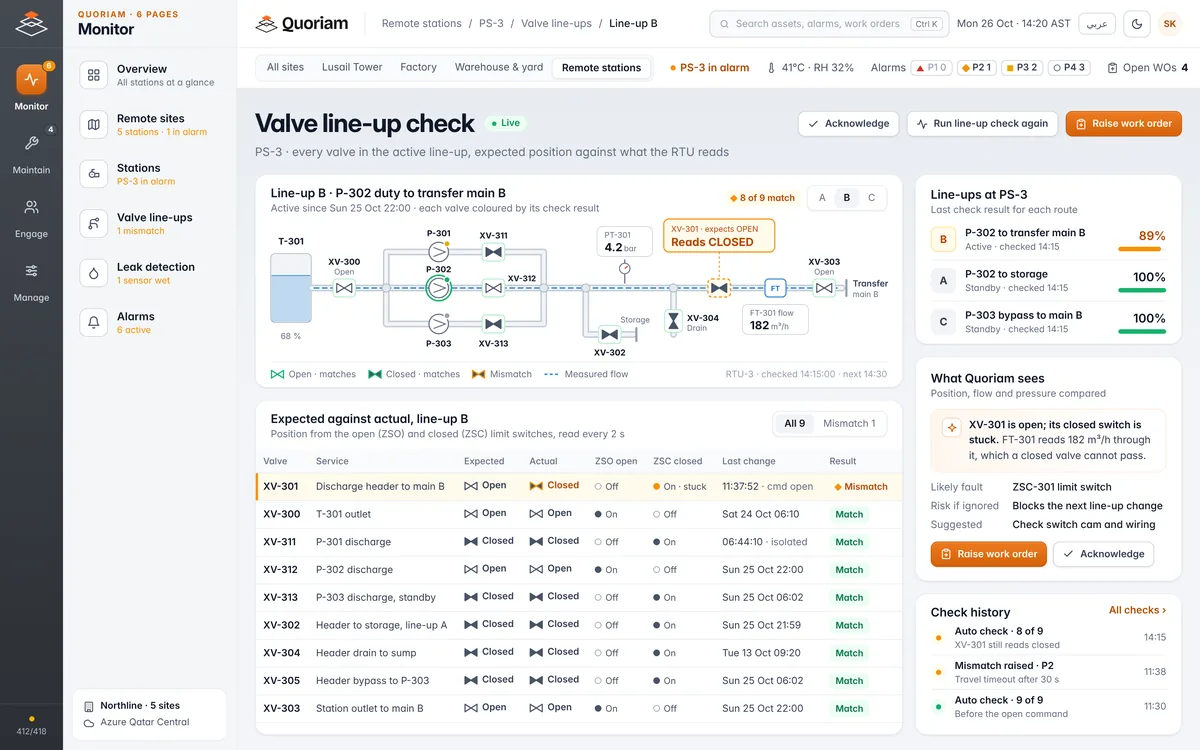
Quoriam valve line-up check for line-up B at PS-3, showing 8 of 9 valves matching and XV-301 reading closed while the line-up expects it open
Quoriam's valve line-up check compares every valve's expected position with what its limit switches report, and names the likely fault.

What are ATEX sensors?

ATEX sensors are monitoring devices certified safe to use where flammable gas, vapour, mist or dust can form an explosive atmosphere. Each carries an Ex marking that states the zones, gas or dust groups and maximum surface temperature it is approved for. ATEX is the European route to certification; IECEx is the international one.

The marking matters more than the brand: a sensor may only go into a hazardous area if its certificate covers that zone, the gases or dusts present and the surface temperature limit.

ATEX and IECEx in two sentences. ATEX is EU law: Directive 2014/34/EU harmonises the laws of EU member states on equipment and protective systems intended for use in potentially explosive atmospheres, and has applied since 20 April 2016. IECEx is an international certification system set up by the IEC, with certificates for equipment, service facilities and personnel competence published online for anyone to check.

Sites in Qatar typically state which certification they accept in the project or operator specification, ATEX, IECEx or both. We work to your site's specification and give you each device's certificate before anything is fitted.

Sound familiar?

What maintenance and operations teams at Qatar's process sites tell us.

  • "The pumps that matter most are the ones we can't monitor."

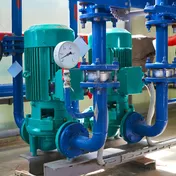
    Process pumps, compressors and fin-fan coolers at Ras Laffan and Mesaieed sit inside classified areas. Standard sensors stop at the zone boundary, so the most critical machines stay on handheld rounds.

  • "New cable through a Zone 1 area means months of paperwork."

    Every cable run, gland and junction box in a hazardous area needs design, permits and inspection. A small monitoring job turns into a project, so it never starts.

  • "The datasheet says ATEX. Our spec says IECEx."

    Checking each vendor's certificate against the operator specification, zone and gas group falls to the site engineer, one datasheet at a time.

What we monitor in hazardous areas.

The same readings as anywhere else on site, from devices certified for the zone they sit in.

What we monitor in hazardous areas.
EquipmentWhat we measureWhy it matters
Process pumpsVibration and bearing temperature on motor and pumpBearing and seal failures caught while a repair can still be planned
Compressors and fin-fan coolersVibration, gearbox and bearing temperatureLarge machines with long lead times for parts
ValvesOpen and closed position from limit switchesLine-up checks without a walk through the unit
Tanks and vesselsLevel, with high and low alarmsOverfill and run-dry warnings before an operator sees them
MotorsWinding temperature on the motor, current at the motor control centreOverload and phase imbalance measured where the electrical supply already is

Hazardous area zones, gas and dust.

A site's area classification divides it into zones by how often an explosive atmosphere is expected. The zone sets the minimum equipment category and protection level.

Hazardous area zones with the matching ATEX equipment category and equipment protection level (EPL)
AtmosphereZoneWhat it meansATEX categoryEPL
Gas, vapour or mistZone 0An explosive atmosphere is present continuously, for long periods or frequently1GGa
Zone 1An explosive atmosphere is likely to occur occasionally in normal operation2GGb
Zone 2An explosive atmosphere is not likely in normal operation and, if it occurs, lasts only a short time3GGc
Combustible dustZone 20A cloud of combustible dust in air is present continuously, for long periods or frequently1DDa
Zone 21A dust cloud is likely to occur occasionally in normal operation2DDb
Zone 22A dust cloud is not likely in normal operation and, if it occurs, lasts only a short time3DDc

Zone definitions and ATEX equipment categories (category 1 for Zones 0 and 20, category 2 for Zones 1 and 21, category 3 for Zones 2 and 22): UK HSE, ATEX and explosive atmospheres: definitions, from the UK's DSEAR regulations. G and D suffixes and EPLs as summarised in Heating and Process, ATEX marking explained. Your site's area classification drawing is the authority for where each zone starts and ends.

How to read an Ex marking.

Every certified device carries a marking like the one below. Read it field by field and check each one against the area it is going into. This example is for illustration, not a specific product.

The Ex marking II 1G Ex ia IIC T4 Ga, field by field
FieldIn the exampleWhat it tells you
Equipment groupIIFor surface industries, not mining. Group I is for mines.
ATEX category1GCategory 1, very high level of protection, for gas, vapour or mist (G). D means dust. Category 2 is high protection, category 3 normal.
Explosion protectedExThe device is certified for use in explosive atmospheres.
Protection conceptiaIntrinsic safety: energy is limited so a spark cannot ignite the gas. ia stays safe with up to two faults and is designed for Zone 0, ib with one fault for Zone 1, ic in normal operation for Zone 2. Other concepts include d flameproof, e increased safety and m encapsulation.
Gas groupIICWhich gases it is safe in. IIA is propane-type, IIB ethylene-type, IIC hydrogen and acetylene, the most severe.
Temperature classT4The highest surface temperature the device can reach: T1 450 °C, T2 300 °C, T3 200 °C, T4 135 °C, T5 100 °C, T6 85 °C. It must stay below the ignition temperature of the gases present.
Equipment protection levelGaGa very high protection, for Zone 0; Gb high, for Zone 1; Gc enhanced, for Zone 2. Dust uses Da, Db and Dc.

Sources: fields, gas groups, temperature classes and EPLs from Heating and Process, ATEX marking and gas groups; ia, ib and ic from AEMT, intrinsic safety. Dust markings use groups IIIA to IIIC and a written temperature such as T135°C (Manufacturing Chemist). Always check the full certificate, including its ambient temperature range and special conditions of use.

How it works.

  1. Survey

    Walk the site with your area classification drawing and specification, and mark each point to monitor with its zone, gas group and temperature class.

  2. Select certified devices

    Choose a device for each point that carries its manufacturer's ATEX or IECEx certificate, issued by a certification body, and hand you the certificates for approval. Where a gateway cannot sit outside the zone, it is Ex-rated as well.

  3. Install and inspect

    Certified specialist partners carry out Ex installation and inspection as part of the project, under your site's permit-to-work system. They provide the installation and inspection records for your site's Ex register.

  4. Alert and act

    The duty engineer gets the alert with the trend and the likely fault, and a work order goes to Quoriam or your CMMS.

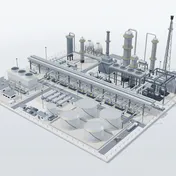
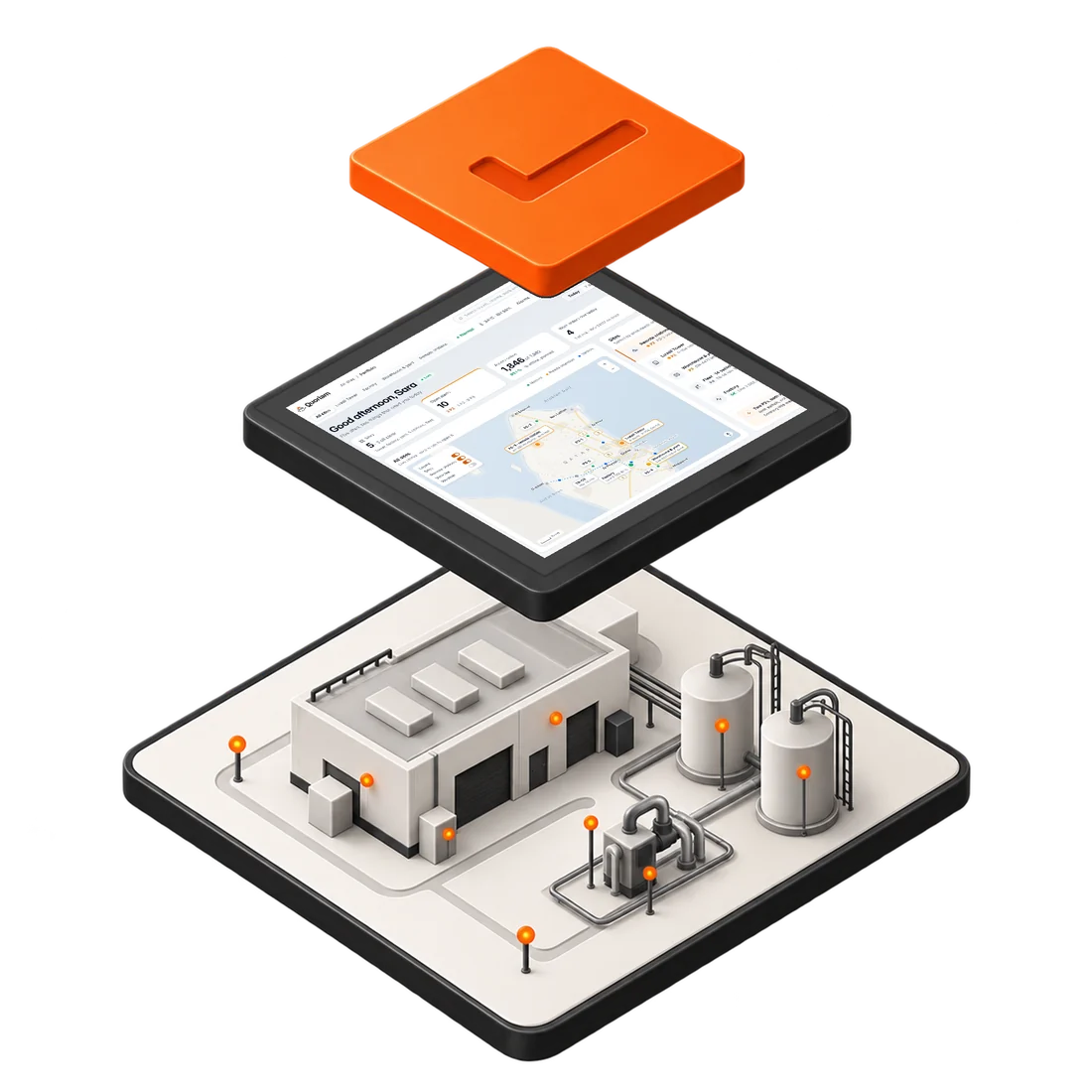
Isometric illustration of the Quoriam platform: sites and assets on the bottom layer, live screens above, and decisions on top

System view

For IT, OT and security reviewers: where the data goes, and how.

  1. In the zoneEx-certified wireless sensors on pumps, compressors, valves and tanks
  2. At the boundaryGateway
  3. NetworkSite LAN or cellular, encrypted and kept apart from the control network
  4. Quoriam platformOn your premises or cloud hosted in Qatar
  5. Your team and systemsApp, SMS and email alerts; work orders to your CMMS; data shared with the control room

The certified hardware we supply.

Selected for each point against your zone, gas group, temperature class and specification. Quoriam is hardware agnostic: each device carries its maker's certificate, which we hand over before anything goes on site.

Any certified make

Ex wireless vibration and temperature sensor

On the bearing housing of a pump, motor, fan or compressor. Reads vibration and surface temperature.

  • Vibration
  • Temperature
  • Battery powered
Certificate
ATEX and IECEx, issued by the device maker and supplied with each unit
Any certified make

Ex pressure, level or valve position sensor

Line pressure, tank level or valve position, for line-up checks and level alarms.

  • Pressure
  • Level
  • Position
Certificate
ATEX and IECEx, issued by the device maker and supplied with each unit
Any certified make

Gateway

Sends every sensor's readings to the Quoriam platform over the site LAN or cellular.

  • Gateway
  • LAN
  • Cellular
Certificate
From the device maker, where the gateway is Ex-rated
Installation
Ex installation and inspection by certified specialist partners as part of the project; they provide the records for your site's Ex register

Hardware agnostic. Makes we fit includeWe can work with any maker and choose the device for each site. The platform reads them all.

What your team sees.

Readings from inside the zone, on the same screens as the rest of the site.

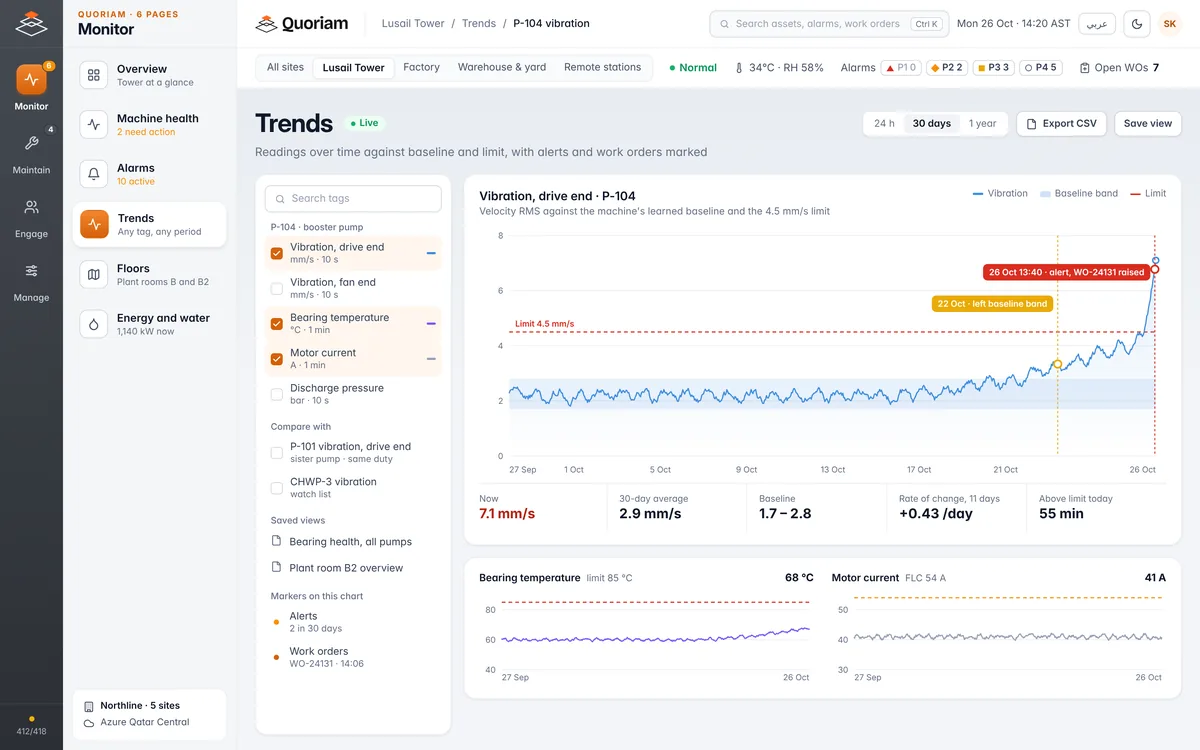
Quoriam trend screen for pump P-104 showing 30 days of drive-end vibration against its baseline band and 4.5 mm/s limit, with bearing temperature and motor current charts
Vibration trend. One machine over 30 days against its learned baseline and limit, with bearing temperature and motor current below.
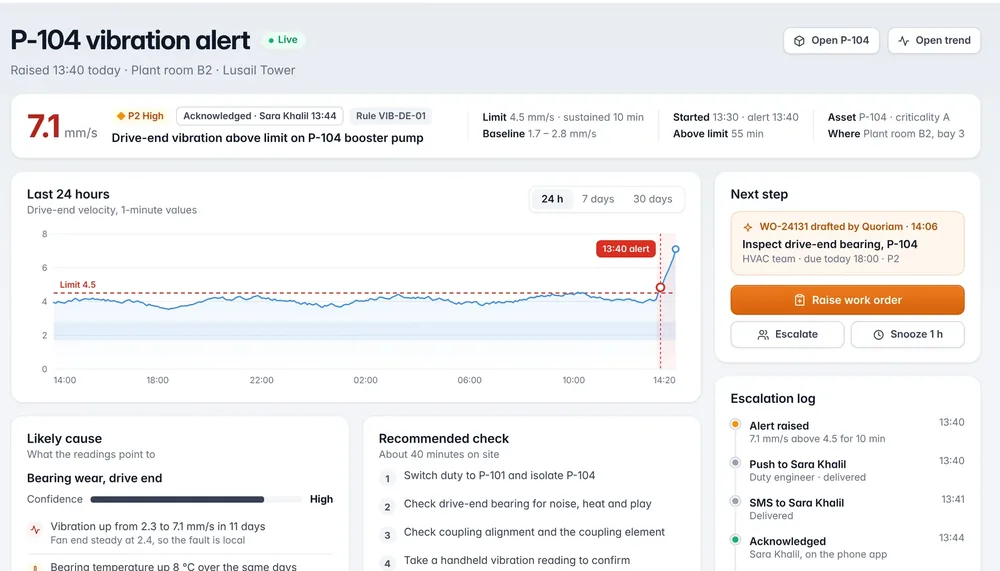
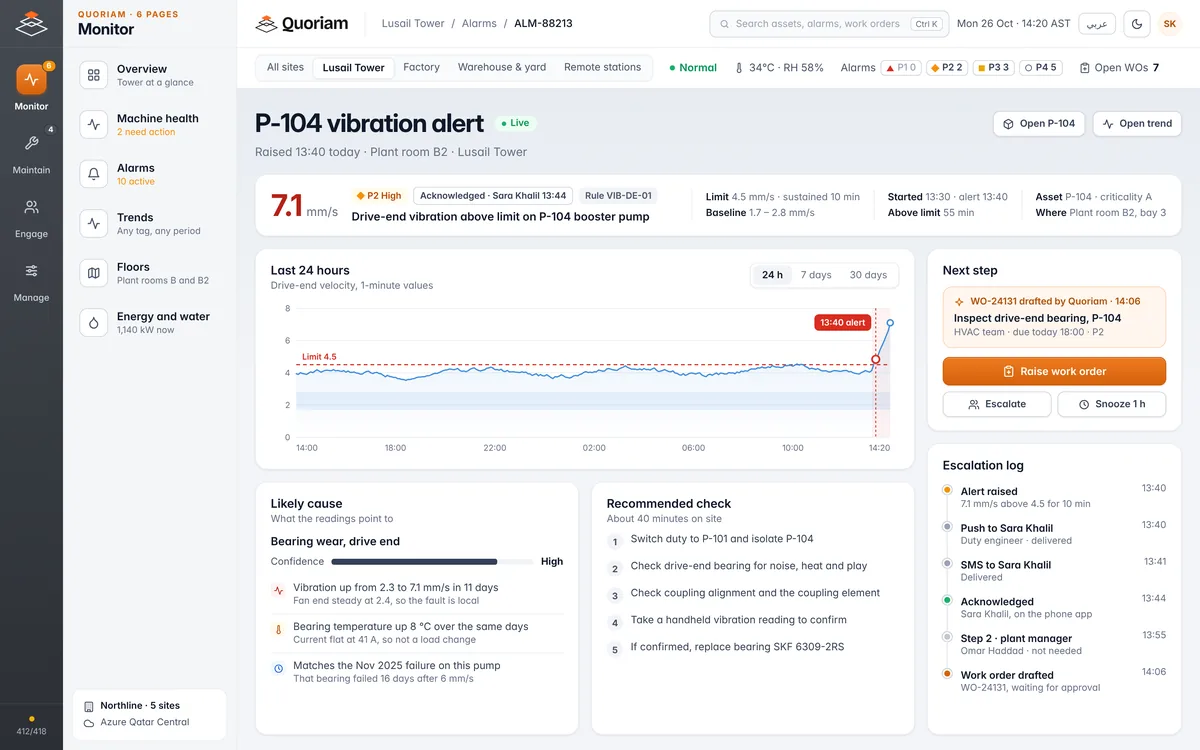
Quoriam alert screen for pump P-104 showing drive-end vibration at 7.1 mm/s above its 4.5 mm/s limit, the likely cause, recommended checks and escalation log
Alert detail. The reading against its limit, the likely fault, the recommended check and who was told.
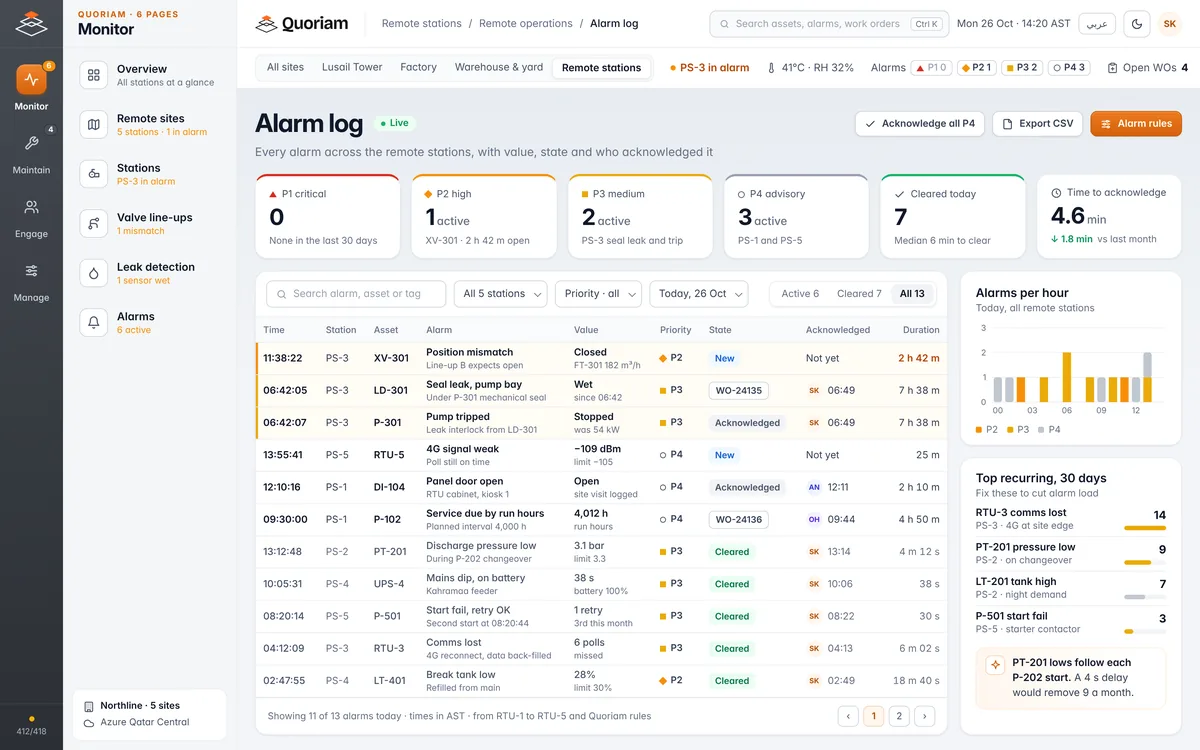
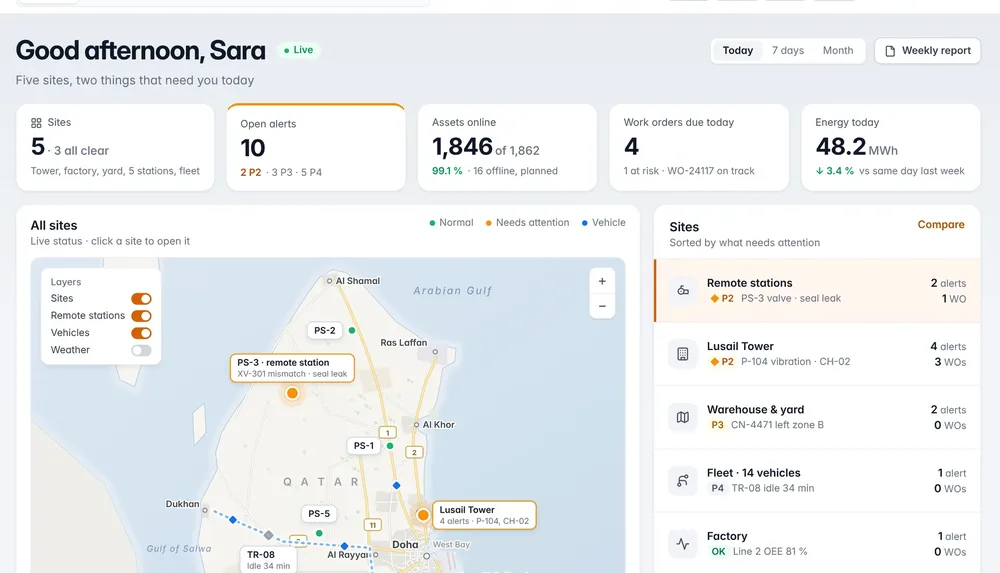
Quoriam alarm log listing the day's alarms across five remote stations with value, priority, state, acknowledgement and duration
Alarm log. Every alarm with its value, priority, state and who acknowledged it.

Or just ask.

Quoriam AI answers in plain language and turns the answer into a work order.

What a first deployment covers.

An example, not a project result.

Example scope: a process pump area in Zone 1

Machines and valves that today are checked only on rounds.

  • Each critical pump: an Ex-certified vibration and temperature sensor on the motor and pump bearings
  • Each compressor or fin-fan cooler: vibration and gearbox temperature
  • Critical valves: open and closed position, checked against each line-up
  • One gateway
  • Device certificates from the manufacturers and installation and inspection records from the certified specialist partners who carry out the Ex work as part of the project, supplied for your site's Ex register.
  • Alerts to the duty engineer's app and work orders into your CMMS

Where it's used in Qatar.

Anywhere flammable gas, vapour or dust is part of normal operation.

  • LNG trains and Ras Laffan

    Process pumps, compressors and fin-fan coolers in classified areas, where a failure stops a train.

    Vibration monitoring
  • Offshore platforms

    Machines and valves on unmanned and normally manned platforms, where every visit needs a boat or a helicopter.

    Remote operations monitoring
  • Tank farms and terminals

    Tank levels, transfer pumps and valve line-ups at storage and loading terminals.

    Remote operations monitoring
  • Chemical plants in Mesaieed

    Pumps, agitators and fans in process areas with gas or dust zones.

    Predictive maintenance

Questions buyers ask.

Something else? Ask us during the free assessment.

Are your sensors ATEX or IECEx certified?

Every device we supply for a hazardous area carries ATEX or IECEx certification, or both, for its zone, gas group and temperature class, matched to your site's specification. You get each certificate for approval before anything is fitted.

Can wireless sensors be used in Zone 1?

Yes, if the device is certified for it: ATEX category 2G or 1G, or protection level Gb or Ga, with a gas group and temperature class that cover the gases present. For intrinsically safe devices, level ib is designed for Zone 1 and ia for Zone 0. The gateway sits outside the zone or is Ex-rated itself. It is always subject to your site's area classification and installation standard (IEC 60079-14), confirmed by your site's Ex authority.

Do you install in hazardous areas yourselves?

We partner with certified specialists who carry out Ex installation and inspection as part of the project. Their work follows your site's permit-to-work system, and they provide the installation and inspection records for your site's Ex register.

Which certification does a site in Qatar need?

We don't advise on the law. Sites in Qatar typically specify the certification in the project or operator specification, ATEX, IECEx or both, and we work to that specification. Our guide to ATEX vs IECEx explains how the two schemes differ and how to read a marking.

Will Ex-certified sensors cope with Qatar's summer?

Each certificate states an ambient temperature range. We check it against the conditions where the device will sit: plant in direct sun gets hotter than the 45 to 50 °C air of a Qatar summer, and a shaded spot or a sunshade can make the difference.

How many sensors do we need?

Usually one per bearing housing that matters on rotating machines, plus position feedback on the valves you check before each line-up change. One gateway can usually cover a process area. The free assessment counts it against your area classification drawing.

What does it cost?

It depends on the number of points, the zones and how the gateway connects. The free three-week assessment ends with a scope and a fixed price for your site.

Start with your riskiest machines in the zone.

A free three-week assessment. We review your area classification, specification and critical equipment, then recommend which certified sensors will pay back first.

We take on two assessments a month.

Quoriam is designed to pay back within six months. How we calculate payback