






- Home
- Solutions
- Predictive maintenance
- Pump and motor monitoring
Pump and Motor Monitoring in Qatar
Vibration, pressure, temperature and motor current on the pumps that keep your water and cooling moving, read together so the alert says what is failing and why.
Last updated
What is a pump monitoring system?
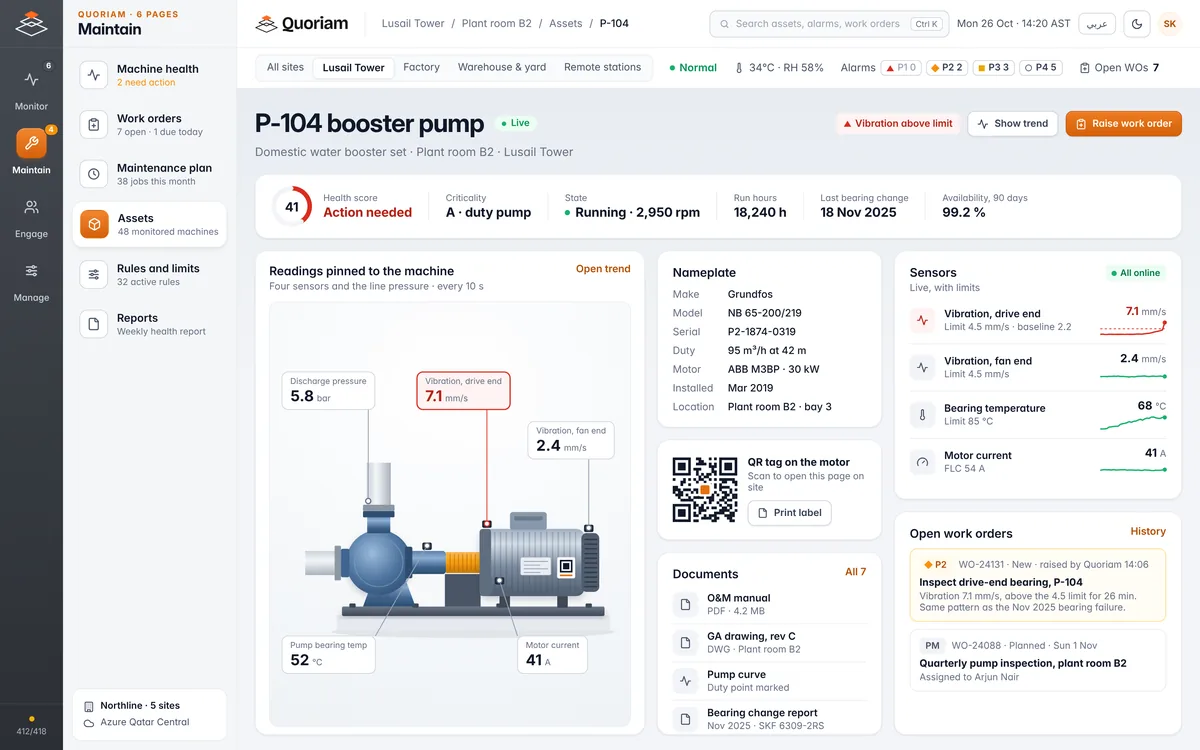
A pump monitoring system reads a pump and its motor together: bearing vibration and temperature, suction and discharge pressure, and motor current. Read side by side, they show cavitation, a leaking seal, a failing bearing, dry running or an overheating winding early, and whether the pump is running far from its best efficiency point.
It is predictive maintenance applied to one class of machine. Vibration monitoring covers the bearings. A pump also fails through its seal, its suction and its duty point, so the system adds pressure, current and temperature.
The combination tells faults apart. Vibration up with current flat points to a bearing. Current falling while the motor runs points to lost suction. Unsteady discharge pressure with broadband vibration points to cavitation.
What it catches on a pump.
Six ways pumps fail, the readings that give each one away, and what the duty engineer does next.
| Fault | What the readings show | What the technician does |
|---|---|---|
| Cavitation | Low suction pressure, unsteady discharge pressure, broadband vibration | Checks the strainer, tank level and suction valve before the impeller erodes |
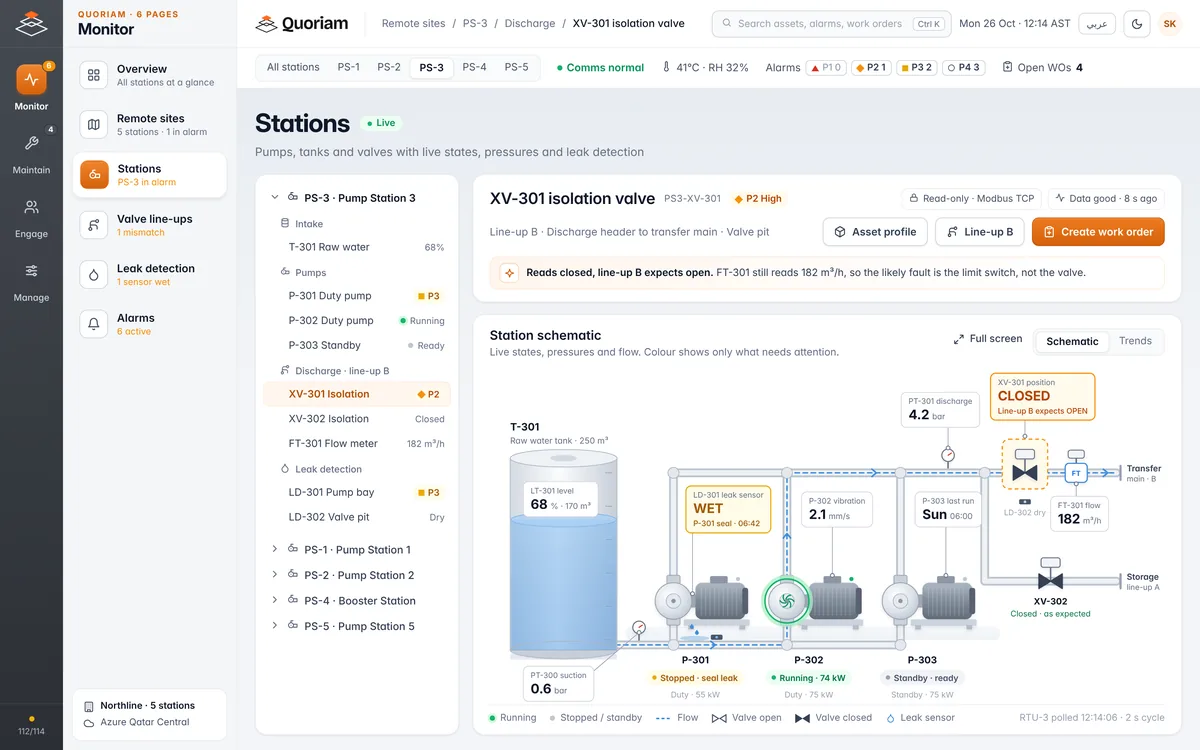
| Mechanical seal failure | Leak sensor wet under the seal, often after high vibration or a dry start | Swaps to the standby and books the seal change |
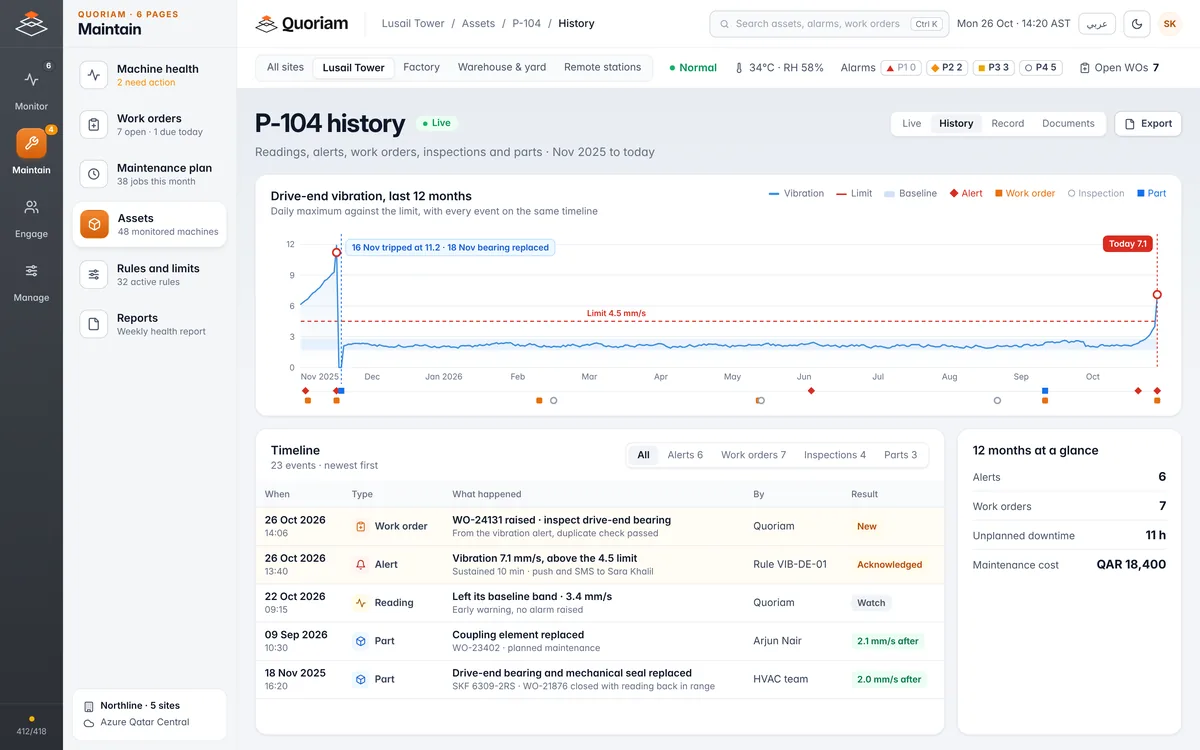
| Bearing failure | Drive-end vibration rising while motor current stays flat | Plans the bearing change; see vibration monitoring |
| Dry running | Motor current falls sharply while the pump runs; suction pressure near zero | Stops the pump and finds the lost suction: empty tank, closed valve or air lock |
| Winding overheating | Motor temperature climbing, current high or unbalanced between phases | Checks load, supply and cooling fan; see motor current monitoring |
| Running off the curve | Live flow and head far from the best efficiency point | Reviews the duty: impeller trim, speed or a different pump |
Where on the curve your pump should run.
A centrifugal pump lasts longest near its best efficiency point (BEP). Quoriam keeps each pump's curve and duty point on its record.
| Region | Flow compared with BEP | What happens to the pump |
|---|---|---|
| Preferred region | 70 to 120% of BEP for most centrifugal pumps | Best efficiency and reliability; reliability peaks near 90% of BEP |
| Low flow | Below the preferred region | Recirculation, local cavitation, higher loads on bearings and seal |
| Very low flow | Below about 10% of BEP | The liquid heats up in the casing and can cause failure |
| High flow | Above the preferred region | Cavitation, vibration, noise, erosion and shorter bearing life |
The allowable range for your pump comes from its manufacturer. Sources: WaterWorld, centrifugal pump flow operating regions; Hydraulic Institute, the basics of NPSH and pump operating regions.
How it works.
Fit
Vibration sensors on the bearing housings, clamp-on current sensors in the starter panel and a leak sensor under the seal. Pressures come from your existing transmitters.
Load the curve
We add each pump's nameplate duty and curve to its record, so live flow and pressure can be checked against the duty point. Limits tighten to each pump's own normal.
Alert and act
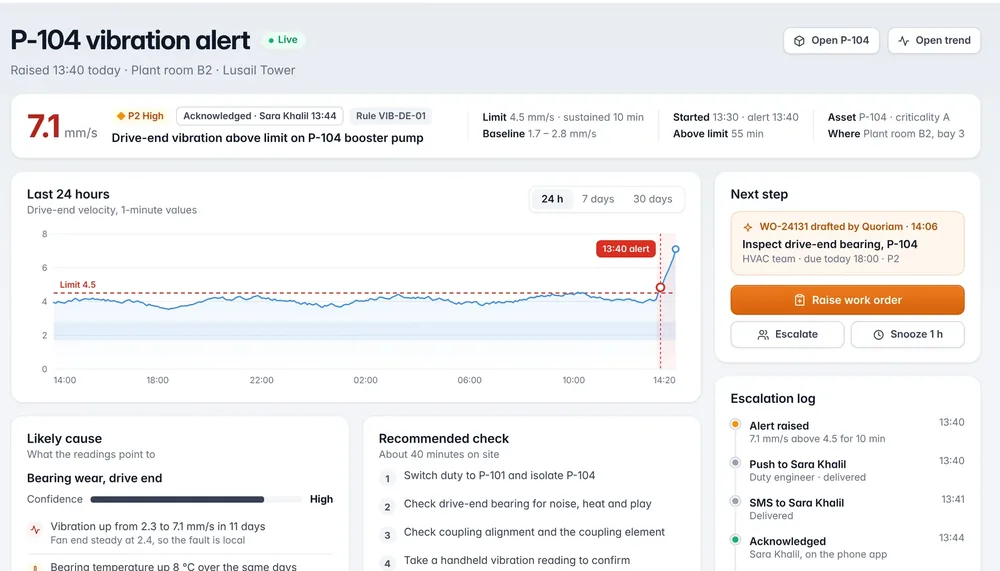
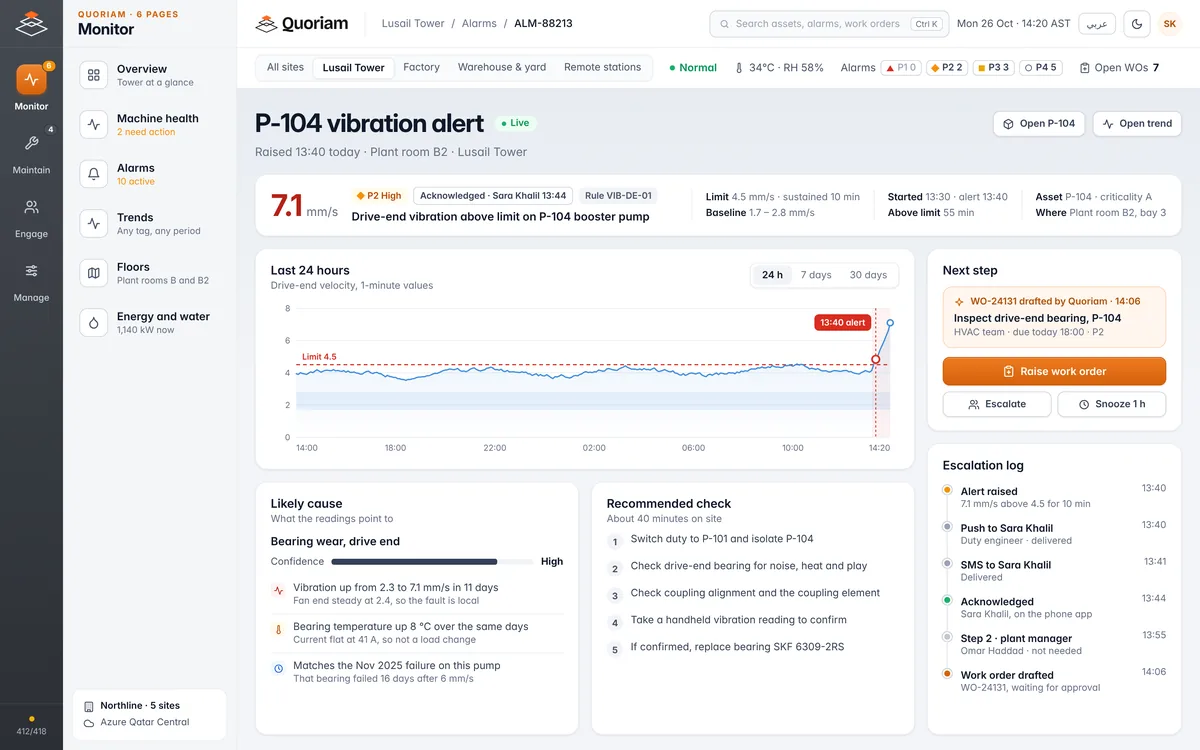
The duty engineer gets the likely cause and a recommended check, and a work order goes to Quoriam or your CMMS.
System view
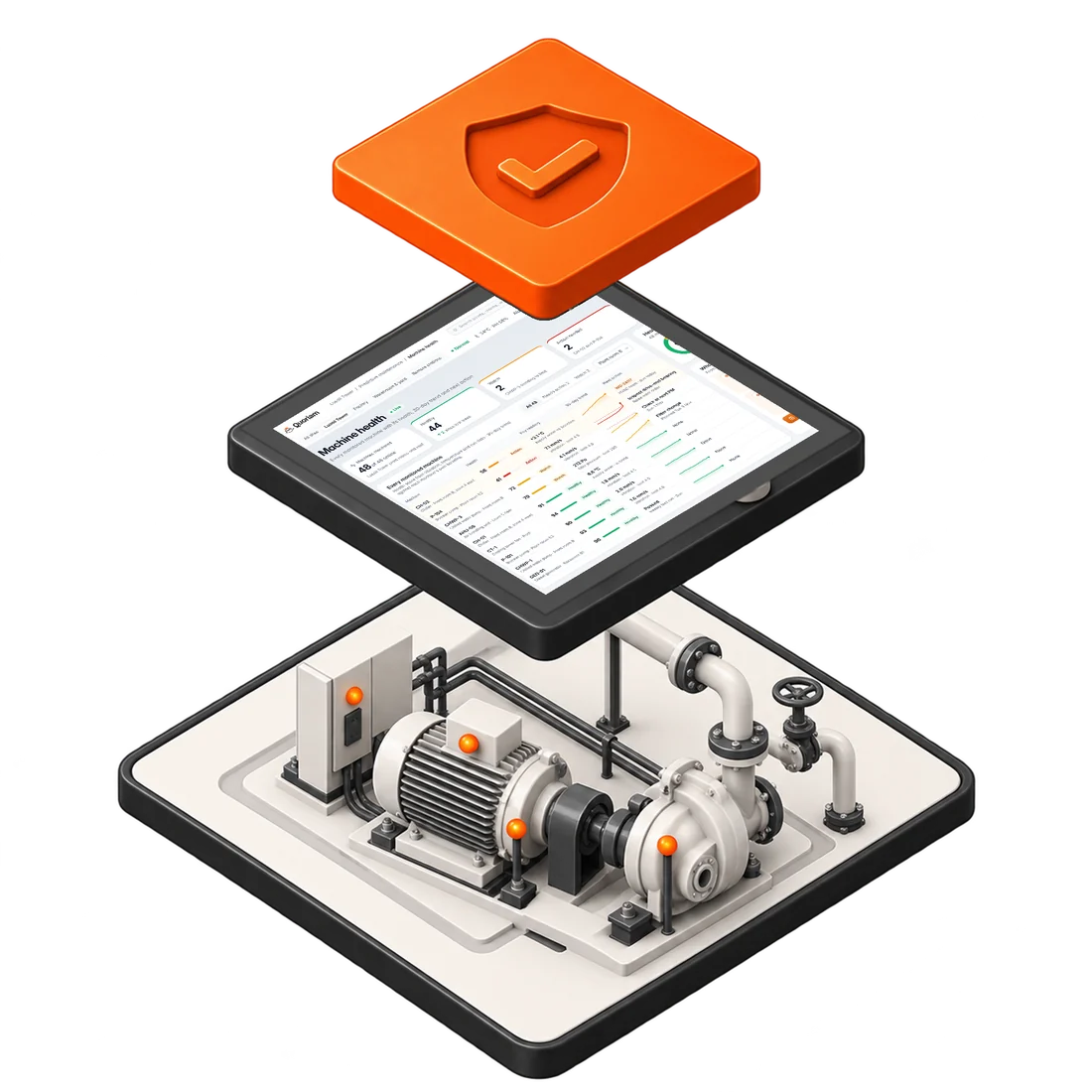
For IT, OT and security reviewers: where the data goes, and how.
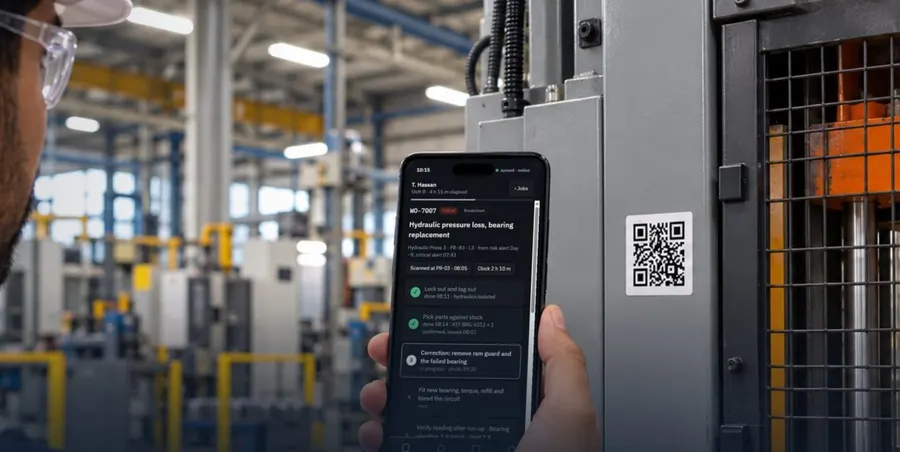
- On the pumpVibration and temperature sensors on the bearings; leak sensor under the seal
- In the panelClamp-on current sensors on the motor supply; existing pressure transmitters, PLC or BMS points
- NetworkLoRaWAN or cellular gateway, site LAN, encrypted and kept apart from the control network
- Quoriam platformOn your premises or cloud hosted in Qatar
- Your team and systemsApp, SMS and email alerts; work orders to your CMMS
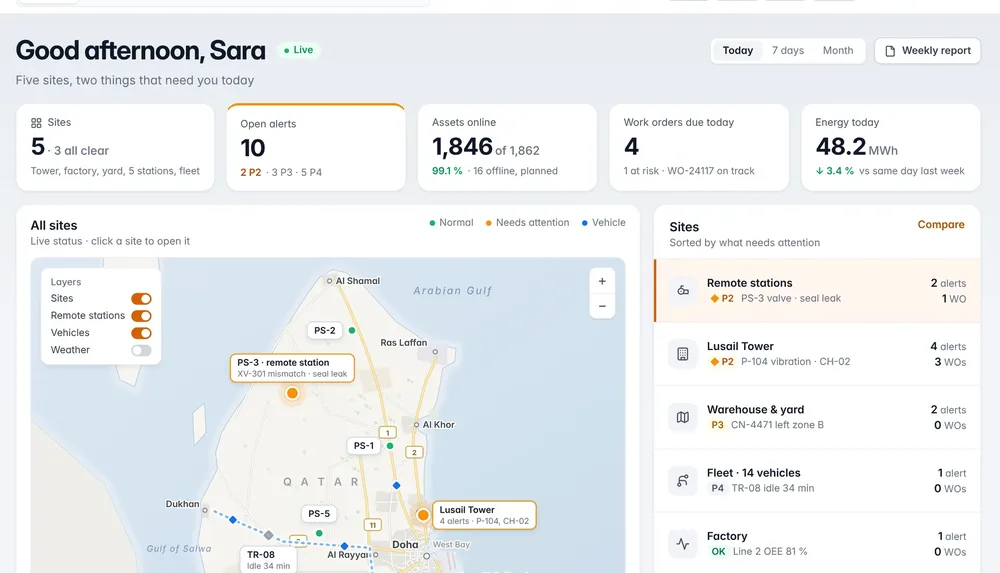
What your team sees.
Each pump's readings, its history and the station it sits in.
Or just ask.
Quoriam AI answers in plain language.
Where it's used in Qatar.
Wherever a stopped pump means no water, no cooling or no production.
Towers and compounds
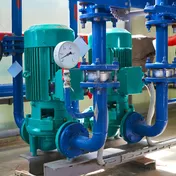
Booster sets, chilled water pumps and sump pumps in plant rooms and basements.
Facilities and smart buildingsDistrict cooling
Chilled and condenser water pumps near full load through a 45 to 50 °C summer.
Utilities and district coolingWater pump stations
Unmanned stations where a seal leak can go unseen until the next round.
Pump station monitoringOil, gas and industry
Process, transfer and cooling water pumps, with certified sensors in hazardous areas.
Oil, gas and energy
Questions buyers ask.
Something else? Ask us during the free assessment.
What does a pump monitoring system measure?
Bearing vibration and temperature, suction and discharge pressure, motor current and, where it matters, a leak sensor under the mechanical seal. Read together, they separate a bearing fault from cavitation, a seal leak or lost suction, so the technician goes to the right part first.
How do you detect pump cavitation?
From three signs at once: low suction pressure, unsteady discharge pressure and broadband high-frequency vibration. Cavitation starts when suction head falls toward NPSH3, the point where the pump loses 3% of its head, as defined by the Hydraulic Institute. The alert names the likely cause, such as a blocked strainer or a low tank.
Can it protect a pump from running dry?
It can warn within seconds. When a pump loses suction its power draw falls, so a low-power alert (on current, and on power where the meter gives it) with a short delay of 2 to 3 seconds catches it without tripping on passing air bubbles, as Pumps & Systems describes. Quoriam alerts your team; the trip itself stays with the motor protection in your panel.
How hot can a pump motor winding get?
It depends on the nameplate insulation class: Class B is rated to 130 °C and Class F to 155 °C. Each 10 °C above the rating can halve motor life, according to the Engineering ToolBox. Where the winding has sensors wired to a protection relay or PLC, we read them; otherwise we watch motor body temperature and current.
How many sensors does each pump need?
Usually two vibration sensors, on the pump and motor drive ends, one set of clamp-on current sensors in the starter panel and a leak sensor under the seal. Pressures come from your existing transmitters. One Quoriam Edge gateway covers a plant room or a pump station. The free assessment gives the exact count.
Will it work with our BMS or SCADA?
Yes. Quoriam reads pressures, flows and run status from your BMS, PLCs or SCADA over BACnet, Modbus or OPC UA, read-only. It adds sensors only where nothing is measured today, so you keep the instruments and control system you already run.
What does pump monitoring cost?
It depends on how many pumps you monitor and what you already measure. The free three-week assessment ends with a fixed price for your site, and a pilot on your most critical pumps is available.
Related.
Pump monitoring is part of predictive maintenance on the Quoriam platform.
- Predictive maintenance
Catch bearing wear, overheating and imbalance weeks before a pump, motor or chiller fails.
- Vibration monitoring
Bearing wear, imbalance and misalignment on pumps, motors, fans and compressors.
- Current and power monitoring
Motor load and phase imbalance from clamp-on current sensors.
- Pump station monitoring
Run status, pressure, flow and power at unmanned pump stations.
Start with the pumps you can't lose.
A free three-week assessment. We review your pumps and the data you already have, then recommend which to monitor first.
We take on two assessments a month.Quoriam is designed to pay back within six months. How we calculate payback