
Fleet Telematics in Qatar
Vehicle tracking with the maintenance attached: live position, fuel and driver behaviour for every truck, van and bus, and servicing scheduled from real kilometres and engine hours.
Last updated
What is fleet telematics?
Fleet telematics is the data a tracker in each vehicle sends back: GPS position, speed, ignition, engine hours, fuel and driving events such as harsh braking. Fleet tracking shows where vehicles are. Telematics adds what they are doing, so you can cut idling, catch fuel loss and schedule maintenance on real use.
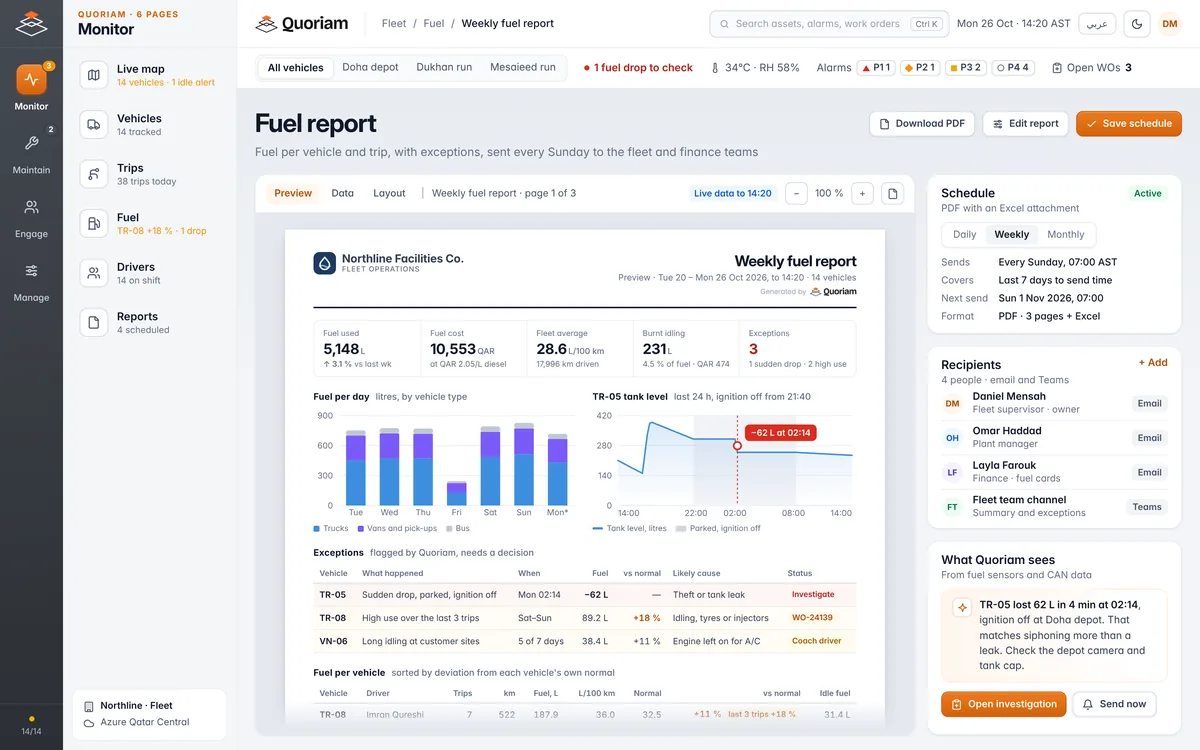
Vehicle tracking and GPS tracking answer where. Telematics answers how: fuel used, time idling, harsh braking and speeding, engine hours and, where the vehicle shares them over its CAN bus, fuel and odometer readings. On Quoriam the same data drives fleet maintenance tracking, so a service falls due on the kilometres actually driven.
Logbooks and phone calls
Drivers report where they are and what they filled. Nobody sees idling, speeding or a service slipping past due.
A tracker service on its own
Dots on a map and a monthly report. Servicing, fuel cards and reefer logs stay in separate spreadsheets.
Telematics on one platform
Position, fuel, drivers, reefers and servicing on one platform, with work orders raised from the same data.
Sound familiar?
What fleet and operations managers in Qatar tell us before we start.
"We only find out about idling from the fuel bill."
From May to September drivers keep the engine running for the air conditioning while they wait at a gate or a customer site. On the long runs to Dukhan, Ras Laffan and Mesaieed, that adds up truck by truck.
"Services slip because the mileage sheet is a month old."
The workshop books services from odometer readings that drivers write down. Heat is hard on tyres, batteries and coolant, and a missed service shows up as a breakdown on the road.
"The reefer was fine when it left the depot."
Chilled and frozen loads cross Doha in 45 to 50 °C. Without a temperature log from the road, a rejected delivery turns into an argument about who was at fault.
What it tells you, and how.
Each event comes from the tracker, the vehicle's own data or a sensor we add. These are the ones most fleets set alerts for first.
| Event | Signal | Measured by |
|---|---|---|
| Idling with the engine on | Ignition on, speed zero, for longer than your limit | GPS tracker wired to ignition |
| Speeding and harsh driving | Speed above policy; acceleration or braking above a set g-force | GPS tracker with accelerometer |
| Fuel drop or theft | Tank level falls while the vehicle is parked with the ignition off | Fuel level sensor in the tank |
| Fuel use above normal | Litres per 100 km above the vehicle's own normal for that route and load | CAN bus data or fuel level sensor |
| Service coming due | Kilometres or engine hours reaching the service interval, whichever comes first | Odometer and engine hours from the tracker or CAN bus |
| Reefer out of range | Load temperature outside its set band, or the door left open | Temperature probe and door sensor in the load space |
| Off route or out of hours | Vehicle leaves a geofence, or moves outside working hours | GPS tracker and geofences |
How it works on Quoriam.
From the tracker in the cab to the service closed in the workshop, on one platform.
Fit
Fit a GPS tracker to each vehicle, wired to ignition and, where the vehicle supports it, its CAN bus for fuel and engine hours. Add fuel sensors and reefer probes where they pay back.
Set up
Load your vehicles, drivers and service plans. Draw geofences around depots, customer sites and the gates you deliver to at Ras Laffan, Mesaieed and Hamad Port.
Alert
Idling, speeding, fuel drops, reefer temperature and services coming due go to the fleet supervisor in the app, by SMS or by email.
Act
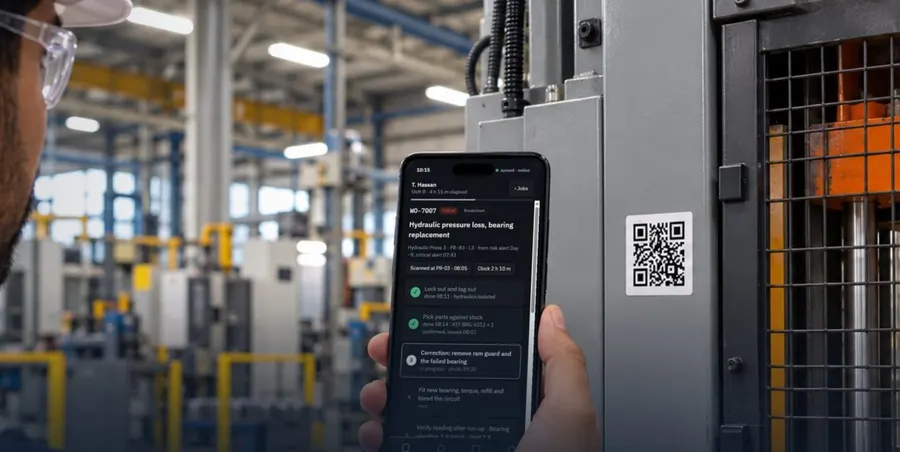
Raise the service as a work order, coach the driver from the trip replay, and send weekly fuel and driver reports to fleet and finance.
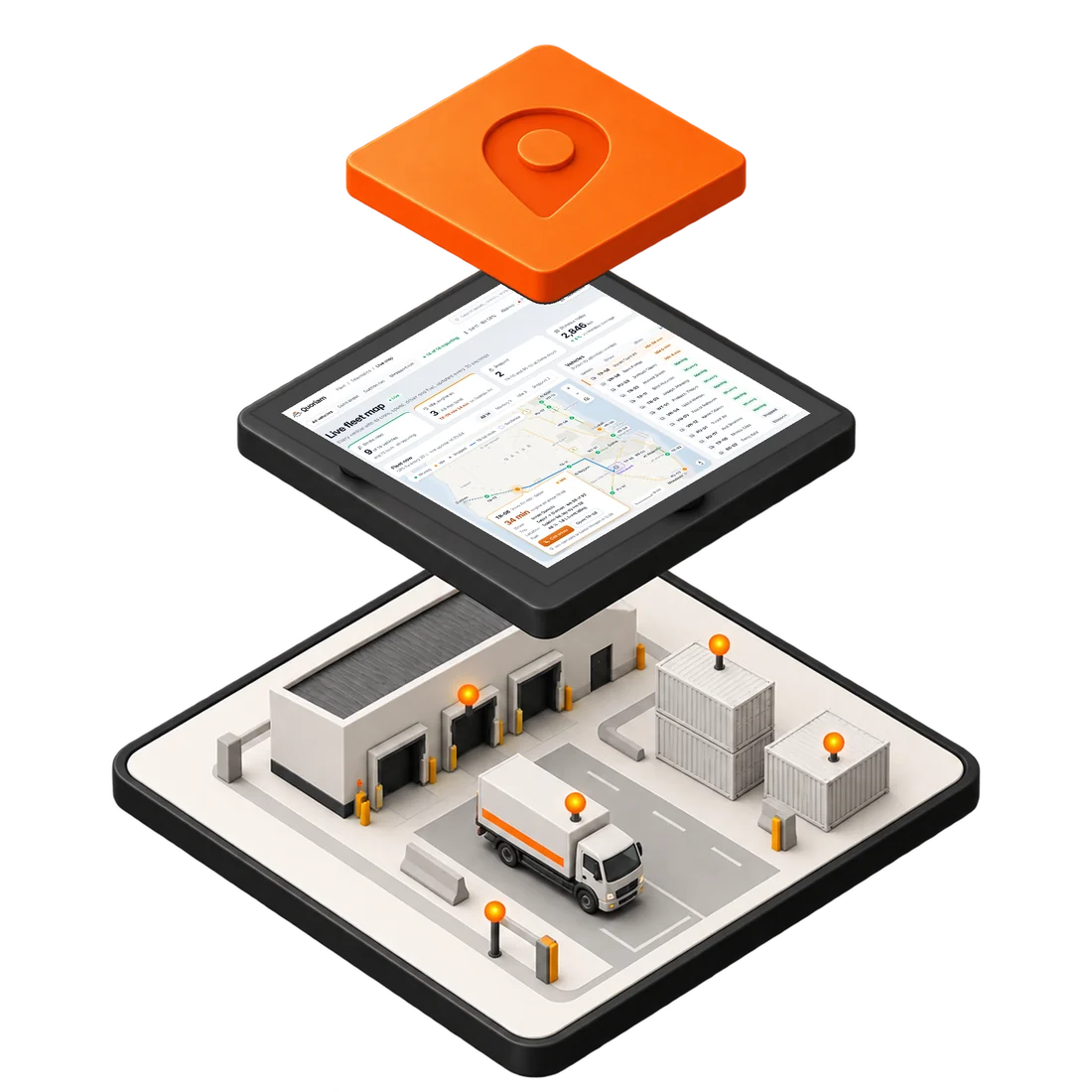
System view
For IT, OT and security reviewers: where the data goes, and how.
- In the vehicleGPS tracker on ignition and CAN bus; fuel sensor and reefer probes where fitted
- From the vehiclePosition, speed and driving events; fuel, odometer and engine hours where the CAN bus shares them
- NetworkCellular from each tracker, encrypted in transit
- Quoriam platformOn your premises or cloud hosted in Qatar
- Your team and systemsApp, SMS and email alerts; work orders for the workshop; reports to fleet and finance
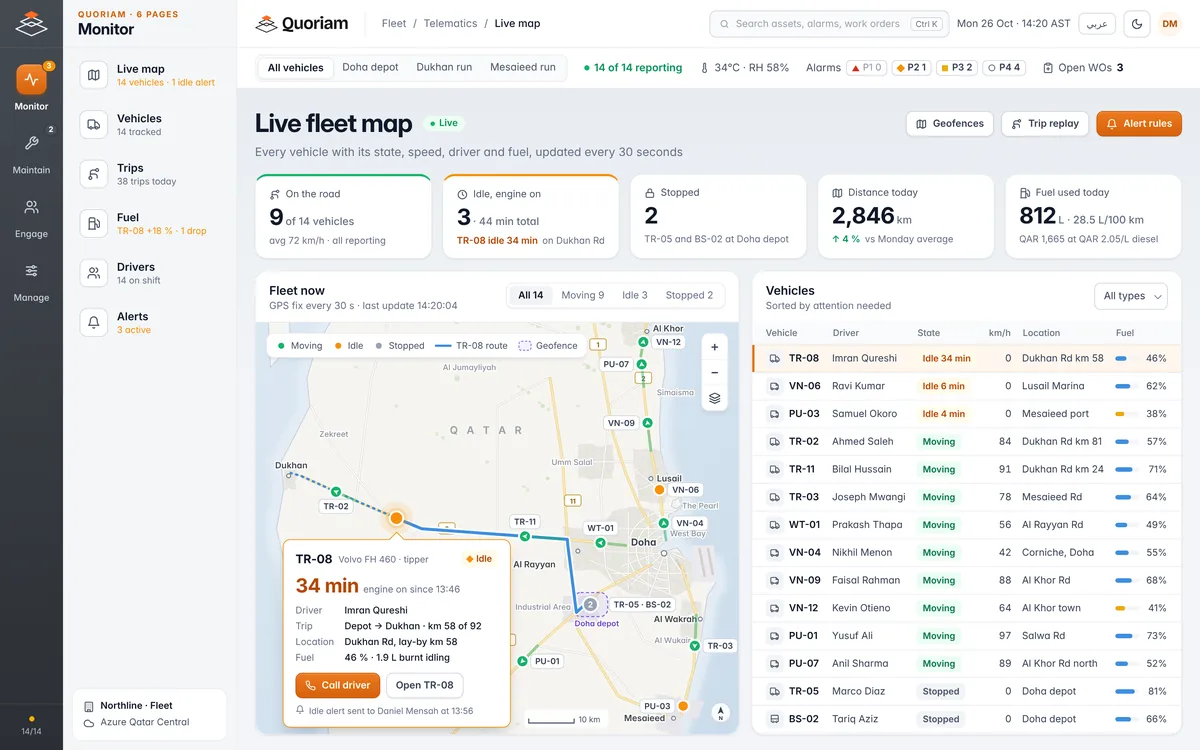
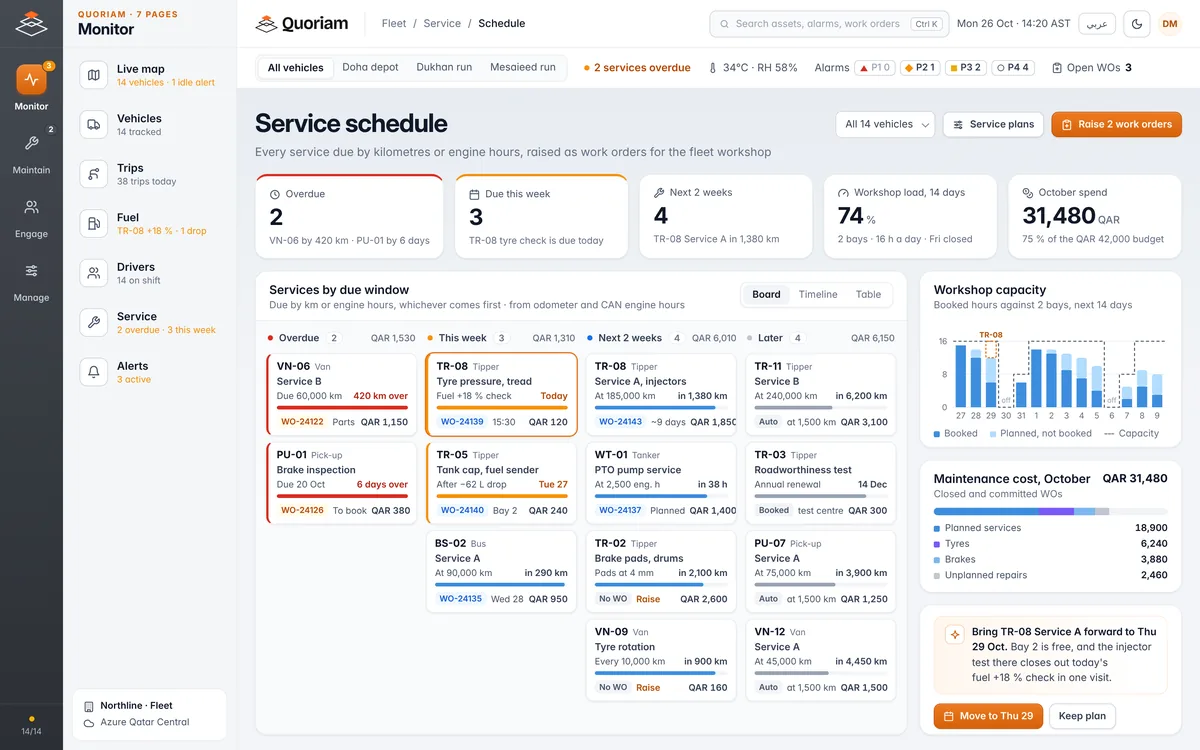
What your team sees.
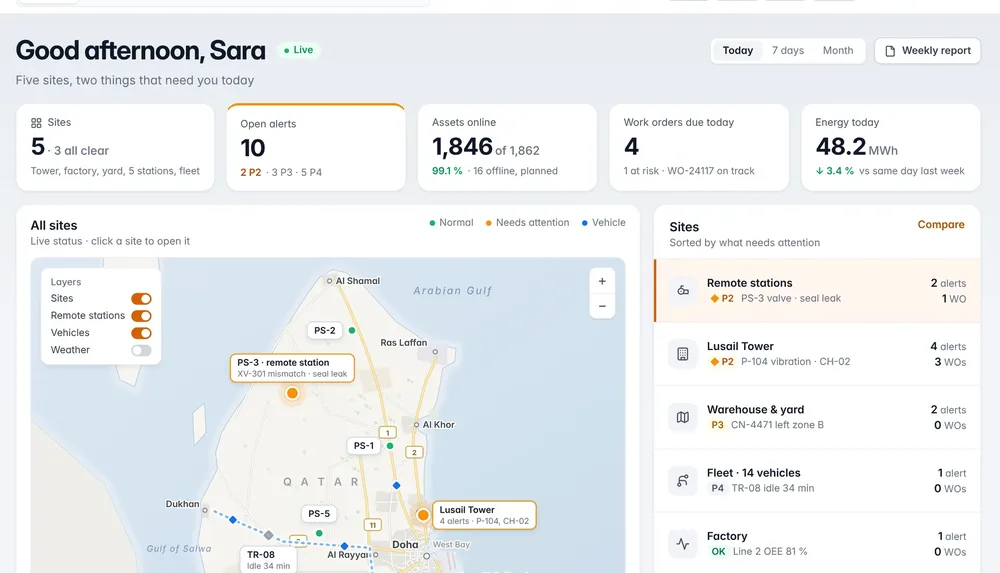
Every vehicle on one map, with the fuel and servicing behind it.
Or just ask.
Quoriam AI answers questions about your fleet in plain language and turns the answer into an action.
Fleet telematics use cases.
Start with the cost that hurts most: fuel, driving or the cold chain.
Trackers, sensors and integrations.
We fit what each vehicle needs and read the data it already has.
- GPS trackers4G, wired to ignition, reading the CAN bus where the vehicle supports it
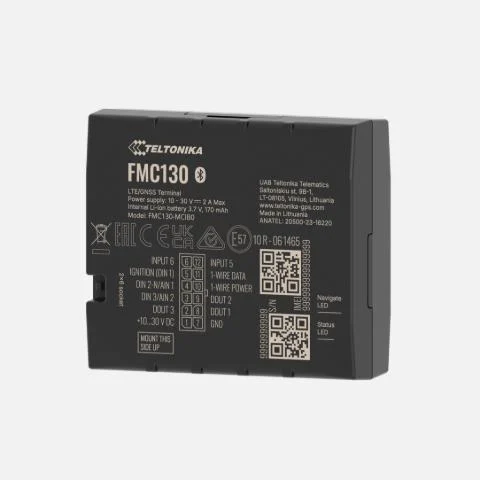
- Fuel level sensorsIn the tank, for drops and refuels the CAN bus doesn't show
- Reefer temperature probesIn the load space, logged on the road
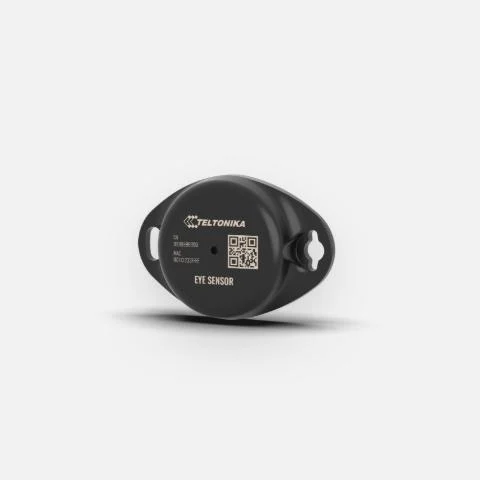
- Door and PTO inputsReefer and tanker doors, PTO use on tippers and tankers
- Reads from
- GPS trackers over cellular; fuel, odometer and engine hours from the CAN bus where available; trackers already fitted
- Work orders to
- Quoriam's own work orders for your workshop, or your existing CMMS or fleet system
- Reports to
- Weekly fuel, driver and service reports by email and Teams, as a PDF with an Excel attachment
- Alerts by
- Quoriam app, SMS and email, with escalation if nobody responds
Hardware agnostic. Makes we fit includeMilesightFootfallCamTeltonikaAdvantechWe can work with any maker and choose the device for each site. The platform reads them all.
Where it's used.
The same platform, set up in each industry's terms.
Questions buyers ask.
Something else? Ask us during the free assessment.
What's the difference between vehicle tracking and fleet telematics?
Vehicle tracking shows where each vehicle is. Fleet telematics adds what the vehicle is doing: fuel, idling, engine hours and how it is driven. That is what lets you cut fuel, coach drivers and plan servicing on real use.
How many trackers do we need?
One tracker per vehicle. Add a fuel level sensor where fuel matters and the vehicle doesn't share fuel data, and a temperature probe for each reefer compartment. The free assessment counts it for your fleet.
Can it read fuel from our vehicles?
Many trucks and vans share fuel used and fuel level over their CAN bus, and the tracker reads it. Where a vehicle doesn't, or where you want to catch theft from the tank, we fit a fuel level sensor.
Will the trackers cope with summer in Qatar?
A parked cab in the sun runs far hotter than the 45 to 50 °C outside air. We choose trackers rated for that heat and mount them out of direct sun. Heat also shortens backup batteries, so the platform shows any tracker that stops reporting.
Will we lose data on long runs to Dukhan or Ras Laffan?
Trackers report over the cellular network, which covers the main routes. Where signal drops, most trackers store their positions and send them once it returns, so the trip replay has no gaps.
How does it schedule servicing?
Each vehicle gets a service plan by kilometres or engine hours, whichever comes first, read from the tracker or the CAN bus. Services coming due appear on one board and become work orders for your workshop, with its capacity alongside.
We already have trackers. Do we have to replace them?
Not always. Where your current trackers can send their data to another platform, Quoriam reads them and adds fuel, servicing and reefer data around them. We replace a tracker only where it can't share data.
What does it cost?
It depends on how many vehicles you track and the sensors each one needs. The free three-week assessment ends with a scope and a fixed price for your fleet.
Add next on the same platform.
Every solution plugs into the one you start with. One login, one set of alarms.
 CN-4471 Left zone B at 14:02
Asset tracking and geofencing
Know where equipment, tools and containers are, and get an alert the moment one leaves its zone.
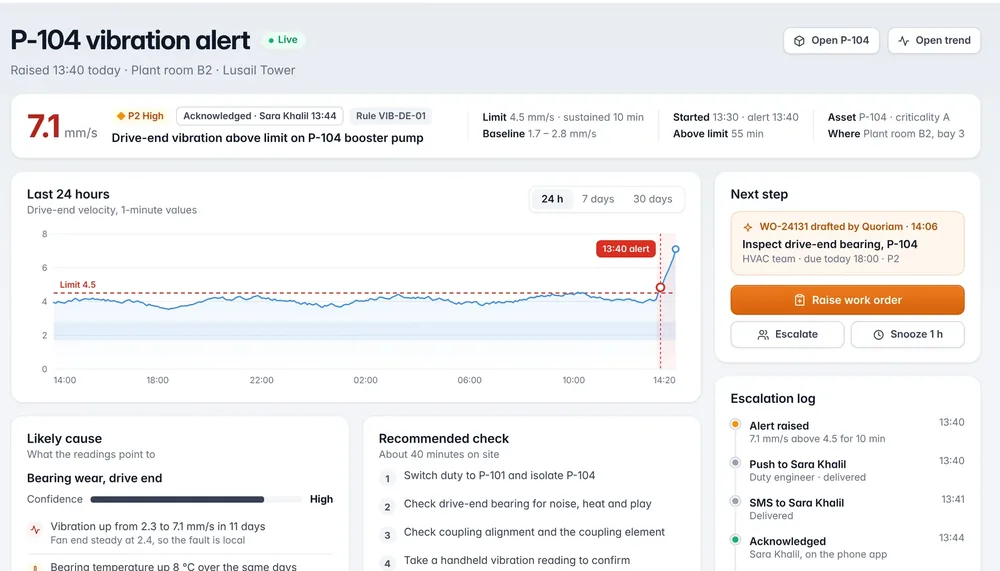
 P-104 Vibration 7.1 mm/s
Predictive maintenance
Catch bearing wear, overheating and imbalance weeks before a pump, motor or chiller fails.
 Station 2 44 °C, RH 18%
Environmental monitoring
Log temperature, humidity and air quality in cold rooms, warehouses and offices, ready for audit.
Start with a pilot.
Prove it on part of your fleet before you fit every vehicle.
- Vehicles chosen with your team in the assessment
- Trackers and sensors supplied, fitted and commissioned by our engineers
- How long it runs is agreed with you, typically around eight weeks
- The results to look for are agreed at the start and reviewed with you at the end
See where your fleet loses fuel and time.
A free three-week assessment. We review your vehicle list, fuel records and service history with your team and deliver a plan: which vehicles to track first, the sensors each one needs, and the alerts and service plans to set.
We take on two assessments a month.Quoriam is designed to pay back within six months. How we calculate payback