







1. Home
  2. Solutions
  3. Predictive maintenance
  4. Vibration monitoring

Vibration Monitoring in Qatar

Sensors on your pumps, motors, fans and chillers that pick up bearing wear, imbalance and misalignment weeks before a breakdown, and raise the work order while there's still time to plan it.

Velocity, acceleration, temperatureMeasured on three axesPumps, motors, fans, compressorsAny make or ageApp, SMS and email alertsWith the trend attached

Last updated

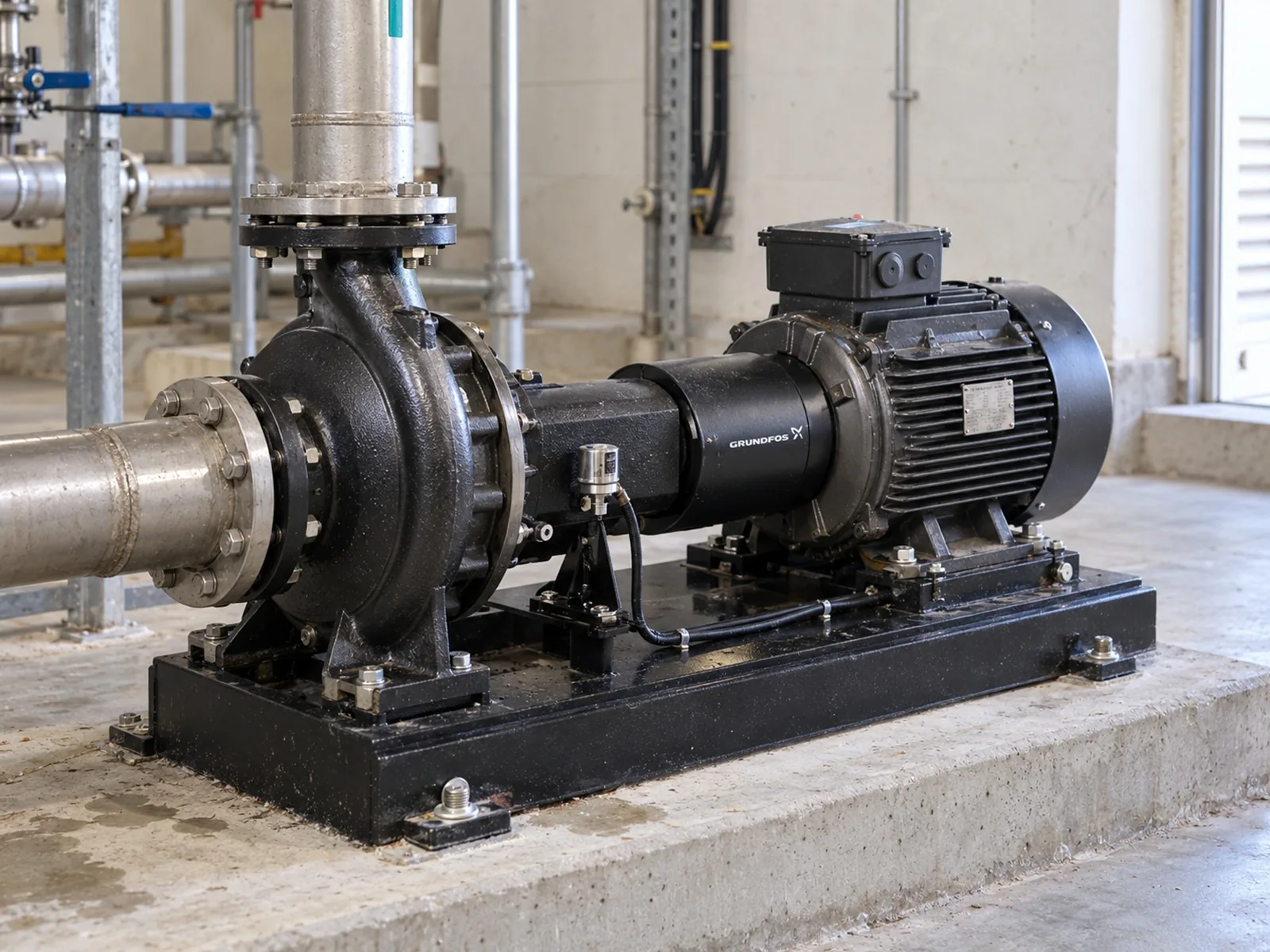
End-suction pump and motor on a plinth with a vibration sensor fitted to the bearing housing
Illustration: a pump's vibration trend rising past its limit over 30 days, flagged as likely bearing wear.

What is vibration monitoring?

Vibration monitoring measures how a rotating machine shakes, all the time, with a sensor fixed to its bearing housing. Each fault in a pump, motor or fan changes that vibration in its own way, usually weeks before the machine fails, so a rising trend tells you what is wearing and how long you have.

It is the most widely used form of condition monitoring for rotating equipment, and the core of any predictive maintenance programme. Unlike a monthly survey with a handheld meter, a fixed sensor catches the faults that start between visits.

What it catches.

Five common faults, what the sensor sees for each, and when you hear about it.

What it catches.
FaultWhat the sensor seesWhen you hear about it
Bearing wearRising high-frequency vibration and impacts from damaged races or rollersEarly, well before heat or noise give it away
ImbalanceStrong radial vibration once per revolutionAs soon as it grows, often after impeller or fan blade build-up
MisalignmentVibration at twice running speed and high axial readingsStraight after an install, a motor swap or a coupling change
LoosenessMany harmonics of running speed and erratic readingsBefore bolts, mounts or the baseplate give way
Pump cavitationBroadband high-frequency vibration, often with falling discharge pressureWhile it's still eroding the impeller, not after

Vibration limits, by the standard.

The following historical ISO 20816-3:2022 values illustrate vibration severity zones. Confirm the applicable edition and machine-specific criteria before setting alarms.

ISO 20816-3:2022 reference values (superseded edition), vibration velocity in mm/s RMS
Machine groupFoundationA/BB/CC/D
Group 2Machines 15 to 300 kWRigid1.42.84.5
Flexible2.34.57.1
Group 1Machines above 300 kWRigid2.34.57.1
Flexible3.57.111.0

Edition status checked 18 November 2026: ISO 20816-3:2026 was published on 28 October 2026 and replaces the withdrawn 2022 edition. The table retains the earlier edition’s reference values; it has not been verified against the full 2026 text. Do not use it as a current compliance or alarm-setting table. Select the applicable machine standard and verify its criteria before commissioning.

  • ANewly commissioned. Where a healthy new machine sits.
  • BFine for long-term running. No action needed.
  • CNot fit for continuous running. Plan the repair for the next stop.
  • DDamage likely. Act now.

How it works.

  1. Fit

    Each sensor mounts on the bearing housing with a stud, an epoxy pad or a magnet. A gateway in the plant room sends readings to the Quoriam platform.

  2. Set the limits

    Alarm limits start from the ISO vibration zones for the machine's type, size and mounting (ISO 20816-3, or ISO 10816-7 for pumps), then tighten to that machine's own normal once Quoriam has a few weeks of data.

  3. Alert and act

    When the trend climbs, the duty engineer gets an alert with the likely fault, and a work order goes to Quoriam or your CMMS for the next planned stop.

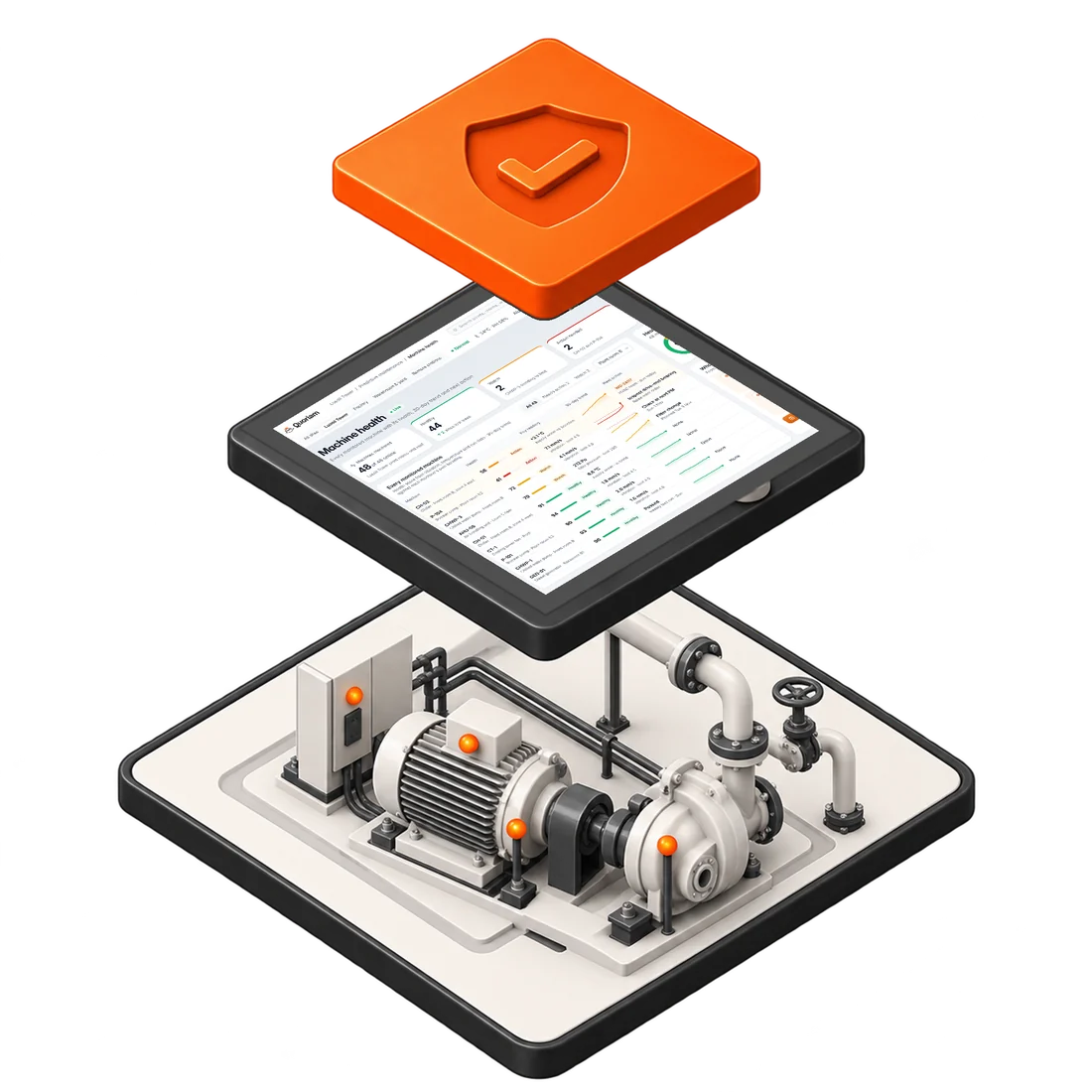
Isometric illustration: a motor and pump on the site layer, the Quoriam machine health screen above, and the decision layer on top

System view

For IT, OT and security reviewers: where the data goes, and how.

  1. On the machineWireless vibration sensors on the bearing housings
  2. In the plant roomLoRaWAN gateway, one per plant room or cluster of machines
  3. NetworkSite LAN or cellular, encrypted and kept apart from the control network
  4. Quoriam platformOn your premises or cloud hosted in Qatar
  5. Your team and systemsApp, SMS and email alerts; work orders to your CMMS; data back to the BMS

The hardware we fit.

Sourced, installed and commissioned by our engineers.

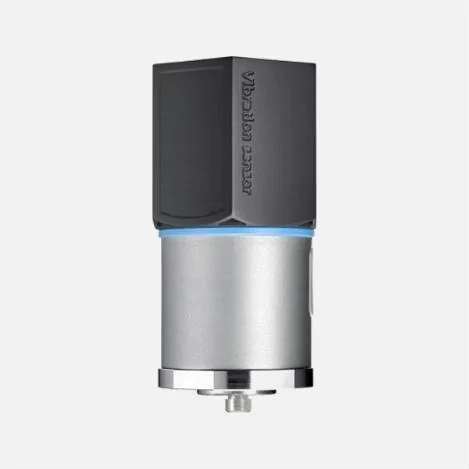
Advantech WISE-2410 wireless vibration sensor
Example: Advantech

Wireless vibration sensor. Shown: WISE-2410

Fixed to the bearing housing. Reads vibration on three axes and the surface temperature.

  • Velocity
  • Acceleration
  • Temperature
Mounting
Stud, epoxy pad or magnet
Connectivity
LoRaWAN or cellular, by device
Battery life
Varies by device and reading interval
Protection
By device, chosen for the location
Operating range
By device, checked against summer conditions on site
Reading interval
Set for each machine, faster in alarm
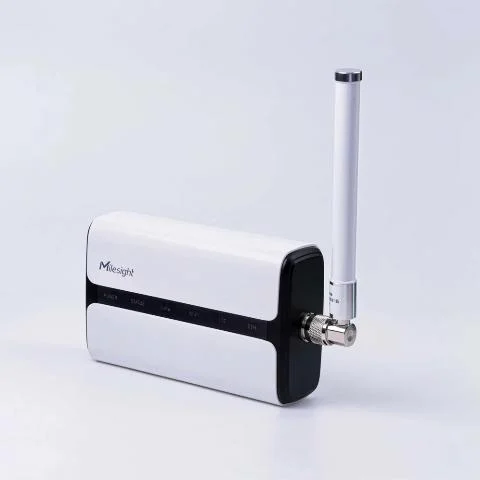
Milesight UG65 LoRaWAN gateway
Example: Milesight

LoRaWAN gateway. Shown: UG65

One per plant room or cluster of machines. Collects every sensor's readings and sends them to the Quoriam platform.

  • LoRaWAN
  • Ethernet
  • Cellular
Coverage
Confirmed on the site survey
Backhaul
Site LAN or cellular
Power
PoE or DC, by model
Protection
Indoor or outdoor model, by location

Hardware agnostic. Makes we fit includeWe can work with any maker and choose the device for each site. The platform reads them all.

What your team sees.

The trend, the likely fault and the action, for every machine.

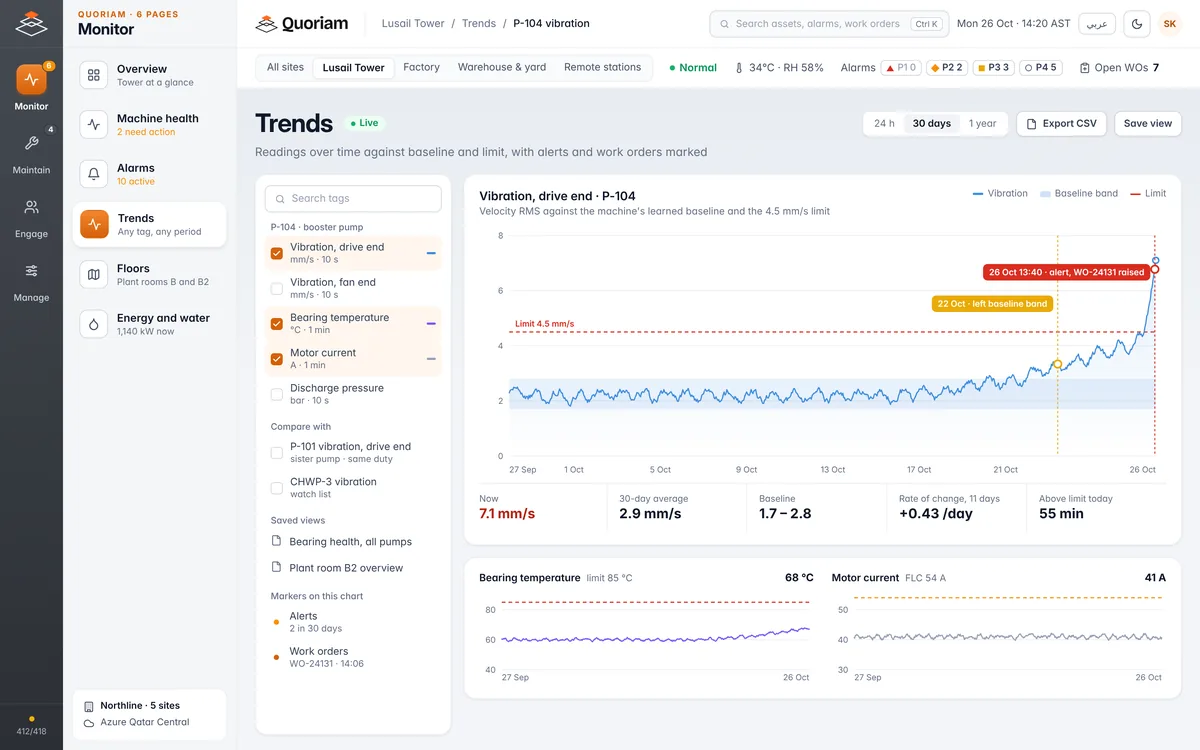
Quoriam trend screen for pump P-104 showing 30 days of drive-end vibration against its baseline band and 4.5 mm/s limit, with the alert marked
Vibration trend. One machine over 30 days against its learned baseline and limit, with the alert marked.
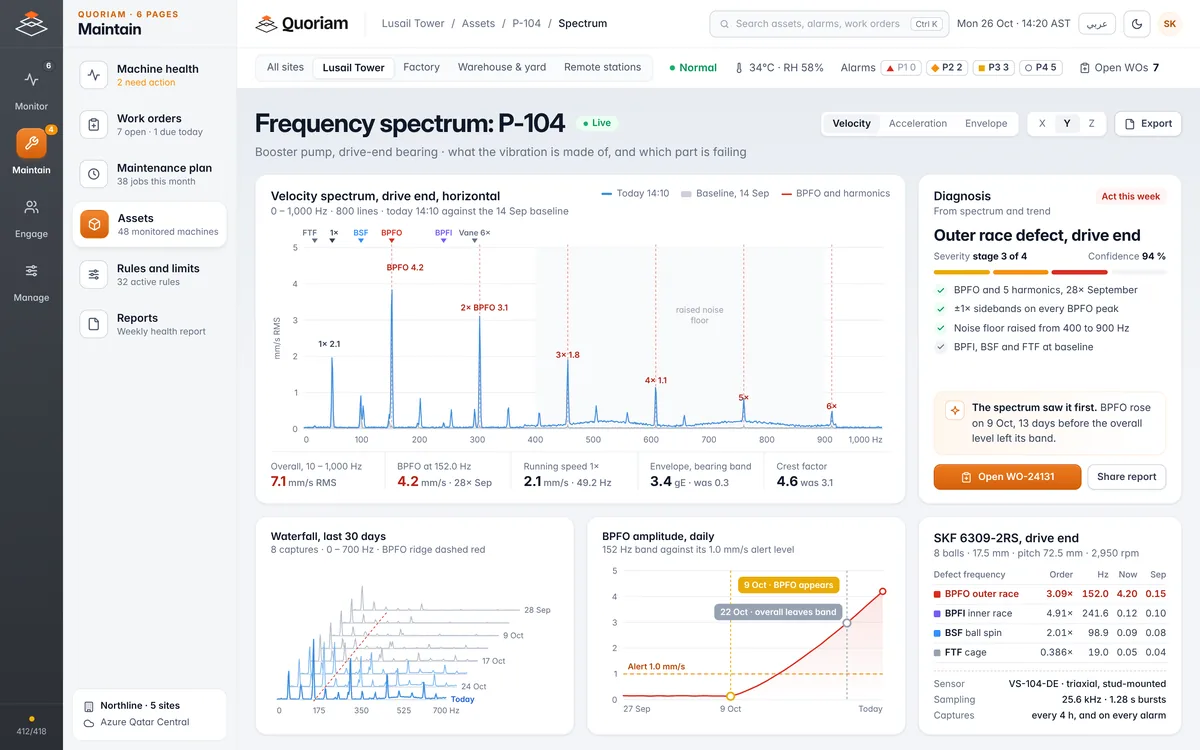
Quoriam frequency spectrum for P-104 with bearing outer race fault frequencies marked and a diagnosis of an outer race defect
Spectrum. Which part is failing: here, the outer race of the drive-end bearing.
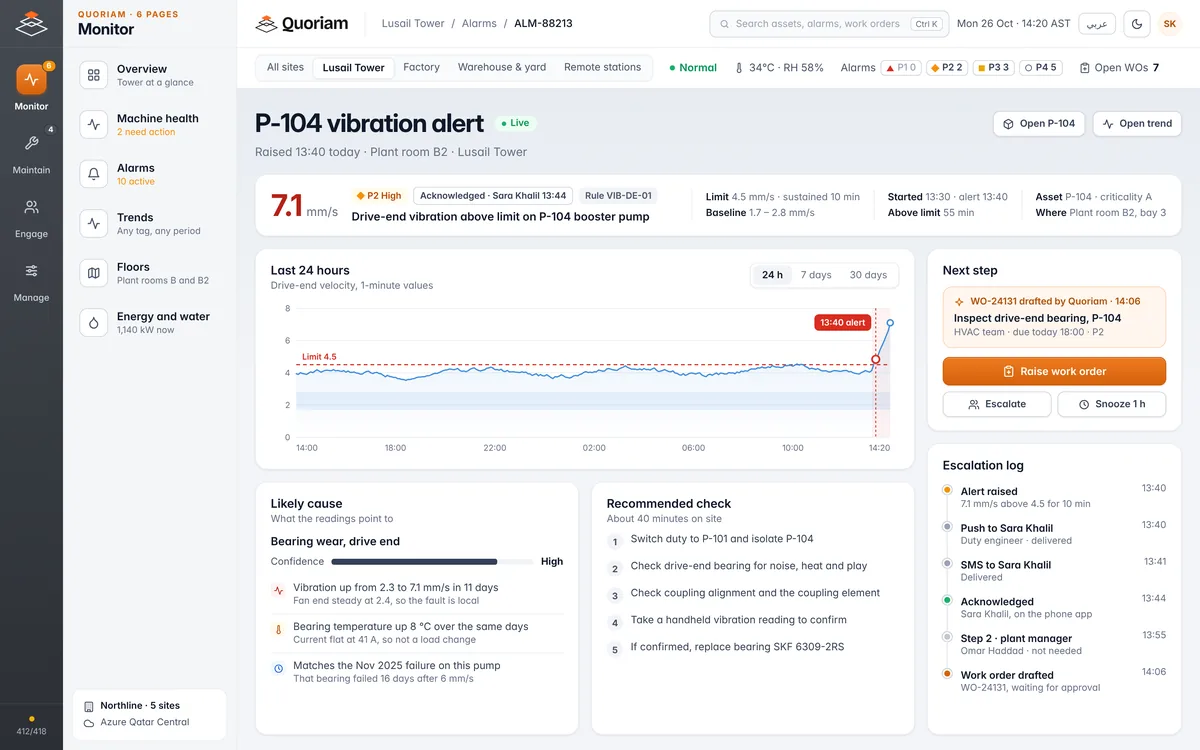
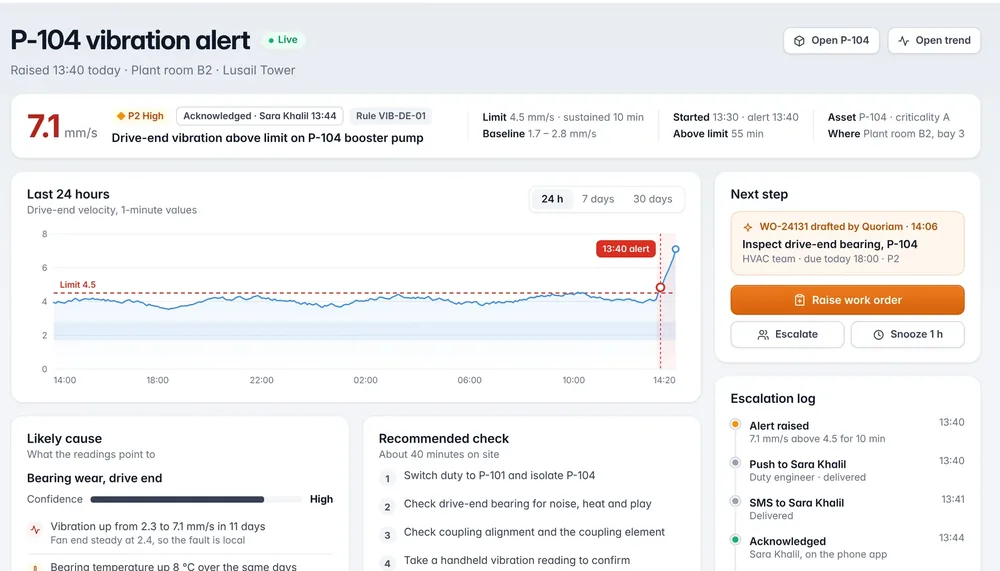
Quoriam alert screen for pump P-104 showing drive-end vibration above its limit, the likely cause and recommended checks
Alert detail. Likely fault, affected bearing and the recommended check.

Or just ask.

Quoriam AI answers in plain language and turns the answer into a work order.

Where it's used in Qatar.

Anywhere a stopped machine stops cooling, water or production.

  • Chiller plants and district cooling

    Compressor motors, chilled and condenser water pumps and cooling tower fans, all under peak load in summer.

    Utilities and district cooling
  • Water and sewage pump stations

    Remote stations visited on rounds, where a failure can go unseen for days.

    Remote operations monitoring
  • Oil, gas and energy

    Pumps, fans and compressors across process and utility areas, with certified sensors in hazardous zones.

    ATEX and hazardous area monitoring
  • Manufacturing

    Kiln fans, extruders, conveyors and gearboxes that hold up the line.

    Manufacturing

Questions buyers ask.

Something else? Ask us during the free assessment.

What does vibration monitoring detect?

Mechanical faults in rotating machines: bearing wear, imbalance, misalignment, looseness and pump cavitation are the most common. Each one changes the vibration pattern in a recognisable way, so the alert can name the likely fault, not just say something is wrong.

How many sensors do we need?

Usually one per bearing housing that matters. A critical pump typically gets two, on the motor and the pump drive ends; a smaller fan, or a machine with a standby, often gets one. One gateway usually covers a plant room or a cluster of nearby machines. The free assessment gives you the exact count and price.

Which machines can you monitor?

Most rotating equipment: centrifugal pumps, electric motors, fans and blowers, compressors, gearboxes, and the motors and pumps in chiller plants and cooling towers, whatever the make or age.

Do you need to stop the machine to fit a sensor?

Magnet and epoxy mounts can usually be fitted to an accessible housing while the machine runs. Stud mounts need a drilled and tapped hole, so we fit those at a planned stop. We agree the method with your safety team first.

How are the alarm limits set?

We start from the ISO vibration severity zones for each machine's type and class (ISO 20816-3, or ISO 10816-7 for pumps), then tighten the limits to that machine's own normal running once Quoriam has a few weeks of data.

How is this different from a monthly vibration survey?

A survey takes one reading per machine every month or quarter. A fixed sensor reads every few minutes, so a fault that starts the week after a survey is caught in days, not at the next visit.

Will it send work orders to our CMMS?

Yes. An alert can raise a work order in Quoriam or in your existing CMMS, such as IBM Maximo or SAP, with the trend attached for the technician.

Start where it hurts most.

A free three-week assessment. We review your rotating equipment and the data you already have, then recommend where sensors will pay back first.

We take on two assessments a month.

Quoriam is designed to pay back within six months. How we calculate payback