


- Home
- Industries
- Construction
Construction Equipment Tracking in Qatar
GPS trackers on plant and hired equipment, BLE tags on tools, and live location for trucks across every site and laydown yard in Qatar, on one platform.
Last updated
What is construction equipment tracking?
Construction equipment tracking puts GPS trackers on plant, generators and trucks and BLE tags on tools, so a contractor sees where every asset is, which site it is on and whether it worked today. Geofences raise an alert when equipment leaves a site or moves at night, and weekly idle reports show which hired plant to off-hire.
A contractor in Qatar typically runs several sites at once, with excavators, hired generators, welding sets, tools and trucks moving between them and the laydown yard. The plant register says where each item should be. Tracking shows where it is, whether it ran today and what it cost while it stood still.
On Quoriam that is asset tracking for plant, containers and tools, and fleet telematics for tippers, pick-ups and crew buses, on one map with one set of alerts.
What goes wrong.
What project, plant and site managers tell us before we start.
"We are paying hire on a generator nobody is using."
Hired plant follows the work from site to site, then stands behind a fence when the work moves on. The charge runs by the day until someone walks the yard and notices.
"Tools go out to site and never come back."
Torque wrenches, test kit and survey equipment get signed out for a job. Weeks later someone buys a replacement, and the original turns up in the back of a van.
"Was anyone working in the open at one o'clock in July?"
From June to mid-September, outdoor work stops at midday by law. Across five sites, a paper register and a few phone calls are all most site managers have to show it did.
Solutions for construction.
Start with hired plant, tools or the fleet, and add the rest on the same platform.
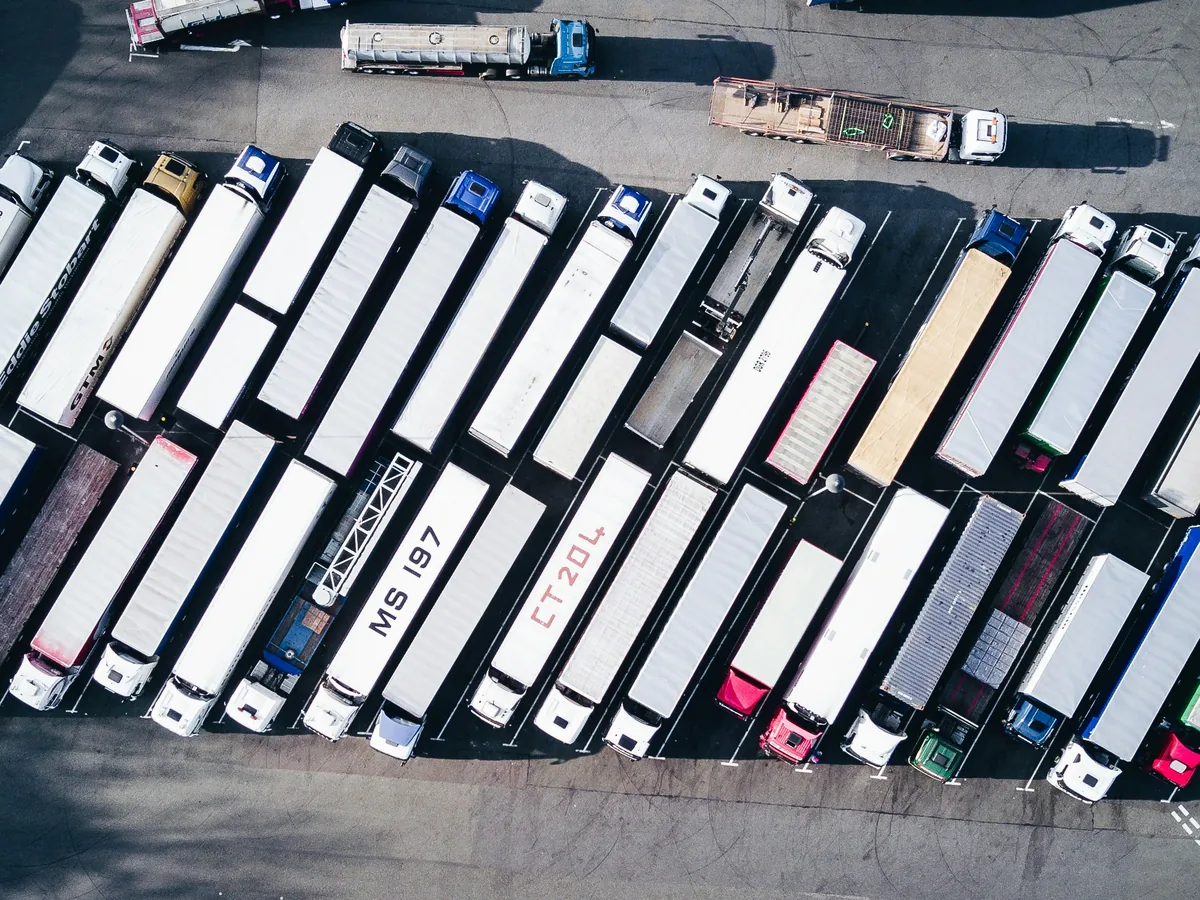
Heat stress rules on Qatar sites.
Qatar's heat stress rules shape the working day on every outdoor site in summer. Quoriam doesn't make you compliant; it gives the site manager the data to check.
| Rule | What it requires | Where tracking helps |
|---|---|---|
| Midday work ban | No work in open areas between 10:00 and 15:30 from 1 June to 15 September | A rule on plant moving or running inside site zones during those hours, sent to the site manager |
| WBGT limit | All work stops if the wet-bulb globe temperature at the workplace rises above 32.1 °C, at any time of day | A WBGT sensor on site, with an alert as it nears the limit |
| Risk assessment | Employers prepare a heat stress risk assessment for their workplaces | Site temperature and humidity history to support the assessment |
| Health checks | Annual health checks for workers | Outside Quoriam's scope |
Rules as summarised by the International Labour Organization, New legislation in Qatar provides greater protection to workers from heat stress (May 2021). In 2025 The Peninsula reported that violations could lead to partial or full worksite shutdowns (The Peninsula). The employer stays responsible for compliance; check the current rules with the Ministry of Labour.
Where most contractors start.
The use cases that cut hire bills and lost tools first.
- Tool and equipment tracking
BLE tags on tools and mobile equipment, found by zone across sites and stores.
- People tracking
Lone-worker alerts and muster counts for people on large or hazardous sites.
- Fuel monitoring
Fuel used, idling and drain alerts per vehicle and route.
- Driver behaviour monitoring
Speeding, harsh braking and idling scored per driver, every week.
Decisions the data makes possible.
Examples of what a reading leads to on a construction programme. Illustrative, not project results.
| What Quoriam sees | The decision | What it saves |
|---|---|---|
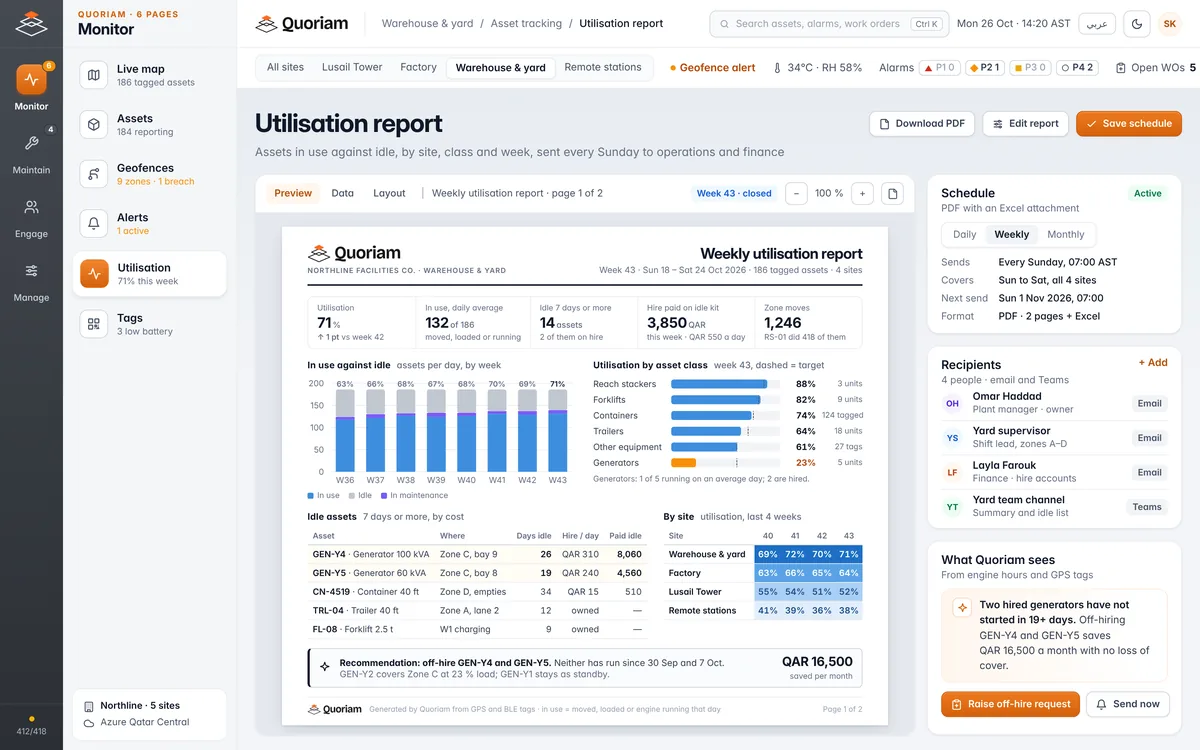
| GEN-Y4, a hired 100 kVA generator, has not started in 26 days at QAR 310 a day | Off-hire it today | About QAR 9,300 a month for a machine doing nothing |
| Excavator EX-07 left the Lusail site boundary at 23:40 | Call site security and the plant manager | A machine found days later |
| Torque wrench TW-09 last heard at the store door at 11:08, two minutes before a truck left | Ask that truck's driver before anyone buys another | A replacement for a tool in the back of a van |
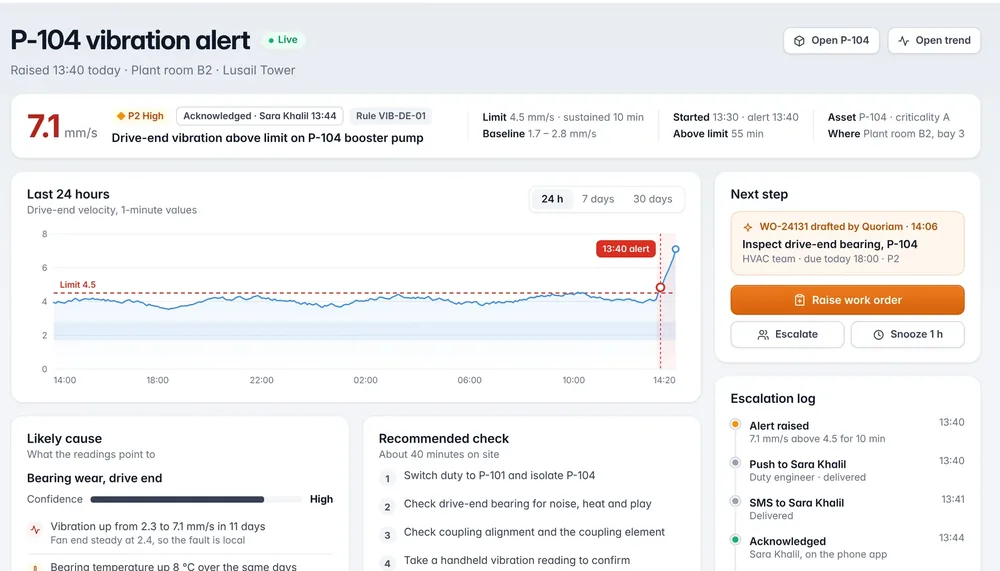
| Tipper TR-08 due a service in 1,380 km, with a fuel check already open | Bring the service forward to the day a workshop bay is free | Two workshop visits instead of one |
| Plant running inside a site zone at 13:20 in July | The site manager checks the crew is out of the sun | A breach of the midday ban found by an inspector |
Quoriam is designed to pay back within six months. How we calculate payback
Quoriam AI in construction.
The digital environmental compliance specialist follows conditions in every zone of the site through the working day.
Digital environmental compliance specialist
It tracks dust, noise and heat against their limits in each zone of the site. It tells supervisors when a zone needs action, such as a rest break or a change of task, and it writes the compliance report from the same readings.
An example of how it works. It is illustrative and is not a project result.- The decision it supports
- When to pause, move or rotate the work in a zone.
- The outcome
- Supervisors act on a reading for their own zone, and the compliance report is ready without anyone compiling it by hand.
What your team sees.
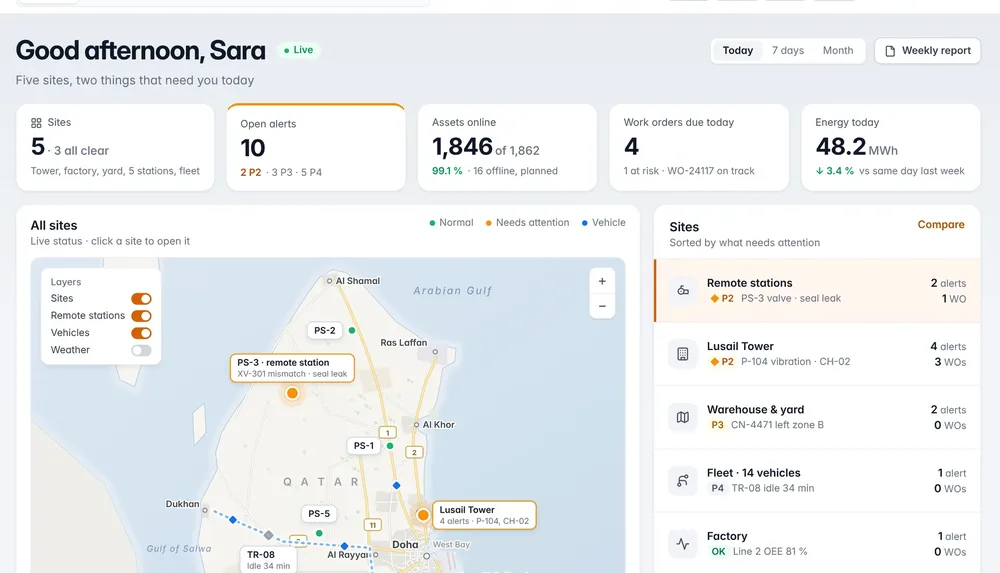
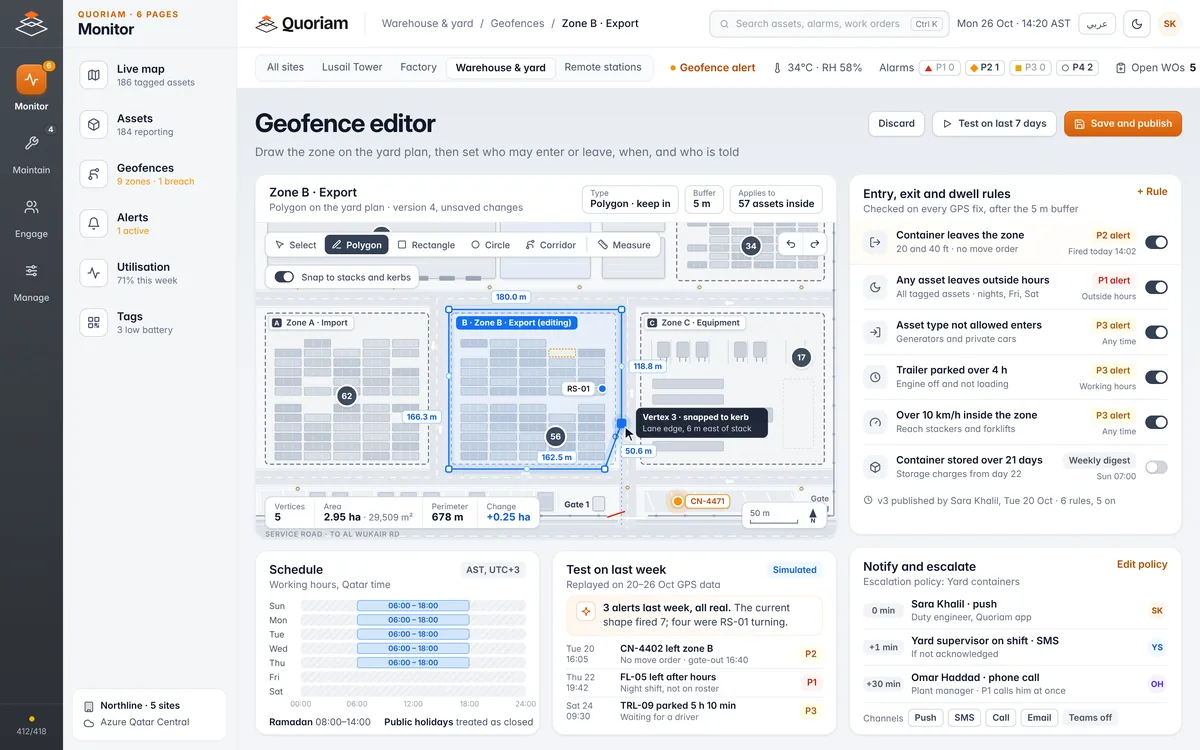
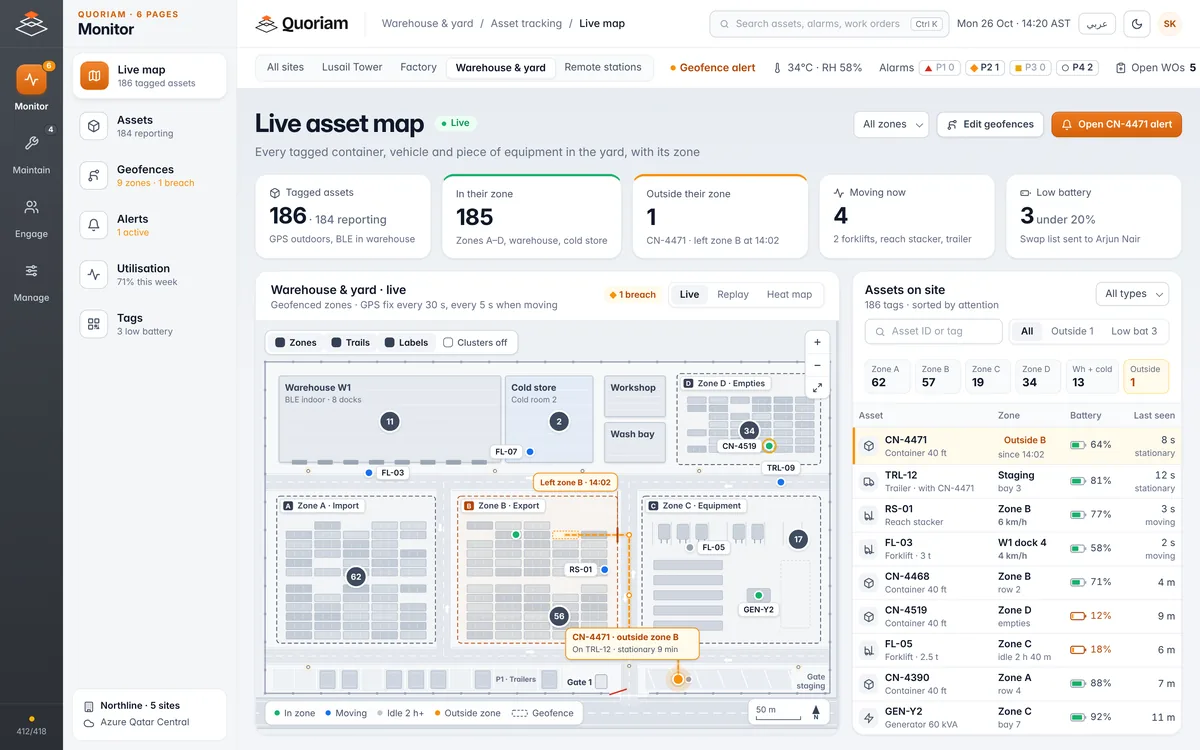
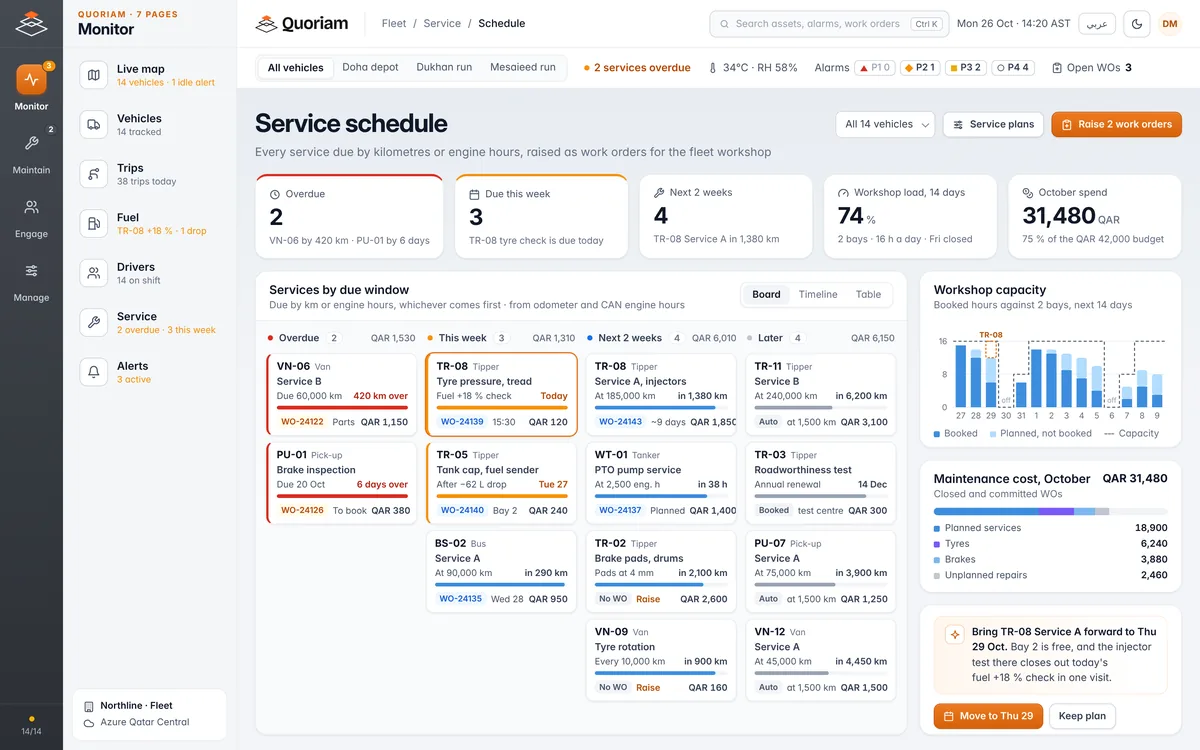
Every site drawn as zones, every tagged asset on the map, and every service due on one board.
Questions buyers ask.
Something else? Ask us during the free assessment.
Which trackers suit construction plant?
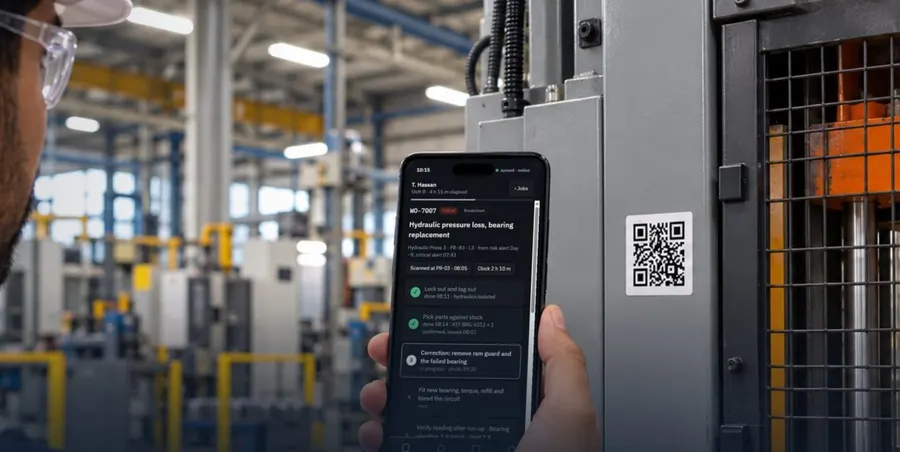
Machines with a battery get a wired GPS tracker with an ignition input, so engine hours and idle time come with the position. Towed and unpowered plant gets a battery tracker that reports more often when it moves. Tools get small BLE tags. Every tracker is checked for its rated temperature range before it goes on a machine in the sun.
Can you read the telematics already on our machines?
Often. Where a machine's own telematics can share its data, Quoriam reads it and shows that machine on the same map as everything else. We fit our own trackers only where nothing reports today, so a mixed fleet ends up on one screen.
Can Quoriam help with the summer midday work ban?
It can show what moved and ran inside each site zone between 10:00 and 15:30, and alert the site manager when it happens. A WBGT sensor on site can warn as conditions approach the 32.1 °C limit. Compliance remains the employer's responsibility.
Does it work across Lusail, Ras Laffan and Mesaieed?
Yes. GPS trackers report over the cellular network, so one map shows assets at every site and on the roads between them. We check signal at remote sites during the assessment and add a local gateway where coverage is weak or where tools sit indoors.
How many trackers do we need?
One GPS tracker per machine, generator or vehicle you want to see, a BLE tag on each tool worth finding, and a gateway in each store and site office where tagged tools live. Most contractors start with hired plant, because its cost is easiest to prove. The free assessment counts it.
What does a pilot cost?
The free three-week assessment ends with a scope and a fixed price. A pilot on one site and its laydown yard can come next.
Find out what you own, what you hire and where it is.
A free three-week assessment. We review your plant register and hire list with your team, then deliver a tracking plan for your sites, with the zones and alerts to set.
We take on two assessments a month.Quoriam is designed to pay back within six months. How we calculate payback