




- Home
- Solutions
- Predictive maintenance
- Chiller monitoring
Chiller Monitoring in Qatar
kW per ton, approach temperatures and compressor health for every chiller in your plant room, read from each chiller's own controller and a few added sensors.
Last updated
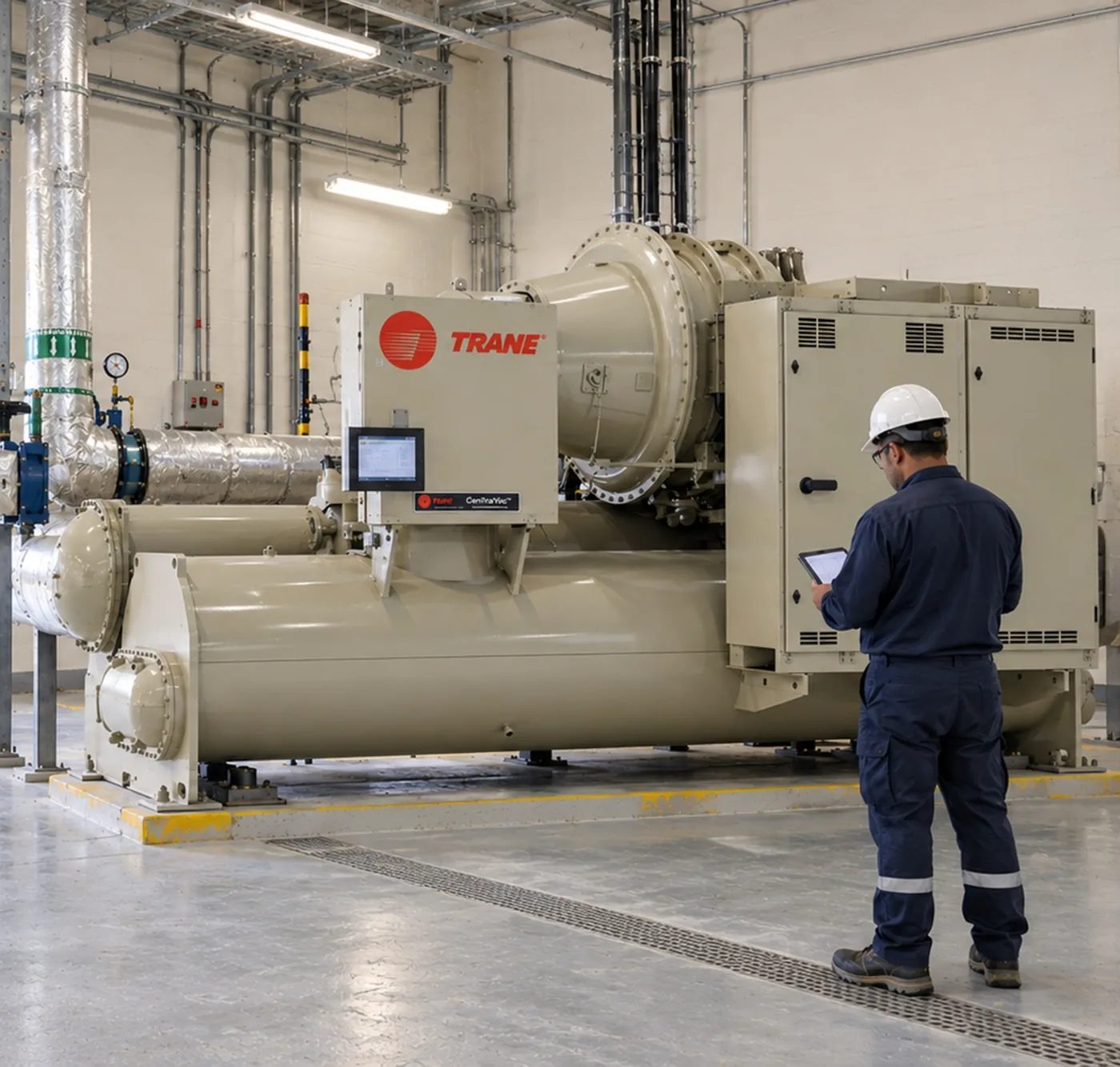
What is a chiller monitoring system?
A chiller monitoring system reads each chiller's own controller over BACnet or Modbus and adds sensors where the controller is blind. It tracks kW per ton, evaporator and condenser approach temperatures, compressor vibration and current, so it catches fouled tubes, low refrigerant and compressor wear while the chiller still holds its load.
Two numbers do most of the work. kW per ton is the electrical power a chiller draws for each ton of refrigeration (TR) it delivers; lower is better. Approach is the gap between refrigerant and water temperature in each heat exchanger. As tubes scale up, approach rises first and kW per ton follows.
Condenser approach is the condensing refrigerant temperature minus the leaving condenser water temperature. Evaporator approach is the leaving chilled water temperature minus the evaporating refrigerant temperature (Oxmaint). Kahramaa says air conditioning accounts for a significant share of Qatar's electricity use (Gulf Times), so a drifting chiller is a cost as well as a predictive maintenance risk.
What it catches on a chiller.
Each fault moves the readings in its own pattern. These are the ones we set alerts for first.
| Fault | What Quoriam sees | Where the reading comes from |
|---|---|---|
| Condenser tube fouling | Condenser approach creeping up at the same load, then kW per ton | Chiller controller |
| Low refrigerant or evaporator fouling | Evaporator approach rising, supply water drifting above setpoint | Chiller controller |
| Low condenser water flow | High condenser approach with a small condenser water temperature difference | Chiller controller and BMS pump status |
| Compressor bearing wear | Compressor vibration rising against its own baseline | Vibration sensor; see vibration monitoring |
| Compressor motor strain | More amps for the same cooling load | Chiller controller or clamp-on current sensors |
What a healthy chiller should draw.
ASHRAE 90.1-2016, Table 6.8.1-3, provides a published benchmark for new water-cooled chillers at standard rating conditions. These edition-specific values are a reference, not a Qatar compliance requirement or an in-service target.
| Chiller type | Size | Full load | IPLV |
|---|---|---|---|
| Centrifugal | Under 300 TR | 0.610 | 0.550 |
| 300 to 400 TR | 0.560 | 0.520 | |
| 400 to 600 TR | 0.560 | 0.500 | |
| 600 TR and over | 0.560 | 0.500 | |
| Screw and scrollPositive displacement | Under 150 TR | 0.720 to 0.750 | 0.560 to 0.600 |
| 150 to 300 TR | 0.660 | 0.540 | |
| 300 TR and over | 0.560 to 0.610 | 0.500 to 0.520 |
kW per ton of refrigeration; IPLV is the integrated part load value. A chiller in service runs at site conditions, so Quoriam compares each machine first with its own baseline at the same load. Source: ASHRAE 90.1-2016 addenda, Table 6.8.1-3, PDF page 72, Path A. Checked 18 November 2026. Both full-load and IPLV limits apply; centrifugal ratings require adjustment outside standard conditions.
How it works.
Connect
An edge gateway in the plant room reads each chiller's controller over BACnet/IP or Modbus, read-only: water temperatures, refrigerant conditions, compressor current and run status.
Fill the gaps
Where the controller is blind we add a vibration sensor on the compressor, clamp-on current sensors and pipe temperature sensors.
Learn
Quoriam learns each chiller's normal kW per ton and approach at each load, so a one-degree drift stands out from the weather.
Alert and act
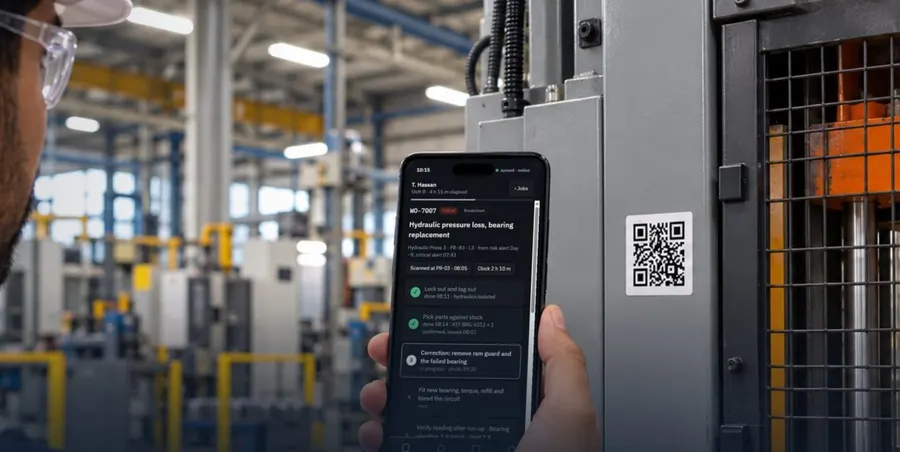
The HVAC team gets the likely cause and the energy it is costing. The work order closes once the readings are back in band.
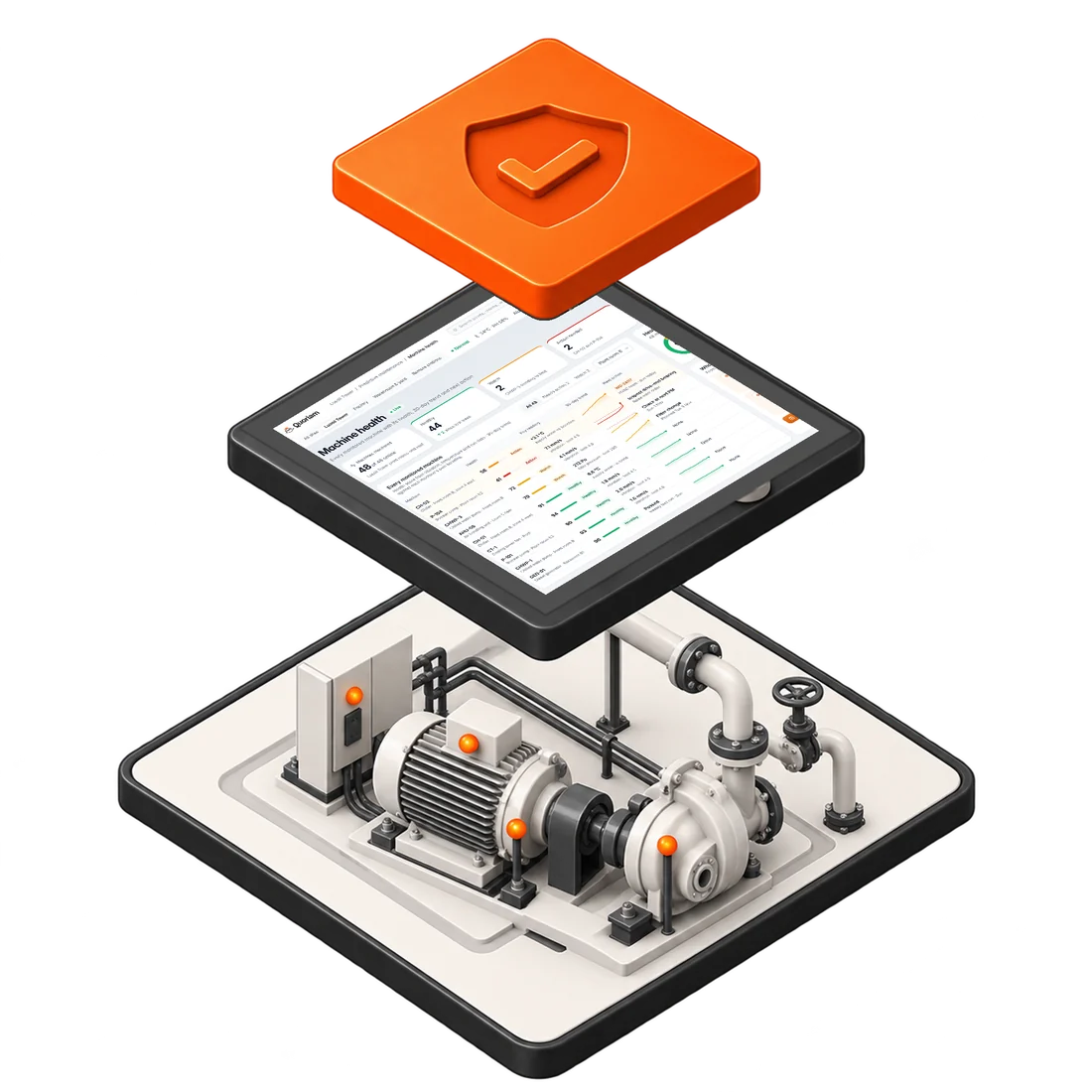
System view
For IT, OT and security reviewers: where the data goes, and how.
- On the chillerController points; vibration sensor on the compressor where needed
- In the plant roomEdge gateway on BACnet/IP or Modbus; LoRaWAN for added sensors
- NetworkSite LAN or cellular, encrypted and kept apart from the control network
- Quoriam platformOn your premises or cloud hosted in Qatar
- Your team and systemsApp, SMS and email alerts; work orders to your CMMS
What your team sees.
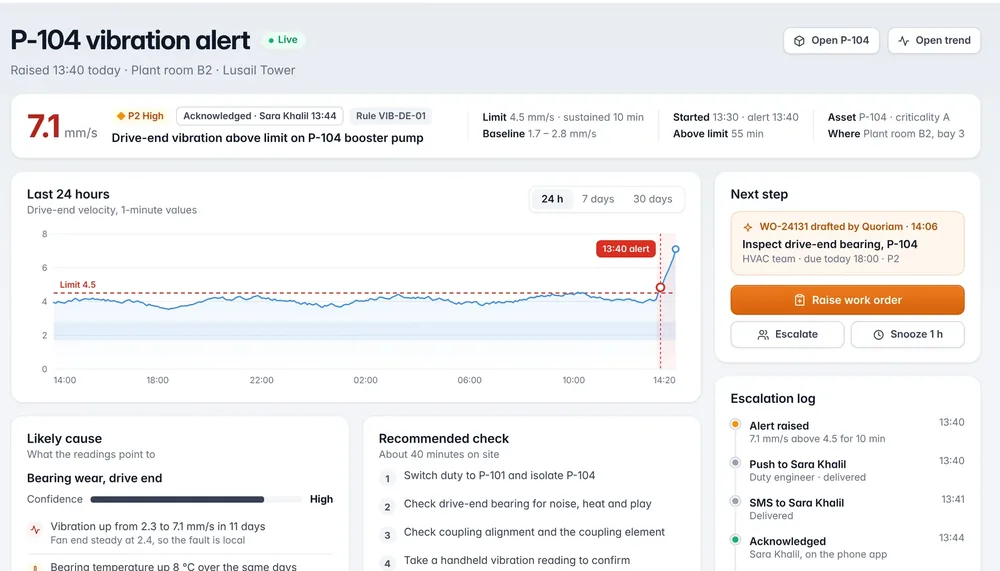
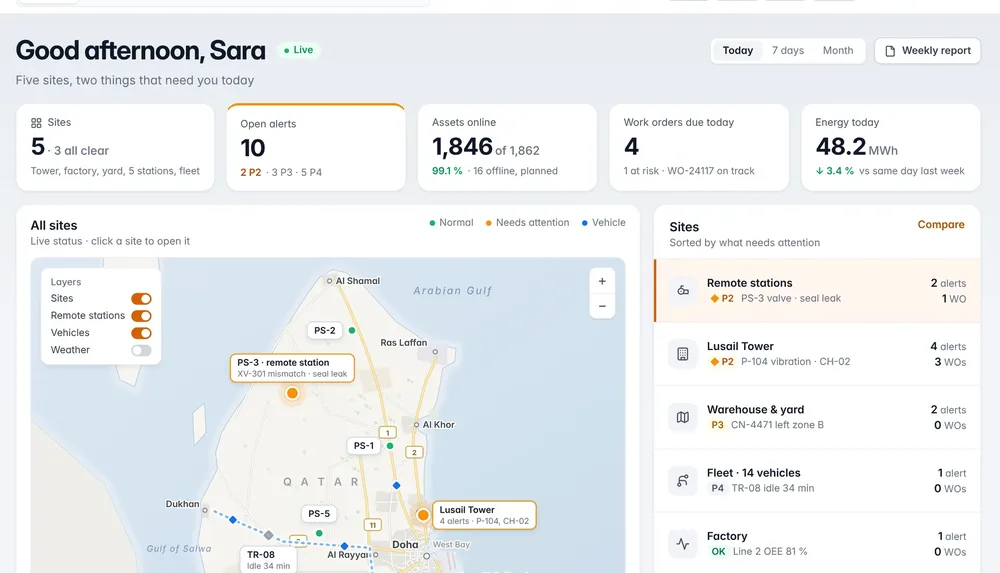
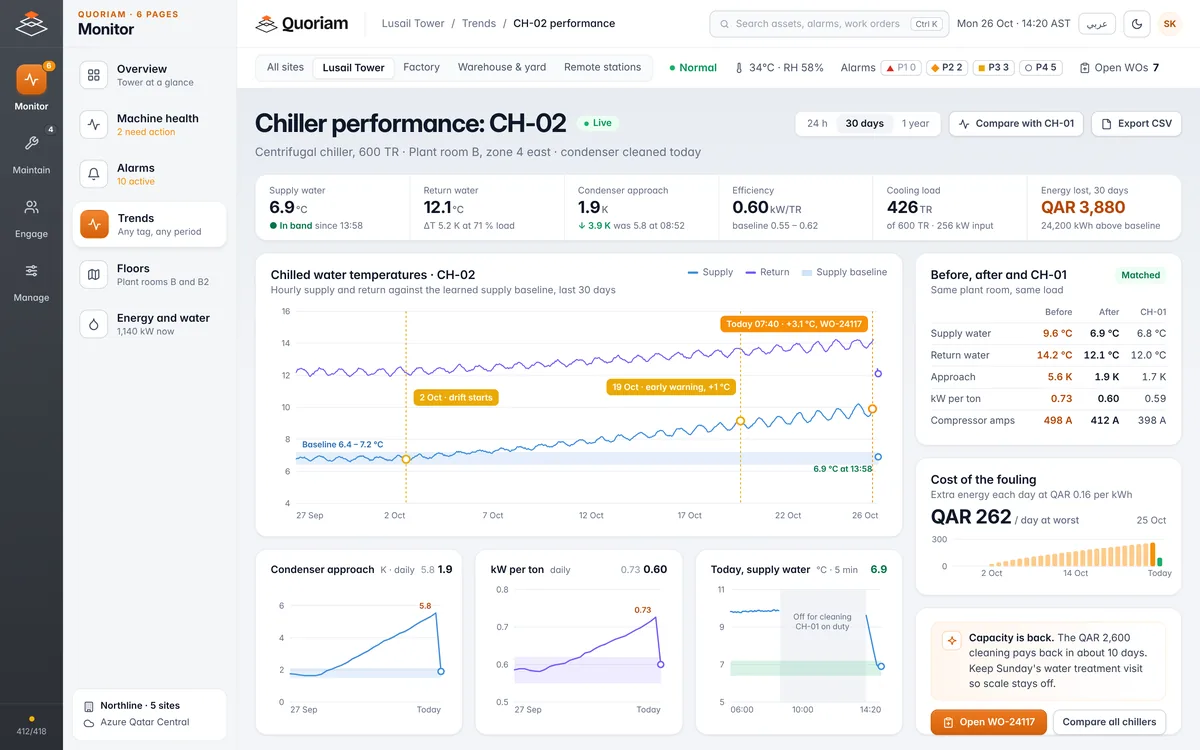
Efficiency, temperatures and the cost of each fault, per chiller.
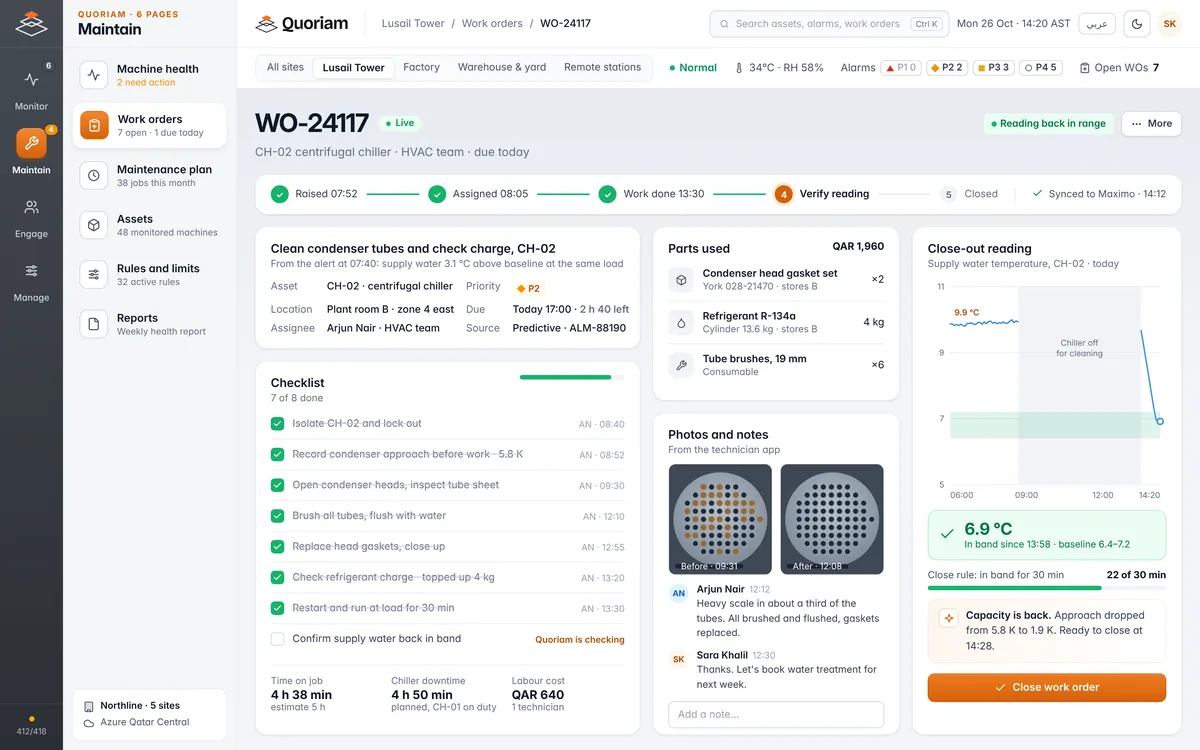
Or just ask.
Quoriam AI answers in plain language and turns the answer into an action.
Where it's used in Qatar.
Anywhere a chiller trip is felt within the hour.
Towers, malls and hotels
Building plant rooms where tenants notice a warm afternoon before the BMS does.
Facilities and smart buildingsDistrict cooling plants
Large centrifugal chillers where a small drift in kW per ton adds up fast.
Utilities and district coolingHospitals
Cooling for wards, theatres and stores that has to hold through the summer peak.
HealthcareManufacturing
Process cooling where warm chilled water slows the line or spoils the product.
Manufacturing
Questions buyers ask.
Something else? Ask us during the free assessment.
What is a good kW per ton for a chiller?
ASHRAE 90.1-2016 Path A lists 0.560 kW per ton at full load for water-cooled centrifugal chillers of at least 300 TR at standard rating conditions; the paired IPLV limit also applies. See ASHRAE Table 6.8.1-3. In service, the better test is each chiller against its own baseline at the same load. A rise of a few hundredths is worth a look.
How do you detect chiller condenser fouling?
By watching condenser approach at the same load. Scale on the tubes stops heat getting from refrigerant to water, so approach rises, then kW per ton and compressor current follow. On the screen above, CH-02's approach went from about 2 K to 5.8 K before cleaning brought it back to 1.9 K.
How do you spot a refrigerant leak?
A low charge usually shows as a rising evaporator approach and supply water drifting above setpoint, though evaporator fouling and oil logging look similar, as Oxmaint notes. The alert asks the technician to check superheat and charge. A refrigerant detector in the plant room can alarm through the BMS too.
Can you read our chiller controllers?
Yes, over BACnet/IP or Modbus, through the BMS or straight from the chiller panel, wherever the controller offers either. We map the points with your BMS contractor and read them without changing the control logic or the chiller's settings.
What hardware does chiller monitoring need?
Often very little. One edge gateway per plant room reads the controllers. We add a vibration sensor on each compressor that matters, clamp-on current sensors where the controller doesn't report amps, and pipe temperature sensors where water temperatures aren't measured. The free assessment counts it for your plant.
Will Quoriam change our chiller setpoints?
No. Chiller monitoring is read-only. Your BMS and chiller controls keep running the plant; Quoriam watches it, alerts your team and raises the work order. Changing sequencing or setpoints stays with your controls team; see HVAC and energy optimisation.
What does chiller monitoring cost?
It depends on how many chillers you have and how each one connects. The free three-week assessment ends with a scope and a fixed price for your plant, and a pilot on your most critical chillers is available.
Related.
Chiller monitoring is part of predictive maintenance on the Quoriam platform.
- Predictive maintenance
Catch bearing wear, overheating and imbalance weeks before a pump, motor or chiller fails.
- Vibration monitoring
Bearing wear, imbalance and misalignment on pumps, motors, fans and compressors.
- BTU and chilled water metering
Chilled water energy measured per tenant or building, read remotely and billed on evidence.
- HVAC and energy optimisation
Cooling matched to occupancy and weather, measured against the meter.
Find the chiller costing you most.
A free three-week assessment. We read your chiller and BMS data, rank each machine by efficiency and condition, and show where monitoring pays back first.
We take on two assessments a month.Quoriam is designed to pay back within six months. How we calculate payback