








- Home
- Solutions
- Predictive maintenance
- Current and power monitoring
Motor Current Monitoring in Qatar
Clamp-on sensors in your motor control panels that show each motor's load, starts and phase balance, with no rewiring.
Last updated
What is motor current monitoring?
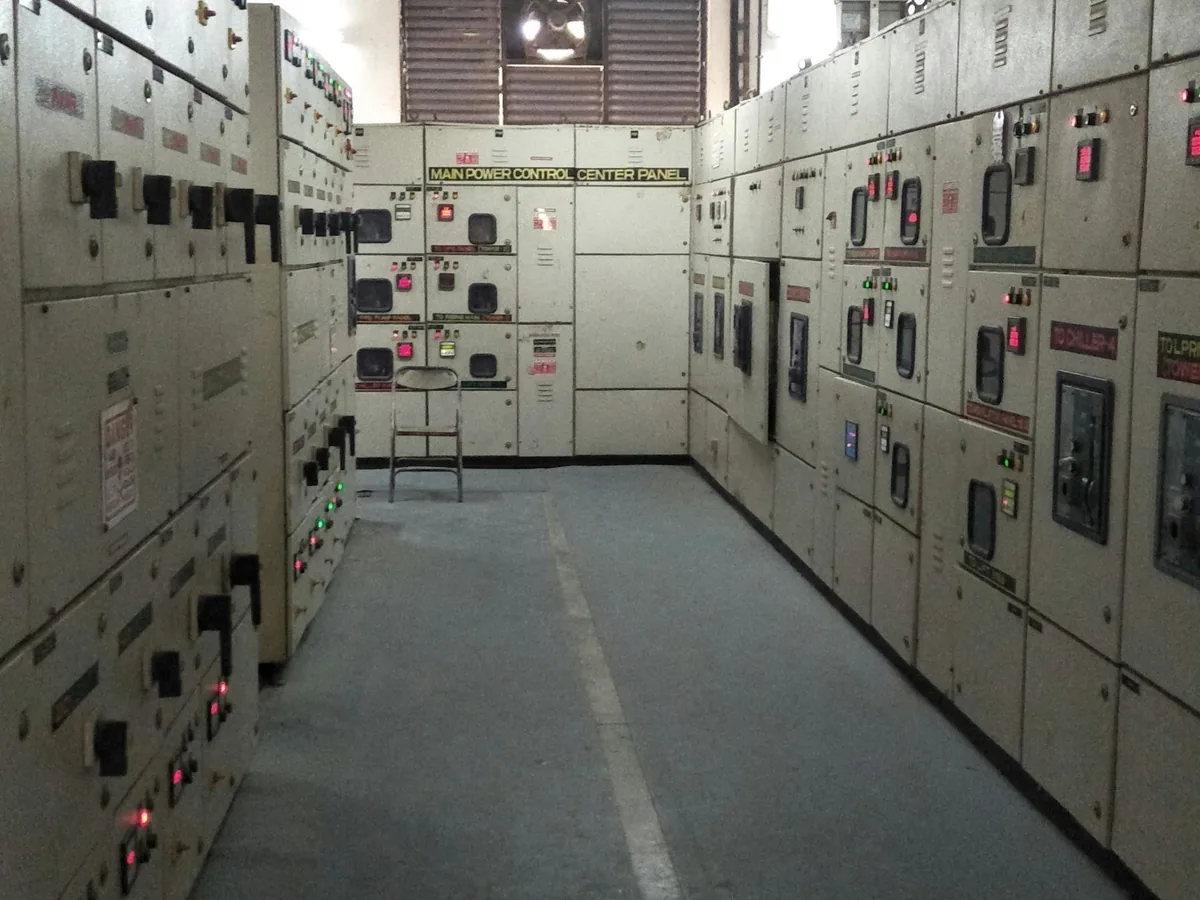
Motor current monitoring puts clamp-on current sensors around a motor's supply cables, so you see its load, starts and run hours, and the balance between its three phases. Current rising at the same duty, one phase drawing more than the others, or a sudden drop in load points to a mechanical, electrical or process fault.
Current is the cheapest window into a motor. A split-core current sensor opens and closes around each phase cable, so nothing is disconnected. From current alone Quoriam works out load against the nameplate full-load current, run hours, starts and phase imbalance. Add voltage from a power meter and you get kW, kWh and power factor too.
It pairs with vibration monitoring: vibration sees the mechanics, current sees the load and the supply. Both are part of predictive maintenance on Quoriam.
What the current tells you.
Six patterns, what usually causes each, and where the technician looks first.
| What the current shows | Likely cause | What the technician checks |
|---|---|---|
| Creeping up at the same duty | Mechanical drag: worn bearings, misalignment, a fouled impeller or a tight belt | The driven machine, coupling and bearings |
| One phase higher than the others | Supply voltage imbalance, a loose connection or a winding fault | Voltages at the terminals first; balanced voltages with unbalanced currents point to the winding |
| One phase at zero | Single phasing from a blown fuse or a failed contactor pole | Fuses and contactor, before the motor overheats |
| Falling while the motor runs | Lost suction, a broken coupling or belt, a closed valve | The driven load; see pump monitoring |
| Too many starts per hour | Short cycling from controls or a pressure switch set too tight | Control settings and switch differentials |
| Drawing current when it should be off | A schedule or interlock fault wasting energy | The BMS or PLC schedule |
Phase imbalance, by the standard.
NEMA MG-1 measures voltage unbalance as the largest deviation of any phase from the average, divided by the average. Above 1%, a motor has to be derated.
| Voltage unbalance | Derating factor | What to do |
|---|---|---|
| 1% or less | 1.00 | Run at rated load |
| 2% | About 0.95 | Find the cause at the next visit |
| 3% | About 0.88 | A 10 kW motor is good for about 8.8 kW |
| 4% | About 0.82 | Investigate now |
| 5% | About 0.75 | NEMA's limit; fix the supply |
| Over 5% | Not given | Operation not recommended |
Current unbalance typically runs 6 to 10 times the voltage unbalance, so 1% on the voltage can mean 6 to 10% on the current, and each 10 °C of extra winding temperature roughly halves insulation life. Quoriam alerts on current unbalance against each motor's own baseline. Sources: Pumps & Systems; Fabrico; Power Monitors.
How it works.
Fit
An electrician fits a split-core sensor around each phase of the motor feeder in the starter panel or MCC, under your permit to work. The sensor size follows the motor's full-load current.
Set the limits
Limits start from the nameplate full-load current and the NEMA unbalance limits, then tighten to each motor's own normal load.
Alert and act
When load climbs, a phase drifts or a motor stops drawing current while it should run, the duty engineer gets an alert with the trend and a work order goes to Quoriam or your CMMS.

System view
For IT, OT and security reviewers: where the data goes, and how.
- In the panelClamp-on current sensors on each phase; existing power meters read over Modbus
- In the plant roomLoRaWAN gateway, or an edge gateway for wired meters
- NetworkSite LAN or cellular, encrypted and kept apart from the control network
- Quoriam platformOn your premises or cloud hosted in Qatar
- Your team and systemsApp, SMS and email alerts; work orders to your CMMS
What your team sees.
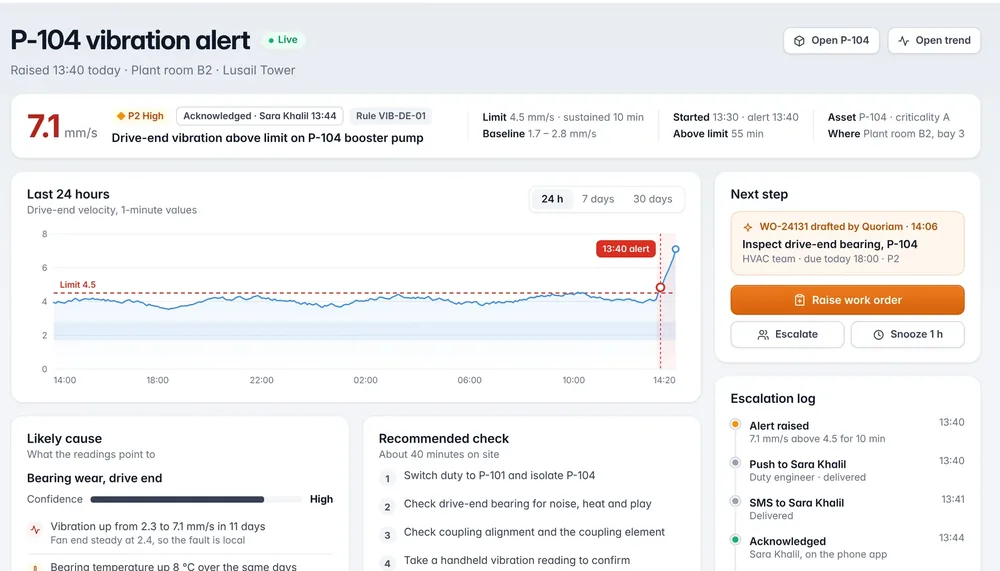
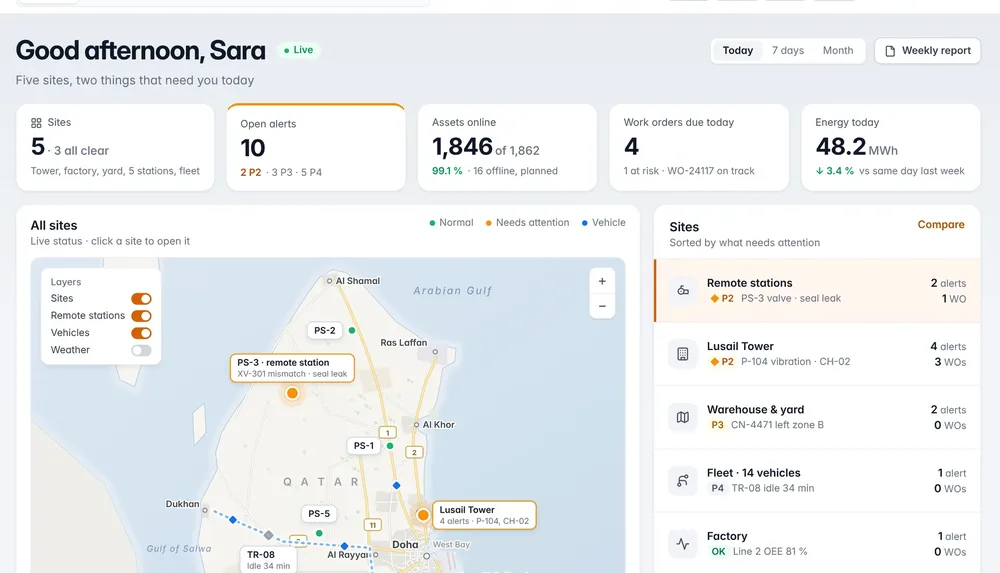
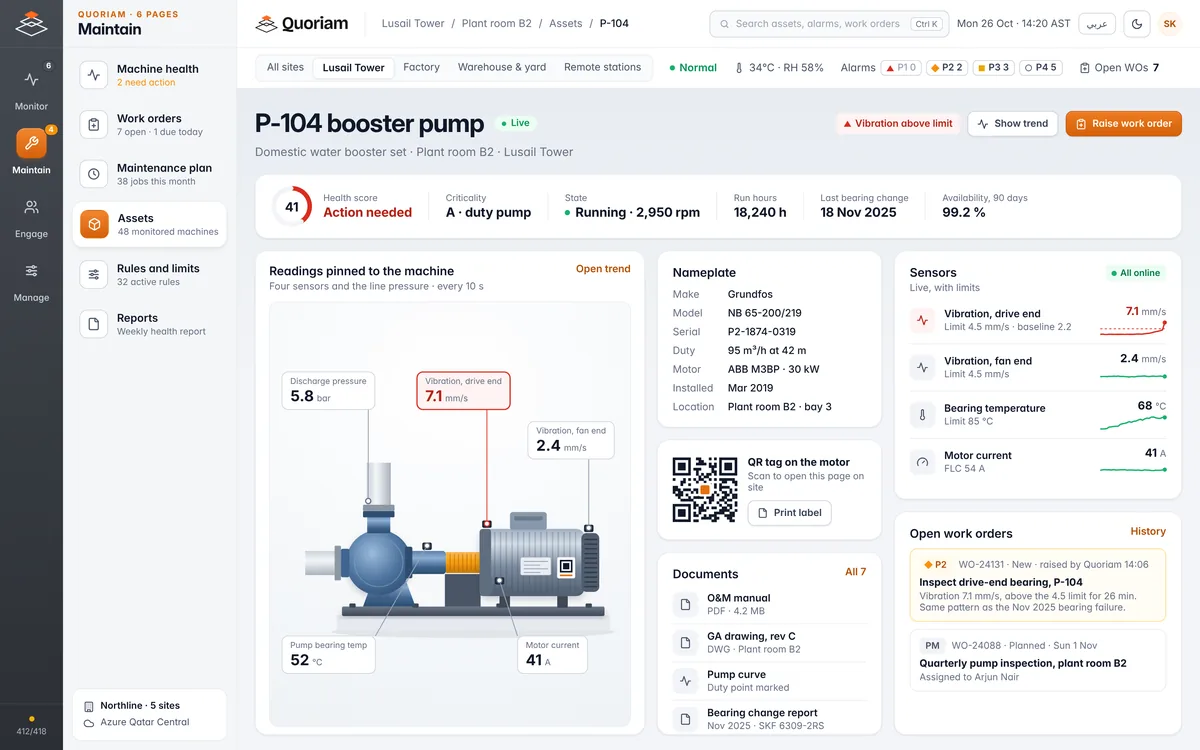
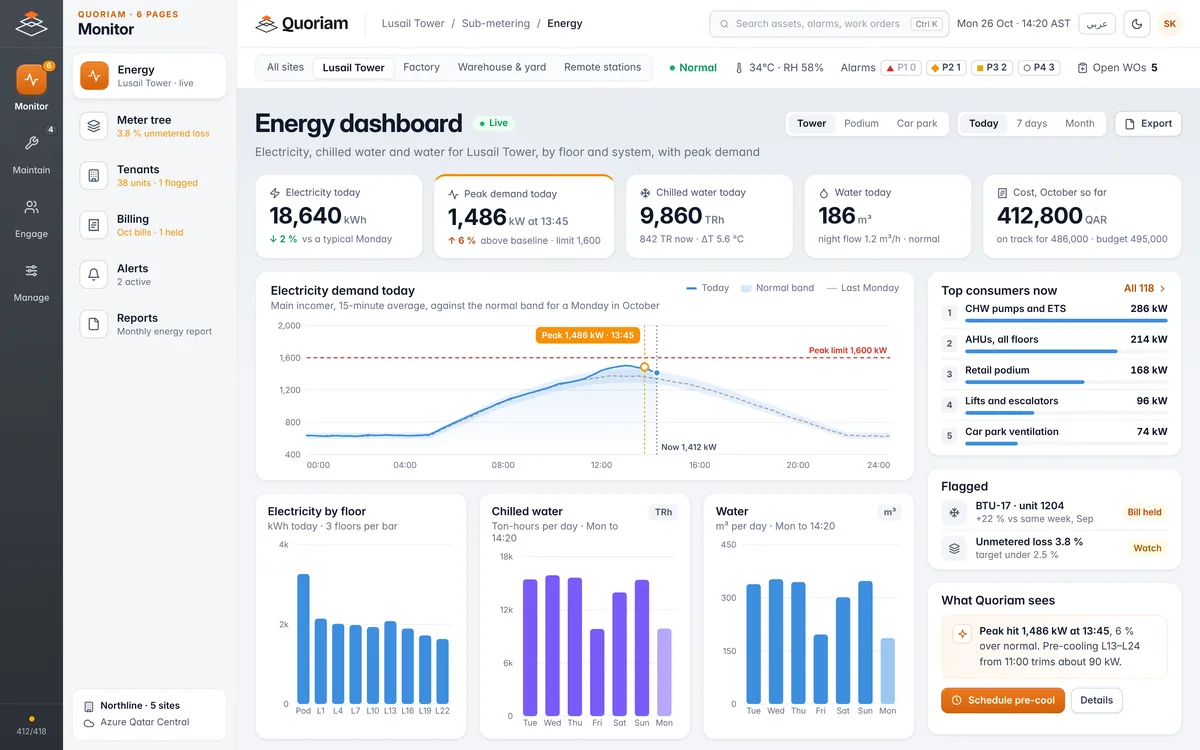
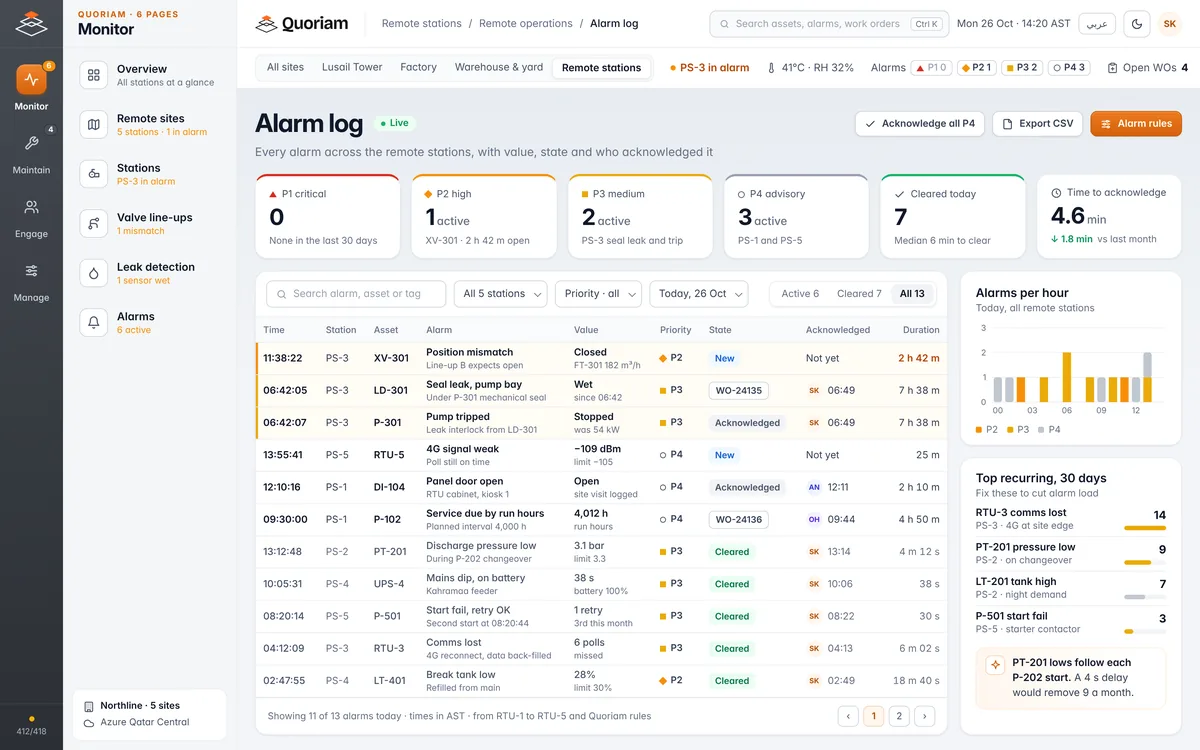
Each motor's current in context: next to its other readings, its system's energy and its alarms.
Where it's used in Qatar.
Any three-phase motor you can't afford to lose.
Manufacturing
Conveyors, extruders, mixers and kiln fans that hold up the line.
ManufacturingCold rooms and warehouses
Refrigeration compressors, where zero current means no cooling.
Environmental monitoringPump stations
Duty and standby pumps, where falling current means lost suction.
Pump station monitoringBuilding plant rooms
Chilled water pumps, cooling tower fans and AHU motors through the summer peak.
Facilities and smart buildings
Questions buyers ask.
Something else? Ask us during the free assessment.
What is an acceptable current imbalance on a three-phase motor?
NEMA MG-1 sets the limit on voltage: a motor carries rated load at up to 1% voltage unbalance and needs derating above that. Current unbalance typically runs 6 to 10 times higher, so 1% on the voltage can show as 6 to 10% on the current, according to Pumps & Systems. Quoriam alerts when a motor's imbalance moves away from its own baseline.
Do you need to switch off the motor to fit the sensors?
Usually not. Split-core sensors clamp around the existing cables, so nothing is disconnected. The panel still has to be opened, so a qualified electrician fits them under your permit to work, and your safety rules decide whether the feeder is isolated first.
What hardware does motor current monitoring need?
One set of clamp-on current sensors per motor, sized to its full-load current, and a gateway per switch room or plant room. Where a power meter already sits on the feeder, we read it over Modbus instead. The free assessment gives the exact count.
Can it measure power and energy as well as current?
Current sensors alone give load, starts and imbalance. For kW, kWh and power factor you need voltage too, from an existing power meter or one we fit. That data also feeds sub-metering, so one meter serves maintenance and energy reporting.
Does it work on motors with a variable speed drive?
Yes. A clamp on the drive's supply side shows the total current it draws. Where the drive has a comms port, Quoriam can also read its speed, motor current and power over Modbus, read-only. That is often the simplest way to monitor a drive-fed motor.
Does it check power quality and harmonics?
Harmonics need a power quality meter that measures voltage and current waveforms. IEEE 519-2014 limits voltage distortion at the point of common coupling to 8% THD on systems up to 1 kV, as Mirus summarises. Quoriam can trend and alert on those readings.
What does motor current monitoring cost?
It depends on how many motors you monitor and how many meters you already have. The free three-week assessment ends with a scope and a fixed price for your site, and a pilot on your most critical motors is available.
Related.
Current monitoring is part of predictive maintenance on the Quoriam platform.
- Predictive maintenance
Catch bearing wear, overheating and imbalance weeks before a pump, motor or chiller fails.
- Pump and motor monitoring
Vibration, temperature and current on the pumps that keep water and cooling moving.
- Vibration monitoring
Bearing wear, imbalance and misalignment on pumps, motors, fans and compressors.
- Smart metering and sub-metering
Meter electricity, water and chilled water by tenant or line, and settle every bill on evidence.
Start with the motors that stop the plant.
A free three-week assessment. We review your motors, panels and the meters you already have, then recommend where current sensors will pay back first.
We take on two assessments a month.Quoriam is designed to pay back within six months. How we calculate payback