

- Home
- Industries
- Oil, gas and energy
IoT for Oil and Gas in Qatar
Remote monitoring, machine health and certified sensors for hazardous areas, for upstream, LNG, refining, utilities and solar sites in Qatar.
Last updated
What is IoT for oil and gas?
IoT for oil and gas puts sensors and gateways on wells, valves, tanks, pumps and compressors, and brings their readings to one platform. Operators see the state of remote and hazardous sites without a drive or a round, and act on alarms before they become trips or spills.
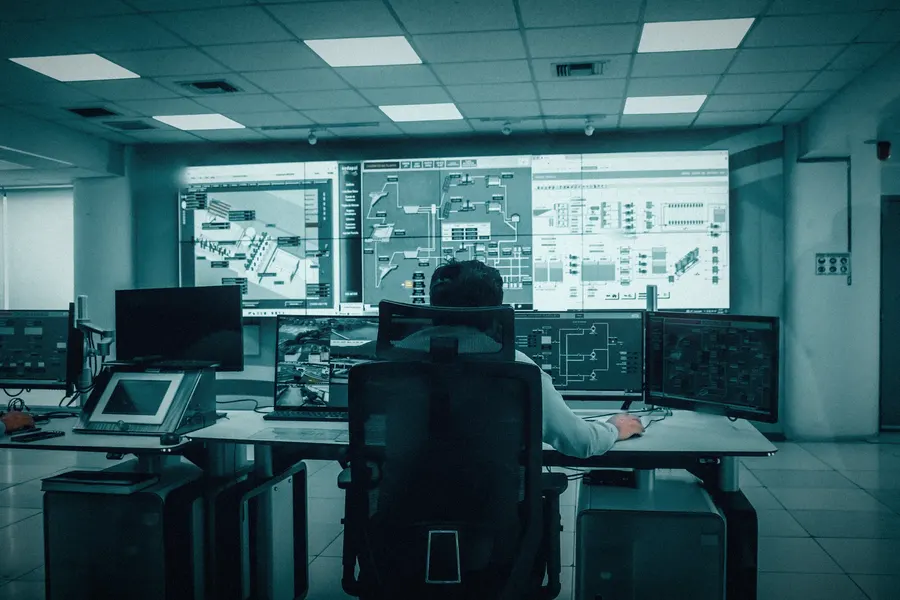
Most production and process plants already have a DCS or SCADA in the control room. What they rarely have is the same visibility for everything outside it: the wellhead valves, the tank farm, the firewater pumps, the cooling fans on the utility block, the solar array at the far end of the site. That gap is still covered by rounds, radio calls and clipboards.
Quoriam fills it. We read what the control systems already know, read-only, and add wireless sensors where nothing is measured, with certified devices in hazardous areas.
What goes wrong.
What operations and maintenance teams at Qatar's energy sites tell us.
"Line-up checks take a whole shift."
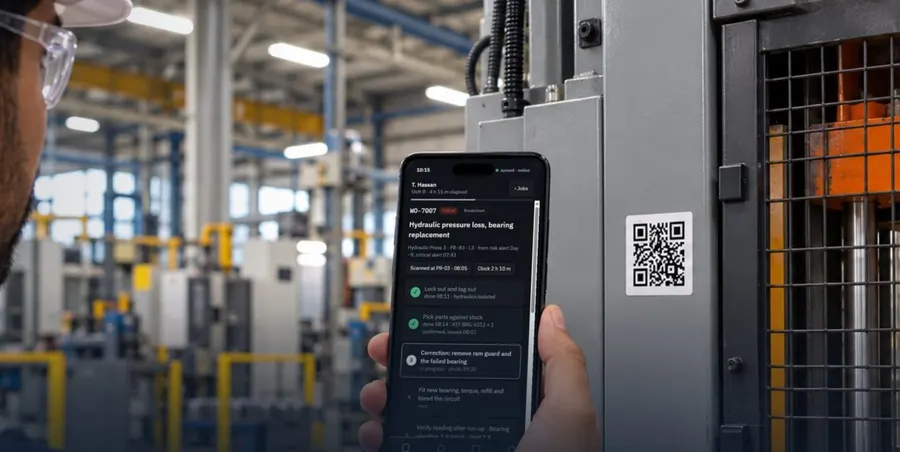
Before a transfer or a start-up, someone walks the line to confirm each manual valve is where the procedure says. On a large site or offshore, that is hours of walking for a check that a position sensor answers in seconds.
"The remote station tripped overnight and nobody knew."
Unmanned pump stations, tank farms and wellpads are visited on a schedule. A trip, a leak or a seal failure between visits goes unseen until the next round, or until someone downstream notices.
"Our rotating equipment is in a hazardous area."
Pumps, fans and compressors in classified zones are exactly the ones that need condition monitoring, and exactly the ones where ordinary sensors can't go. Portable surveys catch problems monthly at best.
Solutions for oil, gas and energy.
The solutions energy sites start with, all on one platform.
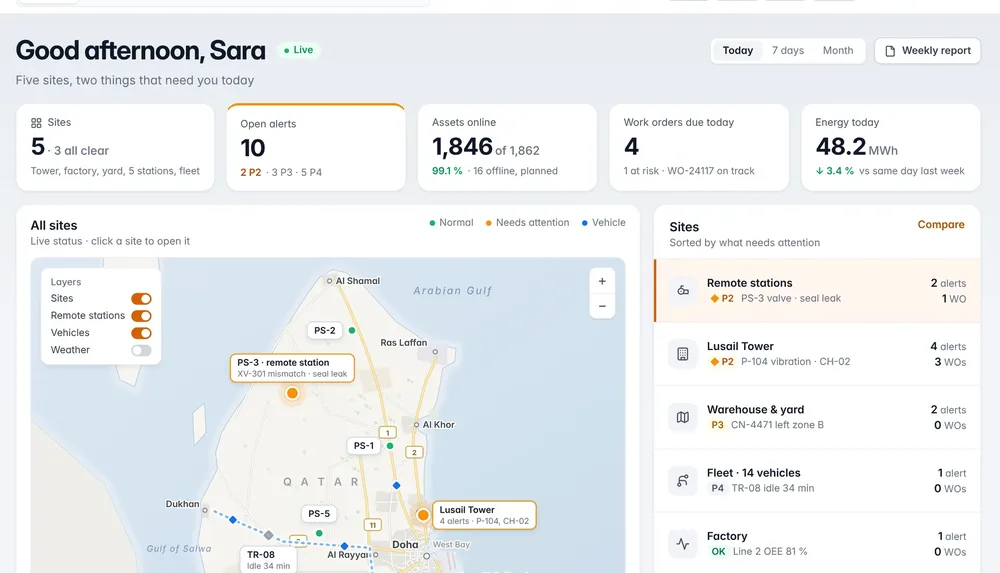
 PS-3 Pump 2 running, 4.2 bar
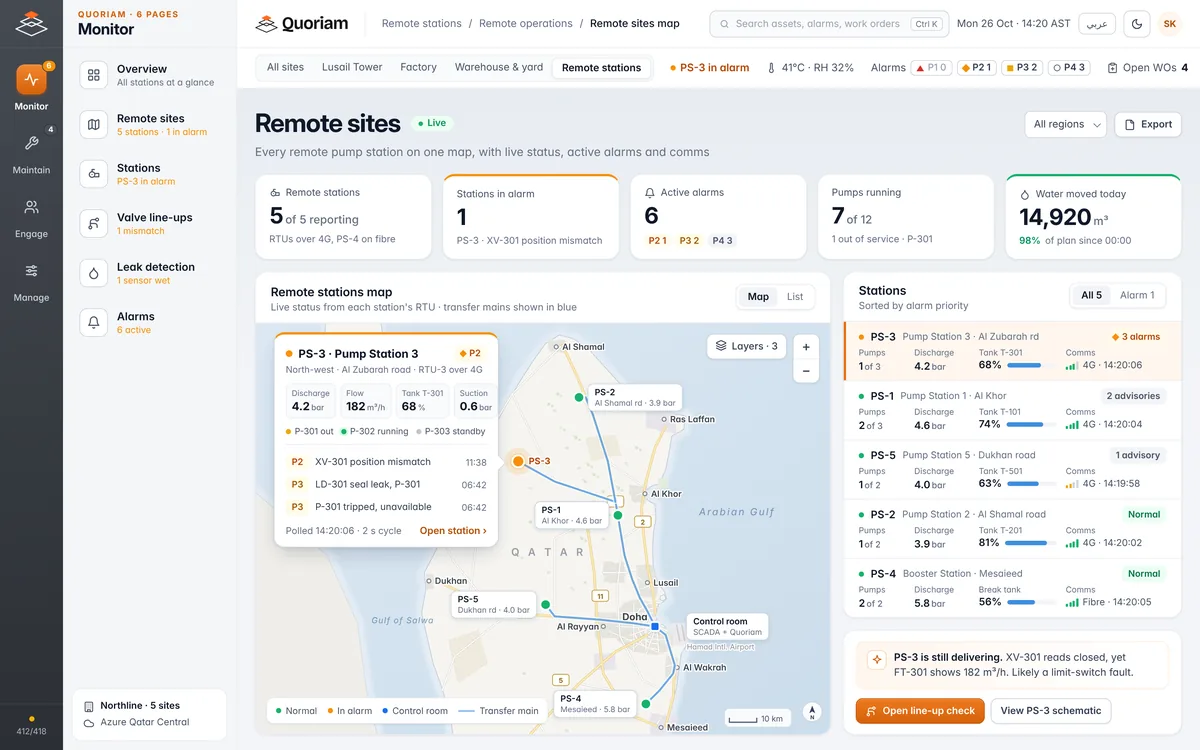
Remote operations monitoring
Valves, tanks, pumps and solar arrays across remote sites on one screen, with alarms on any change.
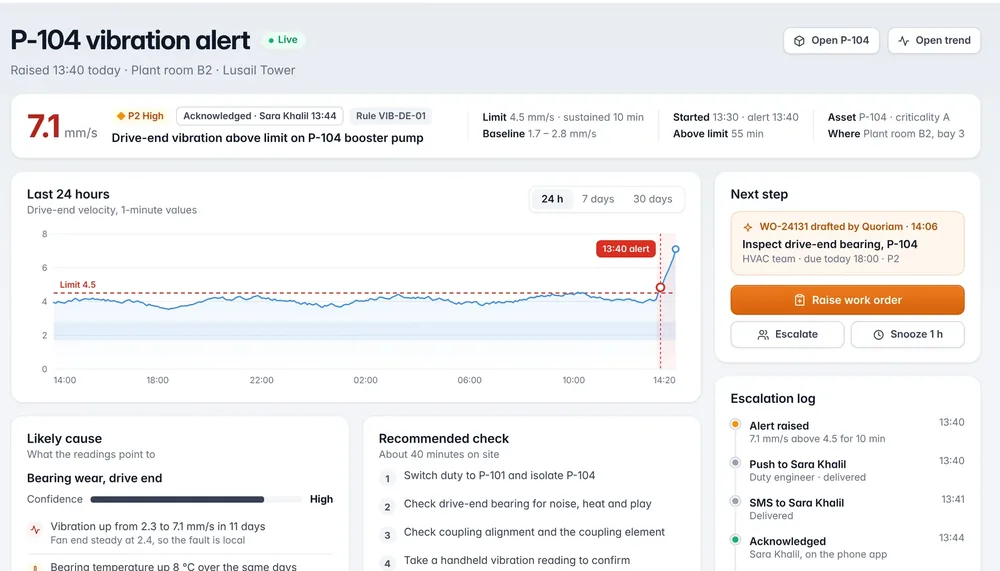
 P-104 Vibration 7.1 mm/s
Predictive maintenance
Catch bearing wear, overheating and imbalance weeks before a pump, motor or chiller fails.
 CN-4471 Left zone B at 14:02
Asset tracking and geofencing
Know where equipment, tools and containers are, and get an alert the moment one leaves its zone.
For classified zones.
The same solutions, with sensors certified for the zone they sit in.
Decisions the data makes possible.
Examples of what a reading leads to on an energy site. Illustrative, not project results.
| What Quoriam sees | The decision | What it saves |
|---|---|---|
| Valve XV-301 reads closed while line-up B expects it open | Hold the start-up and send one operator to that valve | A walk of the whole line before every start-up |
| Tank level falling at night with no transfer scheduled | Raise a leak alarm and isolate the tank | A spill found at the morning round |
| Firewater pump vibration rising for three weeks | Plan a bearing change at the next test run | A pump that fails on demand |
| Solar string output 12% below its neighbours after a dust storm | Send the cleaning crew to that block first | Days of lost generation across the array |
| Cooling fan gearbox temperature climbing in August | Swap the gearbox at the planned stop | A trip on the hottest day of the year |
Quoriam is designed to pay back within six months. How we calculate payback
Quoriam AI in oil, gas and energy.
The digital reliability engineer follows wells, rotating equipment and valves between site visits.
Digital reliability engineer
It notices annulus pressure on a well climbing in steps while tubing pressure stays flat, and flags it as worth investigating. It shows the integrity engineer the evidence alongside a similar past event.
An example of how it works. It is illustrative and is not a project result.- The decision it supports
- Whether to investigate the well now, and which checks to run first.
- The outcome
- The integrity engineer starts from the evidence and the earlier case, and the decision is kept on the well's history.
Questions buyers ask.
Something else? Ask us during the free assessment.
Can Quoriam work alongside our DCS or SCADA?
Yes. Quoriam reads from them, read-only, over OPC UA or Modbus, and adds what sits outside them: remote sites, wireless sensors, alerts to people's phones and work orders. It never writes to the control system unless you ask for it and approve it.
Do you supply equipment for hazardous areas?
We supply devices certified for the zone, gas group and temperature class of each location, to the site's specification. Certified specialist partners carry out Ex installation and inspection as part of the project and provide the records for your site's Ex register. See ATEX and hazardous area monitoring. Certification comes from the device maker, and we hand over each certificate with the device.
How do sensors at a remote site connect?
Usually through a LoRaWAN or cellular gateway on site, which reaches the platform over the mobile network or the site's own network. Offshore and isolated sites use whatever backhaul the site already has.
How many sensors does a site need?
It depends on how many valves, tanks and machines matter. The free assessment walks your P&IDs and asset lists with your team and counts it.
What does it cost?
It depends on the number of sites and points and on the hardware needed for each zone. The free three-week assessment ends with a scope and a fixed price.
See every remote site without the drive.
A free three-week assessment. We review your sites, what is already measured and where rounds are doing the job of sensors, then recommend what to monitor first.
We take on two assessments a month.Quoriam is designed to pay back within six months. How we calculate payback