- Home
- Industries
- Agriculture and food
Smart Agriculture in Qatar
Soil moisture and irrigation, greenhouse climate, water tanks and pumps, and cold storage for farms, greenhouse growers and food producers in Qatar, on one platform.
Last updated
What is smart agriculture?
Smart agriculture uses sensors in the field, the greenhouse and the cold store to show growers what their crops and produce are going through. Soil moisture sensors show when each zone needs water, greenhouse sensors log temperature and humidity, and cold rooms are watched after harvest, with alerts before a crop or a load is lost.
Qatar's National Food Security Strategy 2030, from the Ministry of Municipality, targets 55% self-sufficiency in vegetables by 2030 (The Peninsula). By the ministry's 2025 indicators, local farms met 47% of demand for basic vegetables, and 96 hectares of cooled greenhouses are being established (Qatar Tribune). Water is the constraint: the ministry aims for a 40% improvement in water used per tonne of crop by 2030 (The Peninsula).
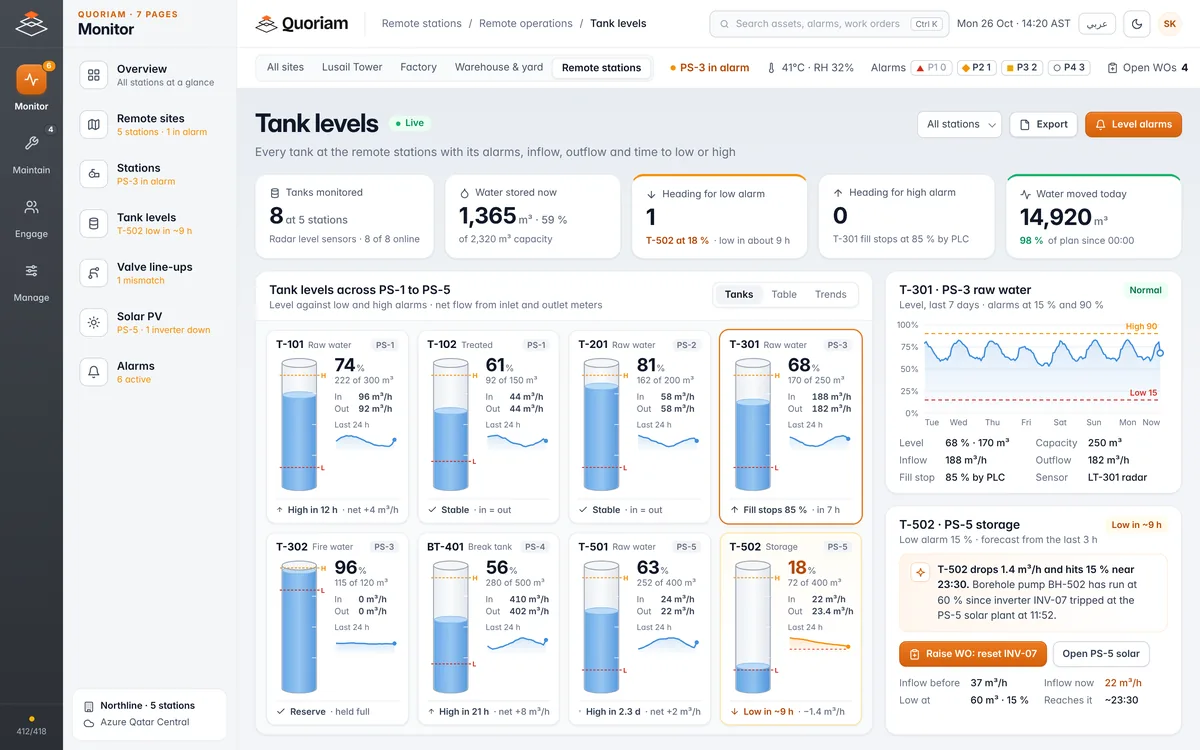
Growing more with less water through 45-degree summers starts with measuring it. On Quoriam, environmental monitoring covers soil, greenhouses and cold stores, and remote monitoring covers the wells, tanks, pumps and solar arrays that supply the water.
What goes wrong.
What farm managers, growers and food producers tell us before we start.
"We irrigate on a timer, whatever the weather."
A fixed schedule waters the same in March as in July, and the same after a cool night as after a hot, dusty day. Some beds get too much, and the far end of the line gets too little.
"The greenhouse cooling stopped on a Friday afternoon."
A cooled greenhouse in summer depends on pads, fans and pumps running all day. When one stops while the farm is quiet, the crop heats up before anyone walks in.
"The produce came out of the cold store soft."
Fresh produce needs temperature and humidity held after harvest. A room that drifts warm or dry overnight, or a door left open at every delivery, costs shelf life nobody can give back.
Solutions for agriculture and food.
Start with water, the greenhouse or the cold store, and add the rest on the same platform.
 Station 2 44 °C, RH 18%
Environmental monitoring
Log temperature, humidity and air quality in cold rooms, warehouses and offices, ready for audit.
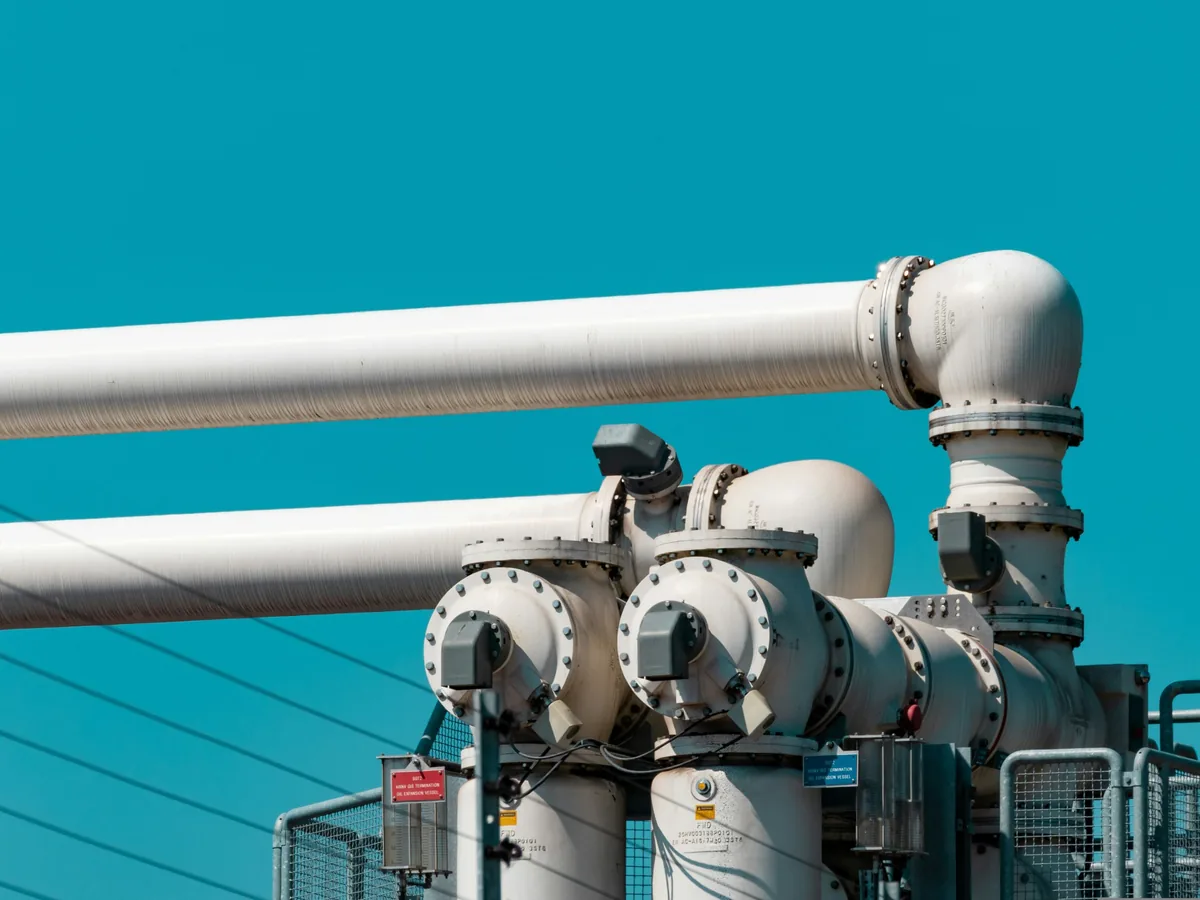 PS-3 Pump 2 running, 4.2 bar
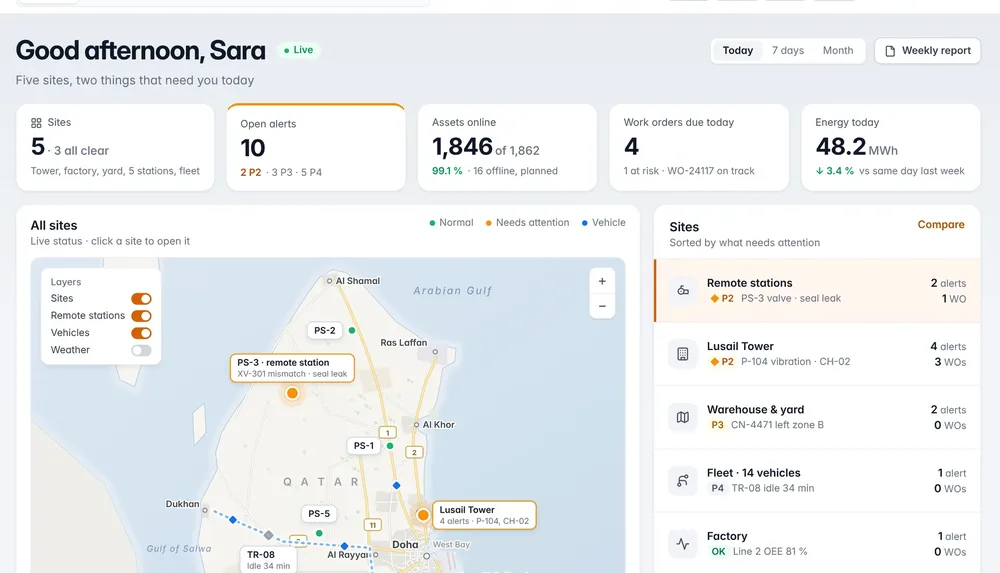
Remote operations monitoring
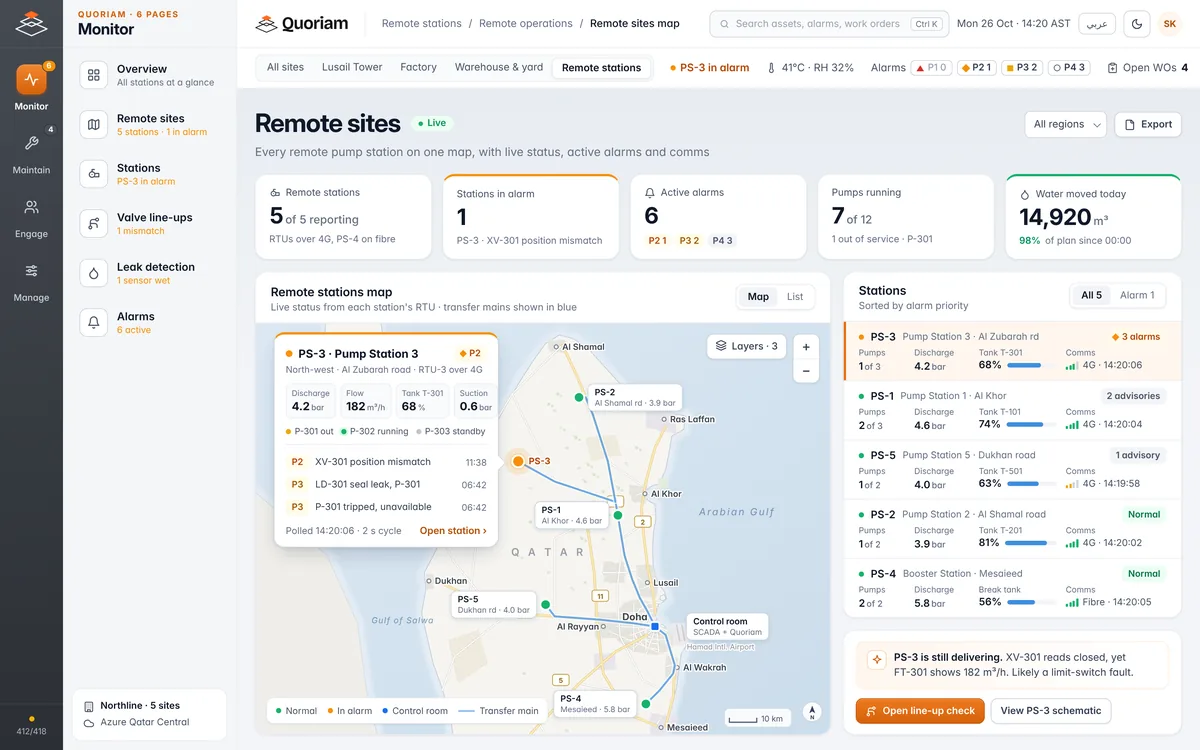
Valves, tanks, pumps and solar arrays across remote sites on one screen, with alarms on any change.
What we measure on a farm.
The readings growers connect first, and what each one catches.
| Where | What we measure | What it catches |
|---|---|---|
| Fields and beds | Soil moisture at root depth, soil temperature | Over- and under-watering, and a blocked or broken drip line |
| Greenhouses | Air temperature and humidity; cooling pads, fans and pumps running or stopped | Cooling failures and humidity out of range |
| Wells and tanks | Tank level, pump run status and flow | A tank heading for empty, or a pump that tripped |
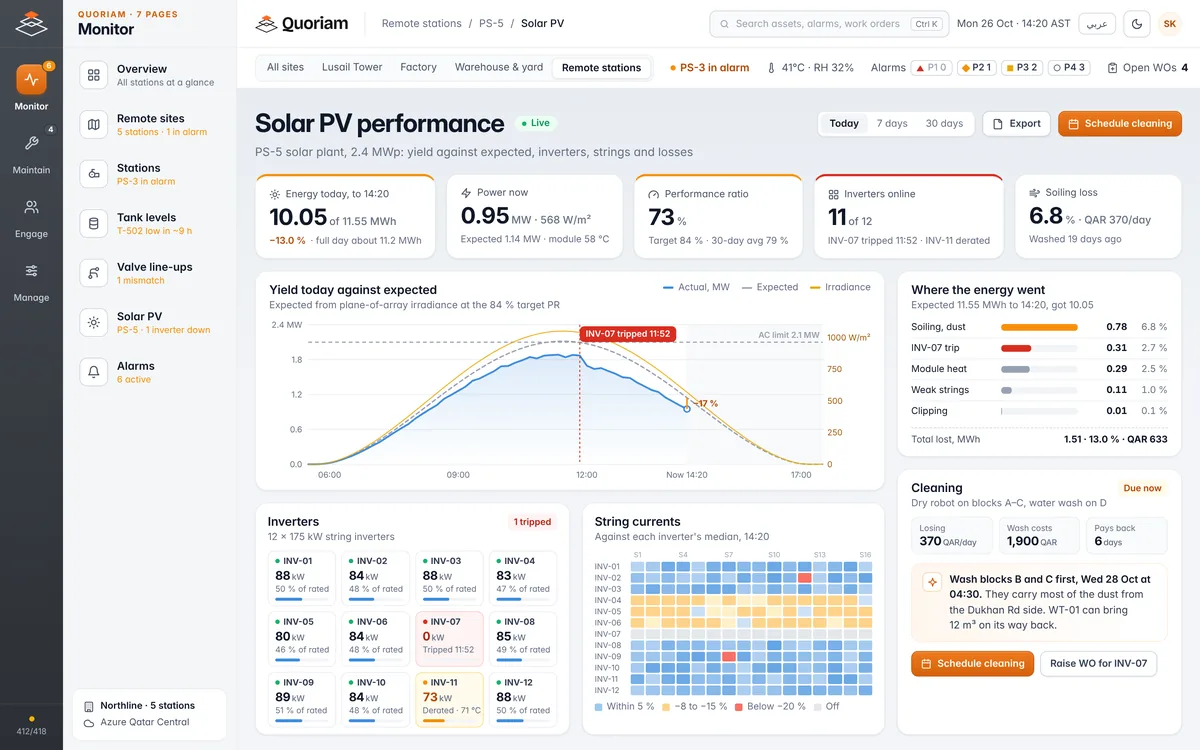
| Solar pumping | Inverter output against what the sunlight says it should be | Dust and tripped inverters cutting the water supply |
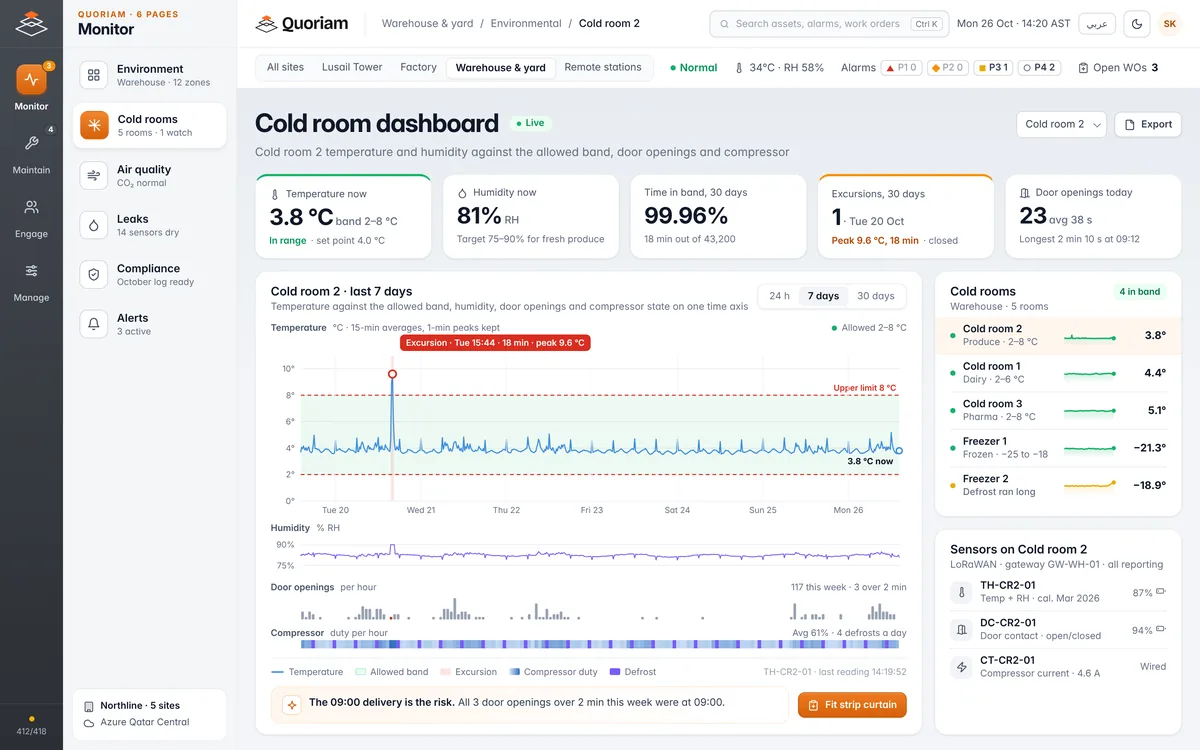
| Cold stores | Temperature, humidity, door openings and compressor current | Excursions after harvest, and doors held open at delivery |
| Refrigerated trucks | Load temperature on the road | A warm load on the way to market |
Where most farms start.
The use cases that save water and protect the harvest first.
- Soil monitoring and smart irrigation
Soil moisture sensors that water landscapes and crops only when they need it.
- Tank level monitoring
Water, diesel and chemical tank levels read remotely, with low-level and leak alarms.
- Cold chain monitoring
Cold rooms and freezers logged every few minutes, with alarms before stock is at risk.
- Refrigerated vehicle monitoring
Load temperature in every reefer truck, with alarms on the road.
Decisions the data makes possible.
Examples of what a reading leads to on a farm or in a food store. Illustrative, not project results.
| What Quoriam sees | The decision | What it saves |
|---|---|---|
| Tank T-502 heading for its low alarm in about 9 hours | Reset the tripped inverter feeding the borehole pump | A dry tank overnight and a missed irrigation |
| Soil in bed 6 still wet 24 hours after the last irrigation | Skip tonight's cycle and check the line for a leak | Water and fertiliser wasted |
| All three long door openings in the produce cold room this week were at the 09:00 delivery | Fit a strip curtain and stage the delivery | Shelf life lost every morning |
| Solar plant output 13% below expected, with one inverter tripped | Reset INV-07 and wash the dustiest blocks first | Pumps running slow on the hottest afternoons |
Quoriam is designed to pay back within six months. How we calculate payback
Quoriam AI in agriculture and food.
The digital reliability engineer follows irrigation, greenhouses and cold storage across the farm.
Digital reliability engineer
It notices soil moisture in one greenhouse zone falling faster than in the zones around it after each irrigation cycle, while the valve reports open. It explains that the pattern points to a blocked line, and drafts the job for the farm team.
An example of how it works. It is illustrative and is not a project result.- The decision it supports
- Inspect the line in that zone today, or change the irrigation schedule.
- The outcome
- The zone is watered properly again before the crop shows stress, and the fix is recorded against the zone.
What your team sees.
The cold store, the solar supply and every remote site on the same platform.
Questions buyers ask.
Something else? Ask us during the free assessment.
What sensors does a smart farm need?
Soil moisture sensors at root depth in each irrigation zone, temperature and humidity sensors in each greenhouse, level sensors on water tanks, current clamps on the pumps, and sensors in each cold room. A LoRaWAN gateway usually covers a farm and sends readings over cellular. The free assessment sizes it zone by zone.
Can Quoriam switch our irrigation on and off?
Quoriam shows when each zone needs water and alerts the farm team when soil is too dry or too wet. Either way, every soil reading is logged by zone, so you can see what each irrigation did.
Does it work on farms with no Wi-Fi?
Yes. Wireless sensors talk to a LoRaWAN gateway on the farm, and the gateway sends readings over the mobile network. We check signal during the assessment. Where there is no mains power at the gateway's spot, a solar-powered gateway is an option.
Will the sensors survive summer in the field?
We specify each sensor for where it goes. Equipment in direct sun runs far hotter than the 45 to 50 °C air, so we check the rated temperature range and the dust and water protection before anything is fitted, and shade enclosures where needed.
Can we monitor cold stores and reefer trucks too?
Yes, on the same platform. Cold rooms are logged against their bands with door and compressor data, and refrigerated vehicle monitoring adds load temperature on the road, so the record runs from the field to the customer, with one set of alarms and one compliance log.
What does it cost?
It depends on the number of zones, greenhouses, tanks and rooms, and how far apart they are. The free three-week assessment ends with a scope and a fixed price. A pilot on one farm or one block comes next.
Find out where your water and your harvest are going.
A free three-week assessment. We walk your fields, greenhouses, tanks and cold stores with your team, then recommend what to measure first.
We take on two assessments a month.Quoriam is designed to pay back within six months. How we calculate payback