



- Home
- Solutions
- Smart metering and sub-metering
- Water metering
Smart Water Metering in Qatar
Smart water meters after the Kahramaa meter, on each riser, floor and tenant, read remotely so you know who used what, where water runs at night and what to recharge.
Last updated
What is a smart water meter?
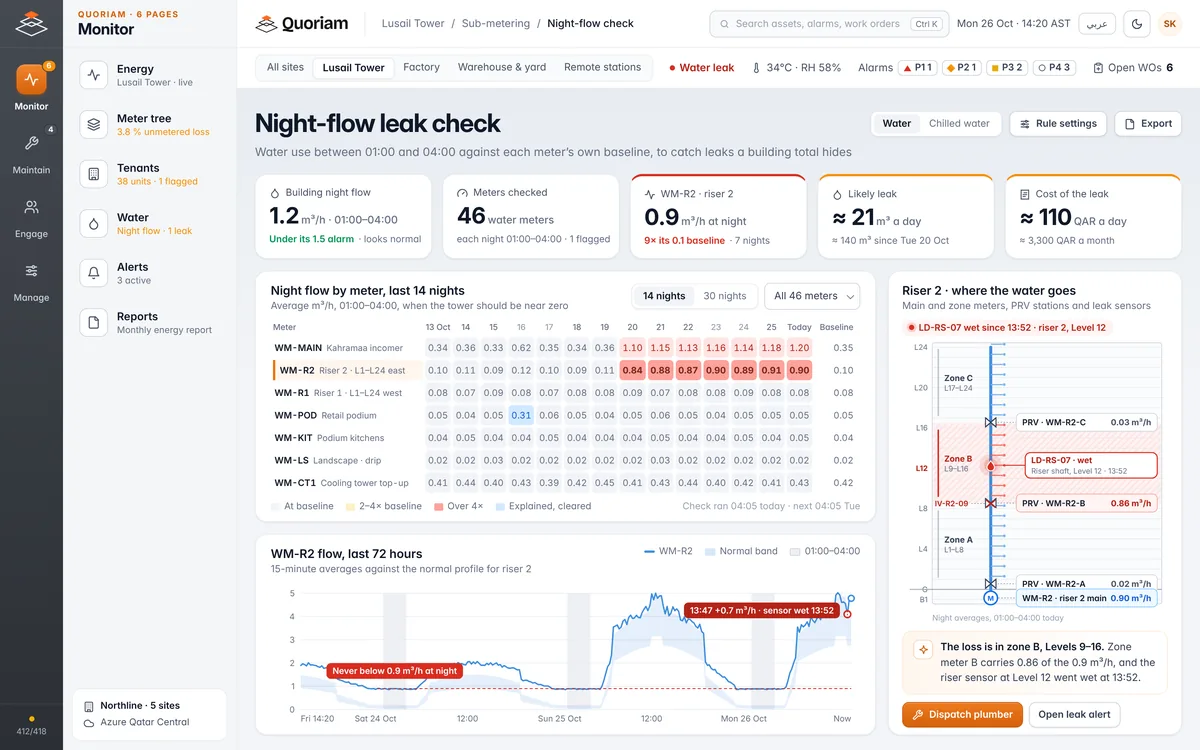
A smart water meter records consumption and sends its readings automatically, so nobody has to walk the risers with a clipboard. Fitted after the Kahramaa meter on each building, riser, floor or unit, smart water meters show who uses what, catch flow that never stops at night and give you readings you can bill from.
Kahramaa is replacing its own meters with smart ones: about 460,000 smart water meters were in place by mid-2025, with the rollout due to finish by the end of 2027 (Smart Water Magazine). That meter tells Kahramaa what your building used. It can't tell you which floor or tenant used it. That is the job of sub-metering.
Two terms come up. AMR, automatic meter reading, collects readings without a site visit. AMI, advanced metering infrastructure, adds frequent interval data and two-way communication. For a building, what matters is readings every 15 minutes or so, since that is what reveals night flow and leaks.
Where the meters go, and what each one settles.
A water meter tree for a typical tower, from the inlet down.
| Meter | What it measures | What it settles |
|---|---|---|
| Building inlet after the Kahramaa meter | Total water, every 15 minutes | Whether the sub-meters add up to what Kahramaa bills |
| Riser meters | Each riser, day and night | Night flow by riser, which narrows a leak to a few floors |
| Floor or unit meters | Each tenant or apartment | Water recharges from real readings |
| Cooling tower make-up | Water topped up to the towers | Plant water use, and a stuck float valve |
| Landscape irrigation | Water by zone | Over-watering and split drip lines |
| Kitchens and retail podium | Food and beverage units | High users recharged fairly |
How accurate a water meter has to be.
Water meters are rated by four flows. The error limit is tighter at normal flow and looser near the bottom of the range, which is where small leaks live.
| Flow zone | From | To | Error, water up to 30 °C | Error, water above 30 °C |
|---|---|---|---|---|
| Lower zone | Q1, minimum flow | Q2, transition flow | ±5% | ±5% |
| Upper zone | Q2, transition flow | Q4, overload flow | ±2% | ±3% |
Q3 is the permanent flow the meter is sized for; Q3/Q1 is at least 10, Q2/Q1 is 1.6 and Q4/Q3 is 1.25. Source: Measuring Instruments Directive, Annex MI-001. A higher Q3/Q1 ratio means the meter still registers smaller flows, so for night-flow checks we choose meters with a high ratio, sized to the flow the building actually draws.
How the readings reach Quoriam.
Most meters already have one of these outputs. We read what you have and add what's missing.
| Output | How it works | Best for |
|---|---|---|
| Pulse | A contact closes every set number of litres; a gateway counts the pulses | Older meters and simple installs |
| Wired M-Bus | A two-wire bus to EN 13757 that carries data and can power the meter; one master reads many meters | Risers and meter rooms with many meters |
| Wireless M-Bus | The radio version of M-Bus, EN 13757-4 | Apartments where new cable is hard to run |
| LoRaWAN | A battery radio sends readings to a nearby gateway | Spread-out sites, landscapes and compounds |
| Modbus | RS485 or TCP from larger electronic meters | Building inlets and plant meters |
How it works.
Survey
We list every water meter, its size, its output and whether it is read today, and mark where the tree has gaps.
Connect
Existing meters are read through their pulse, M-Bus or Modbus output. New meters go where nothing is measured.
Build the tree
Each meter is placed under its riser, floor and tenant, so the sub-meters are checked against the inlet every day.
Watch and bill
Night flow, missing readings and units far above last month raise alerts. Monthly readings go to tenant billing.
System view
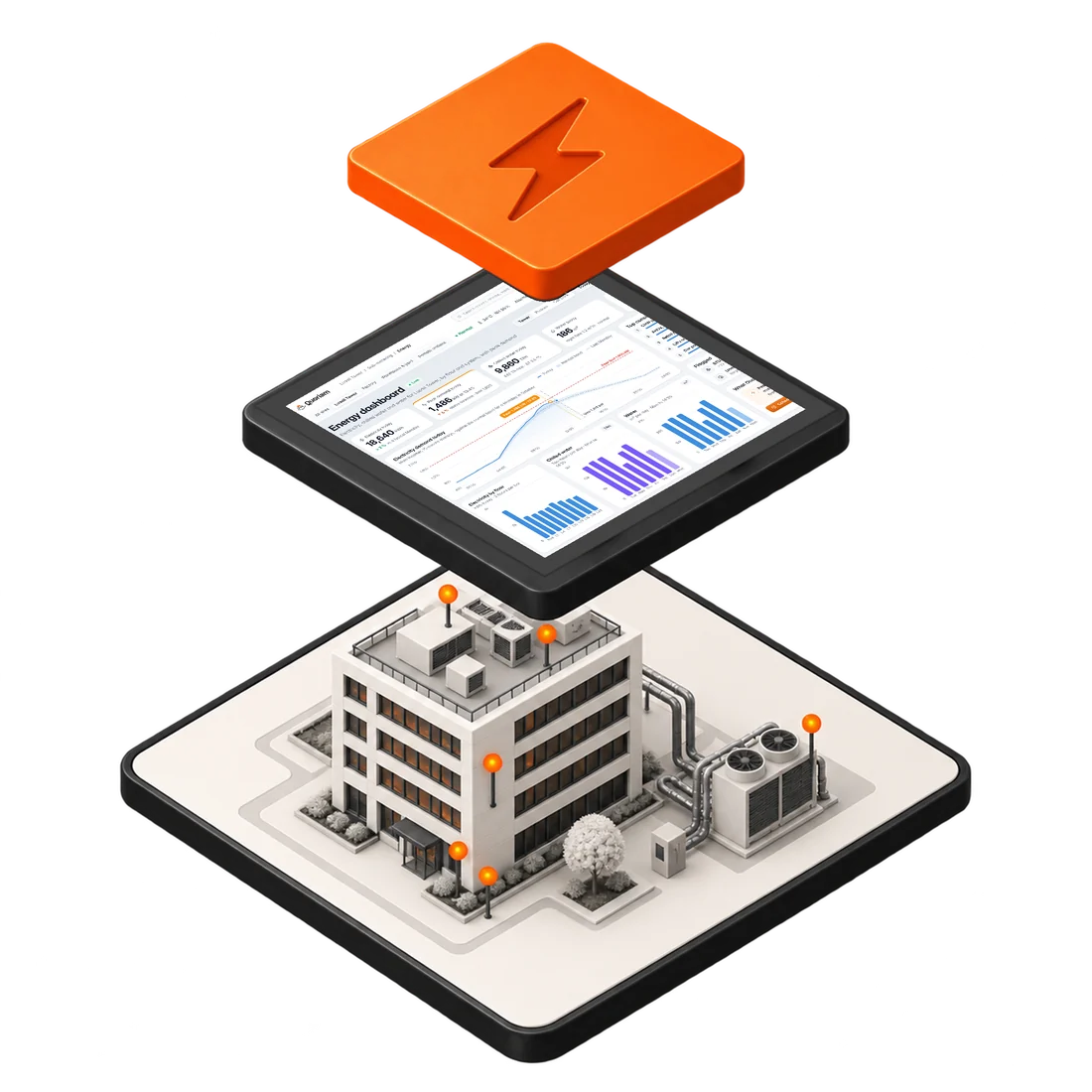
For IT, OT and security reviewers: where the data goes, and how.
- At the metersWater meters by inlet, riser, floor and unit, existing and new
- In the riser or meter roomM-Bus master, pulse inputs or LoRaWAN gateway
- NetworkSite LAN or cellular, encrypted and kept apart from the control network
- Quoriam platformOn your premises or cloud hosted in Qatar
- Your team and systemsAlerts, tenant statements and exports to finance
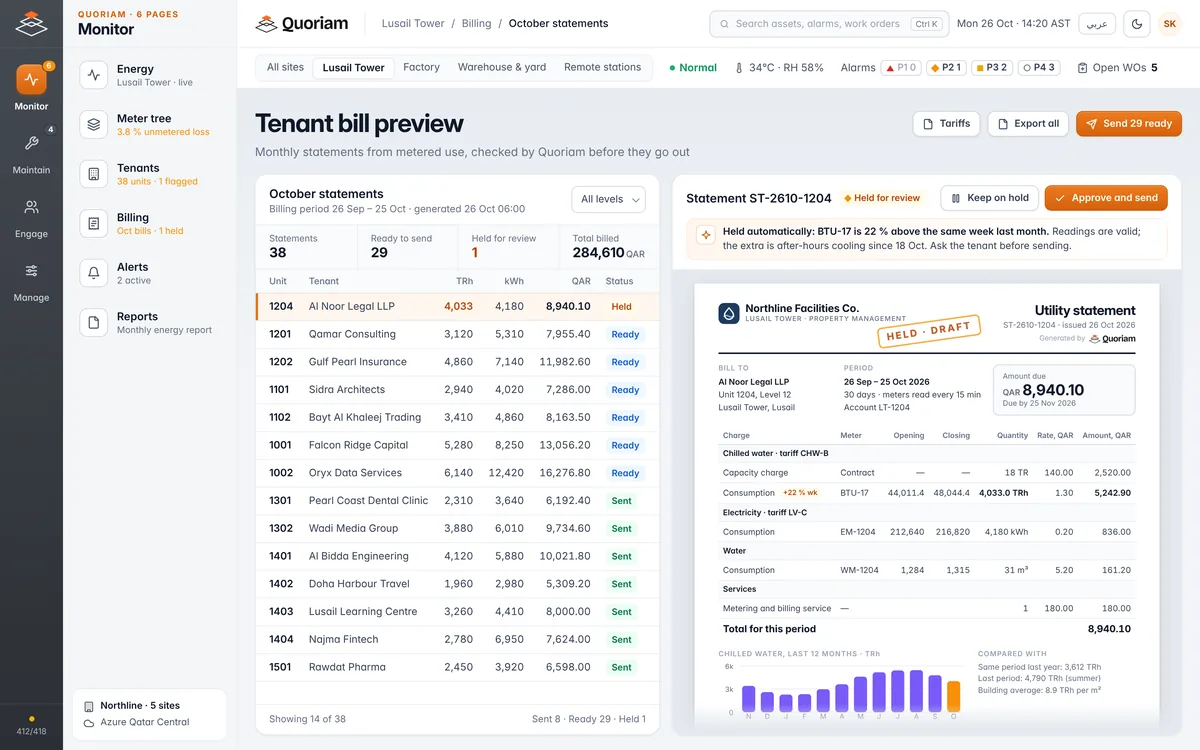
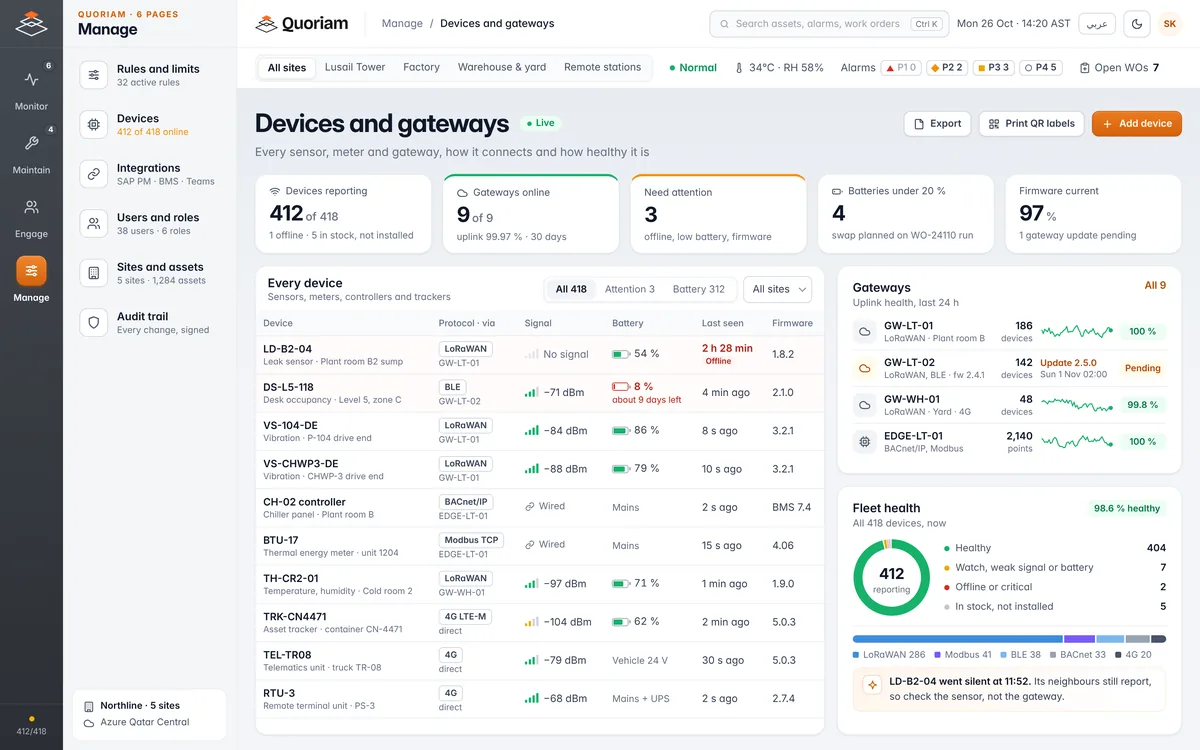
What your team sees.
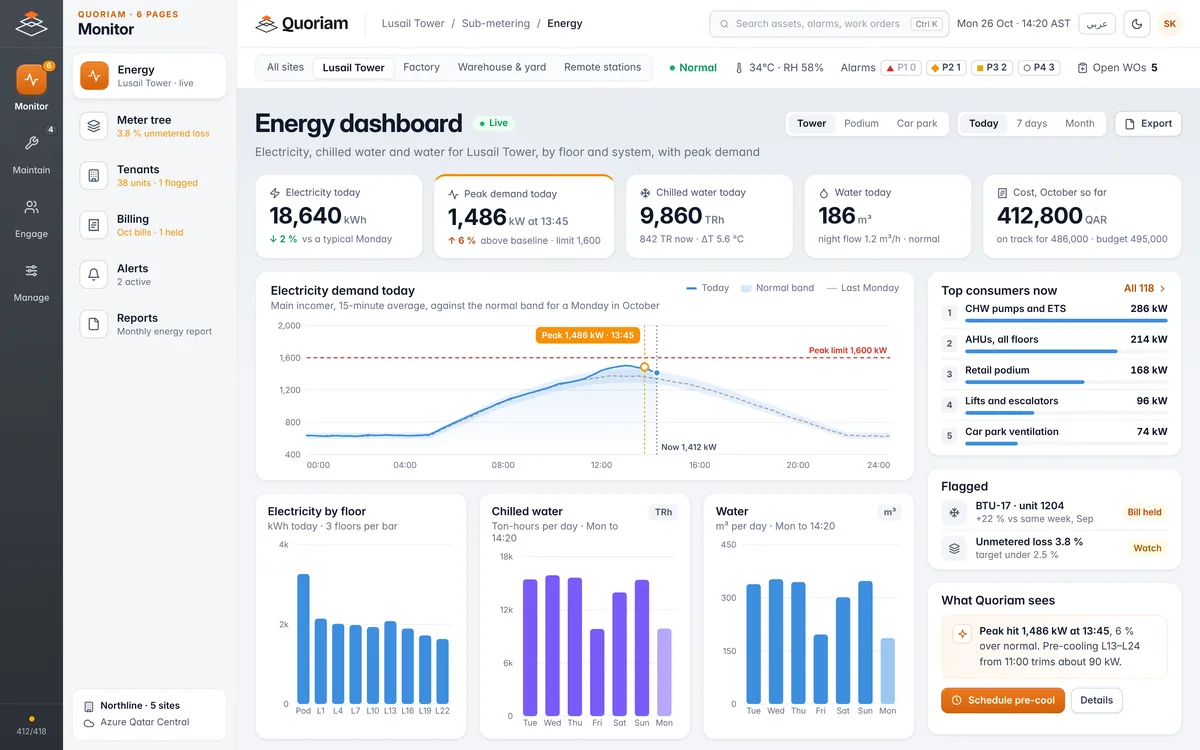
Every water meter, whether it is reporting and what it means for the bill.
Where it's used in Qatar.
Wherever one Kahramaa bill is shared by many users.
Office and residential towers
A meter per unit or floor, and one per riser for the night check.
Facilities and smart buildingsCompounds and master-planned districts
Villas and blocks on one supply, where the bill is split today.
Utilities and district coolingLandscapes and irrigation
Water by zone, with soil moisture deciding when to water.
Soil monitoring and smart irrigationFactories
Process water, cooling towers and washdown by line.
Manufacturing
Questions buyers ask.
Something else? Ask us during the free assessment.
What is the difference between a smart water meter and a normal one?
A normal meter has to be read by hand, usually once a month. A smart water meter sends its readings automatically, often every 15 minutes, so you see use by hour, catch flow at night and bill without a meter round. Many existing meters can be made smart by reading their pulse or M-Bus output.
How do smart water meters send their readings?
Through a pulse output, wired M-Bus, wireless M-Bus, LoRaWAN or Modbus, to a gateway or M-Bus master in the riser or meter room. The gateway sends the readings to Quoriam over the site network or cellular. Which one fits depends on the meters you have and how hard it is to run cable.
Can you read our existing water meters?
Usually. Meters with a pulse, M-Bus or Modbus output are read directly. Meters with no output are replaced or fitted with a reader where the make allows it. We check every meter in the assessment before we quote.
How many water meters does a building need?
One at the inlet, one per riser and one per unit you bill separately, plus meters on large users such as cooling tower make-up, kitchens and irrigation. Riser meters matter most for leaks; unit meters matter most for billing. The free assessment counts it for your building.
Do smart meters catch small leaks?
Down to the meter's minimum flow, Q1. A meter with a high Q3/Q1 ratio registers smaller flows, and the night-flow check compares each meter with its own normal, so a slow leak shows up as flow that never drops to zero. For water that never reaches a meter, add leak sensors.
What does it cost?
It depends on how many meters you have and how many need replacing or connecting. The free three-week assessment ends with a meter survey, a scope and a fixed price.
Related.
Water metering is part of sub-metering on the Quoriam platform.
- Smart metering and sub-metering
Meter electricity, water and chilled water by tenant or line, and settle every bill on evidence.
- Water leak detection
Leak sensors and night-flow checks that catch a burst before the flood or the bill.
- Tank level monitoring
Water, diesel and chemical tank levels read remotely, with low-level and leak alarms.
Find out where your water goes.
A free three-week assessment. We survey your water meters and readings, then show you the gaps in the tree and what they cost.
We take on two assessments a month.Quoriam is designed to pay back within six months. How we calculate payback