





- Home
- Solutions
- Smart metering and sub-metering
- Water leak detection
Water Leak Detection in Qatar
Leak sensors where water lands first, and a night-flow check on every water meter, so a burst riser or a running cistern is caught before the flood or the Kahramaa bill.
Last updated
What is a water leak detection system?
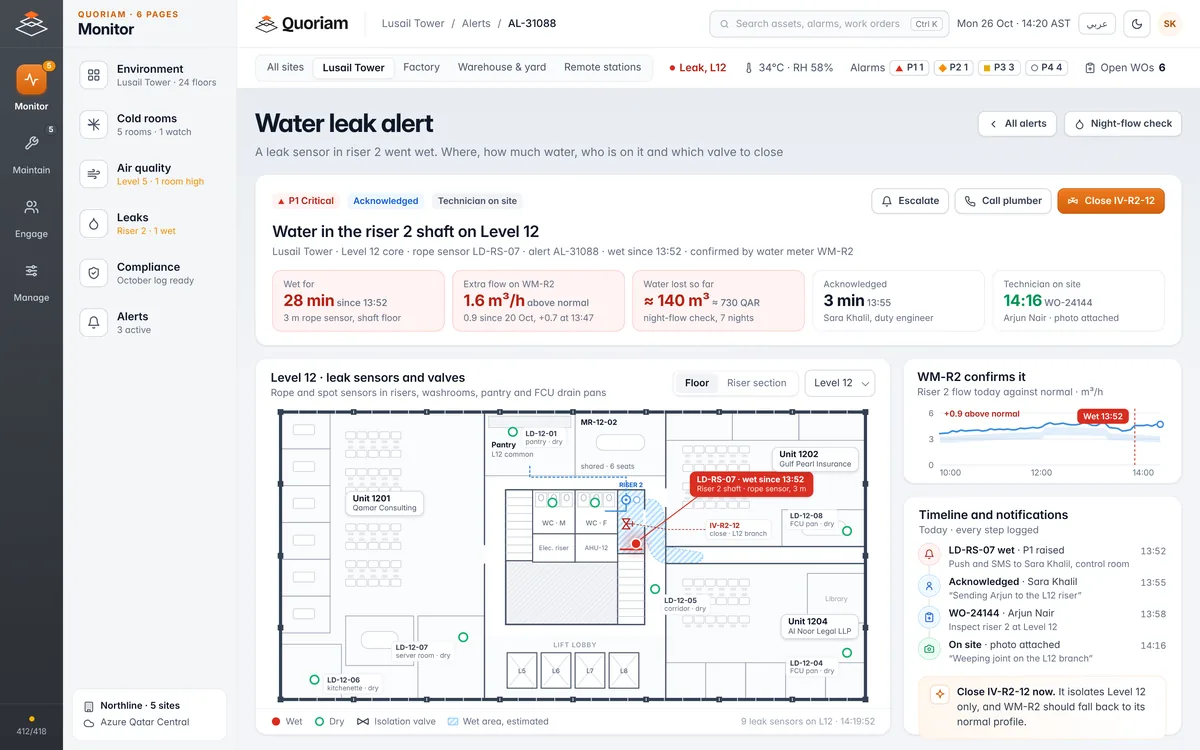
A water leak detection system finds escaping water in two ways. Rope and spot sensors raise an alarm the moment water reaches a riser floor, drain pan or plant room. Water meters are checked every night, when use should be near zero, so flow that never stops points to a hidden leak and the zone it is in.
A sensor only knows about water that reaches it, such as a weeping riser joint or an overflowing condensate tray. A meter sees water that never lands where you look: a cistern running all night, a split drip line under the landscape. A building needs both, on one screen.
The night check works because water use should drop close to zero in the small hours. Utilities use the same idea on their networks (Esri). The meters come from your sub-metering; if you have none yet, start with smart water metering.
What it catches.
Six common leaks, what catches each one and when you hear about it.
| Leak | What catches it | When you hear about it |
|---|---|---|
| Weeping joint in a riser shaft | Rope sensor on the shaft floor, confirmed by the riser meter | As soon as water reaches the cable |
| Blocked FCU or AHU condensate drain | Spot sensor in the drain pan | Before the ceiling tile stains or the tenant calls |
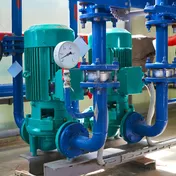
| Pump seal or valve leak in a plant room | Spot sensor on the plinth or in the sump | While it's still a drip |
| Cistern or tap left running | Floor or riser meter that never drops to its night baseline | The next morning, after one night's check |
| Split irrigation line or buried pipe | Landscape or podium meter flowing outside its watering schedule | After one night, before the ground goes soft |
| Roof or ground tank overflowing | Spot sensor at the overflow, or the tank's level reading | At the first spill, with the level trend attached |
What a small leak costs over a month.
A leak that never stops adds up fast. Volume is litres per second × 86,400 seconds a day.
| Continuous leak | Lost a day | Lost in 30 days | Cost in 30 days |
|---|---|---|---|
| 0.01 L/s (36 L/h) | 0.86 m³ | 26 m³ | QAR 156 to 223 |
| 0.05 L/s (180 L/h) | 4.3 m³ | 130 m³ | QAR 778 to 1,115 |
| 0.1 L/s (360 L/h) | 8.6 m³ | 259 m³ | QAR 1,555 to 2,229 |
| 0.25 L/s (900 L/h) | 21.6 m³ | 648 m³ | QAR 3,888 to 5,573 |
Checked 18 November 2026: Kahramaa's official tariff page, Commercial category, lists QAR 6.00/m³ for the first 50 m³ and QAR 8.60/m³ above 50 m³. The range multiplies unrounded leak volume by each rate, rounded to the nearest riyal; it is not a bill calculation. Actual extra cost depends on existing consumption and account category. Water damage is extra.
How it works.
Fit the sensors
Rope sensors go on riser shaft floors and along plant room pipework. Spot sensors go where water collects: drain pans, pump plinths, sumps and tank overflows. Battery sensors report to a nearby gateway.
Learn each meter's night
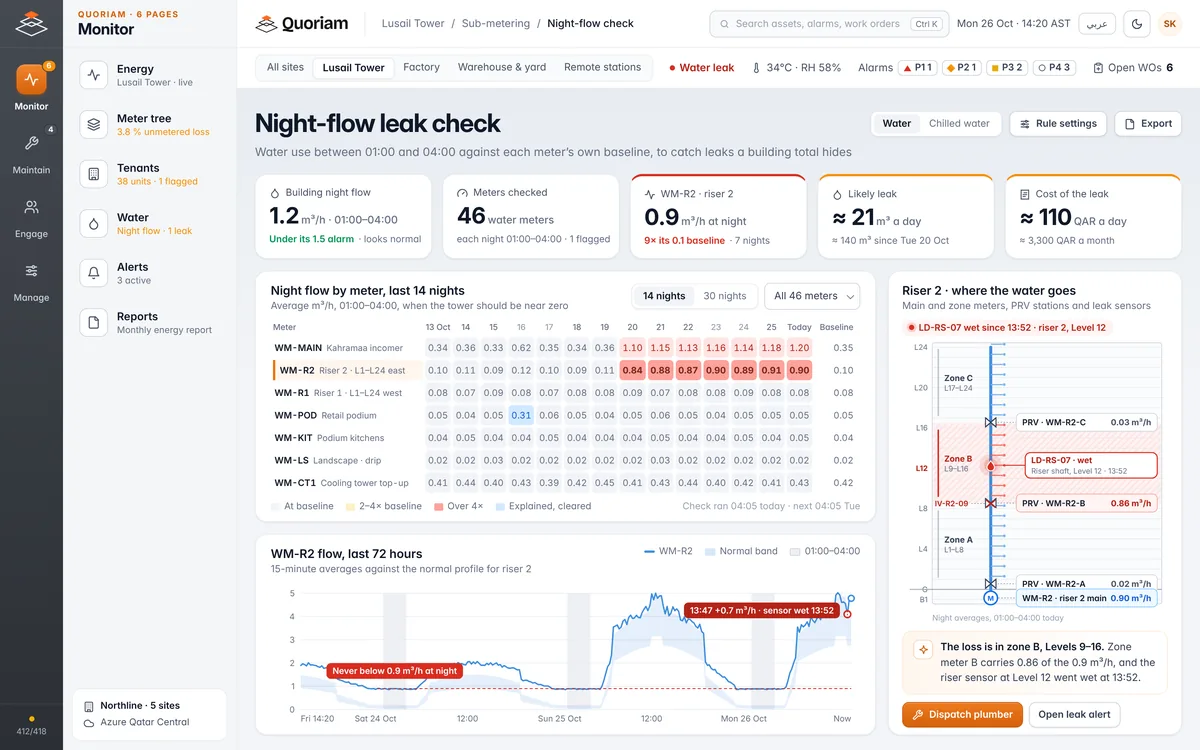
Quoriam learns each water meter's normal flow between 01:00 and 04:00. A cooling tower top-up runs all night and a kitchen should sit near zero, so each meter is judged against its own baseline.
Alert and isolate
A wet sensor raises a critical alert at once, with its place on the floor plan and the nearest isolation valve. High night flow raises a lower-priority alert in the morning. Your technician closes the valve by hand, or closes a motorised valve from the alert.
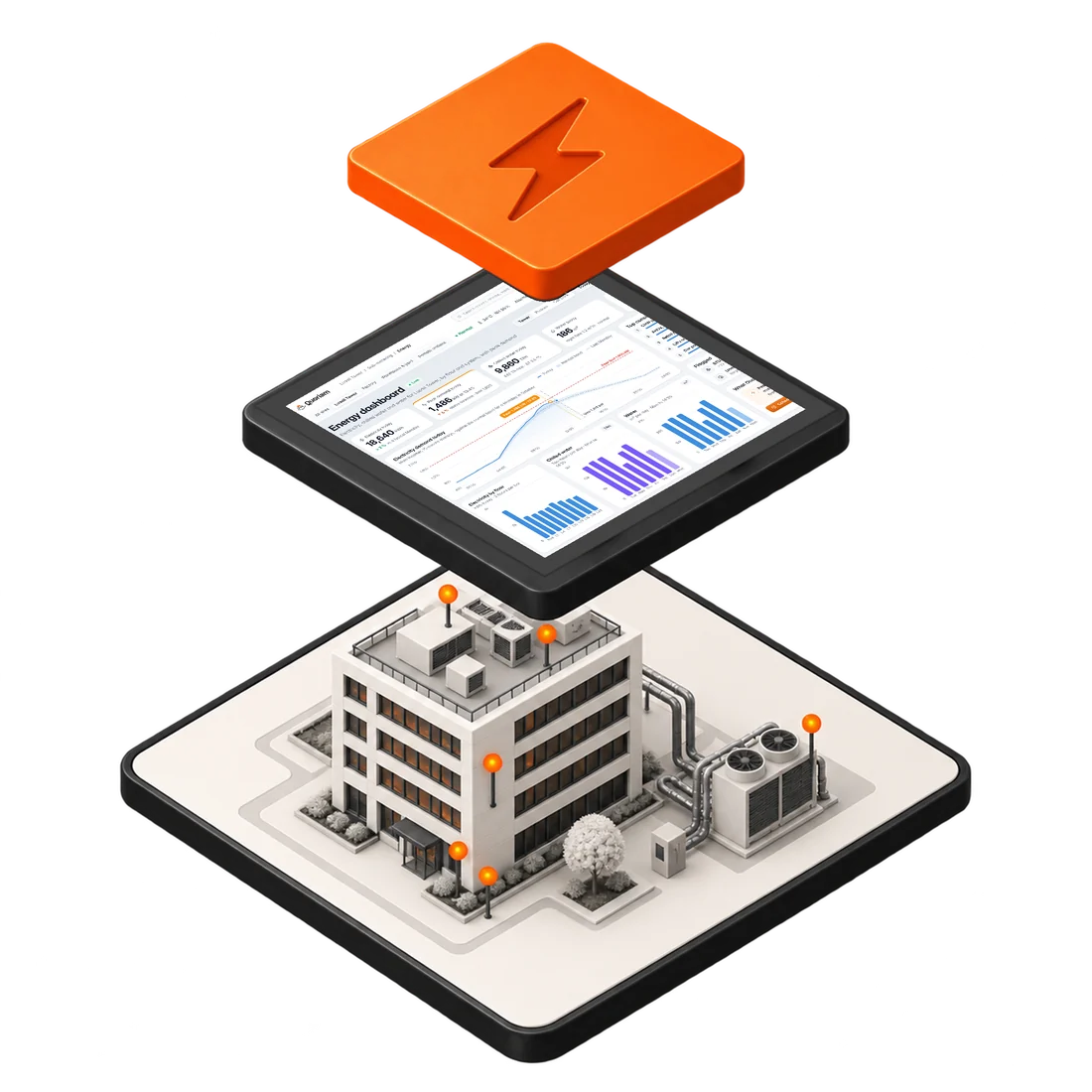
System view
For IT, OT and security reviewers: where the data goes, and how.
- In the buildingRope and spot leak sensors; water meters by riser, floor and system
- On the floor or in the plant roomGateway for the leak sensors; M-Bus master or pulse inputs for the meters
- NetworkSite LAN or cellular, encrypted and kept apart from the control network
- Quoriam platformOn your premises or cloud hosted in Qatar
- Your team and systemsApp, SMS and email alerts with escalation; work orders to your CMMS
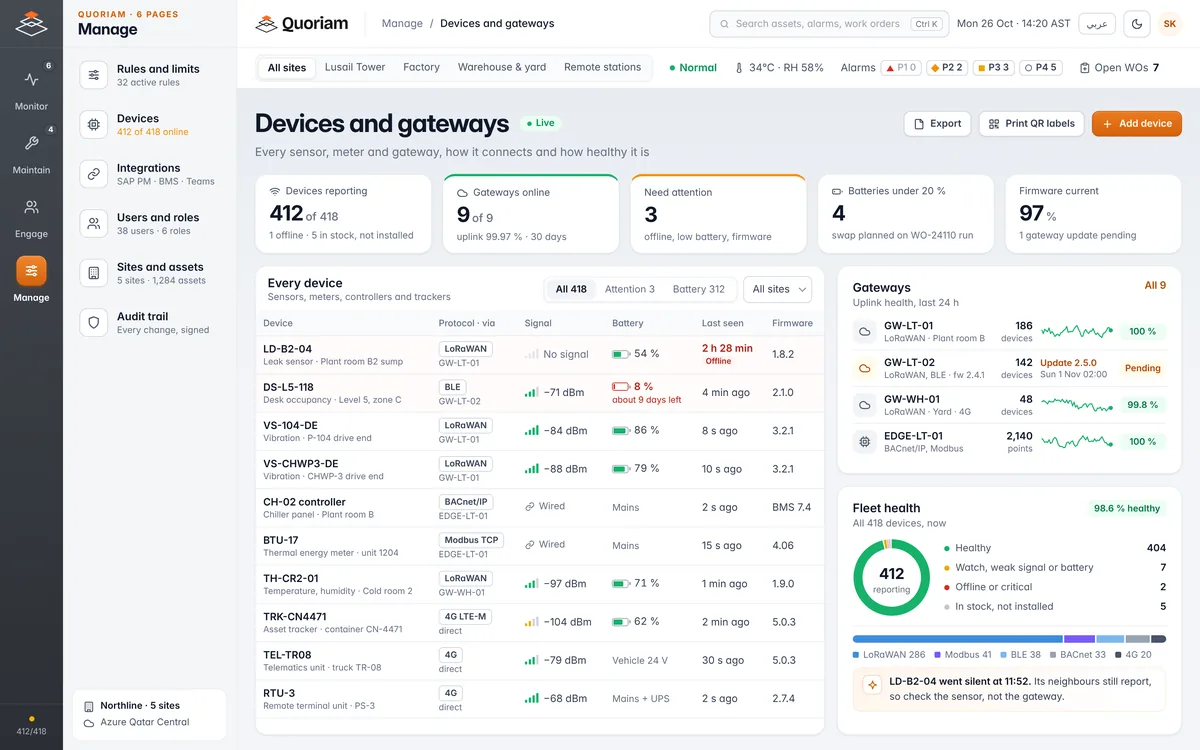
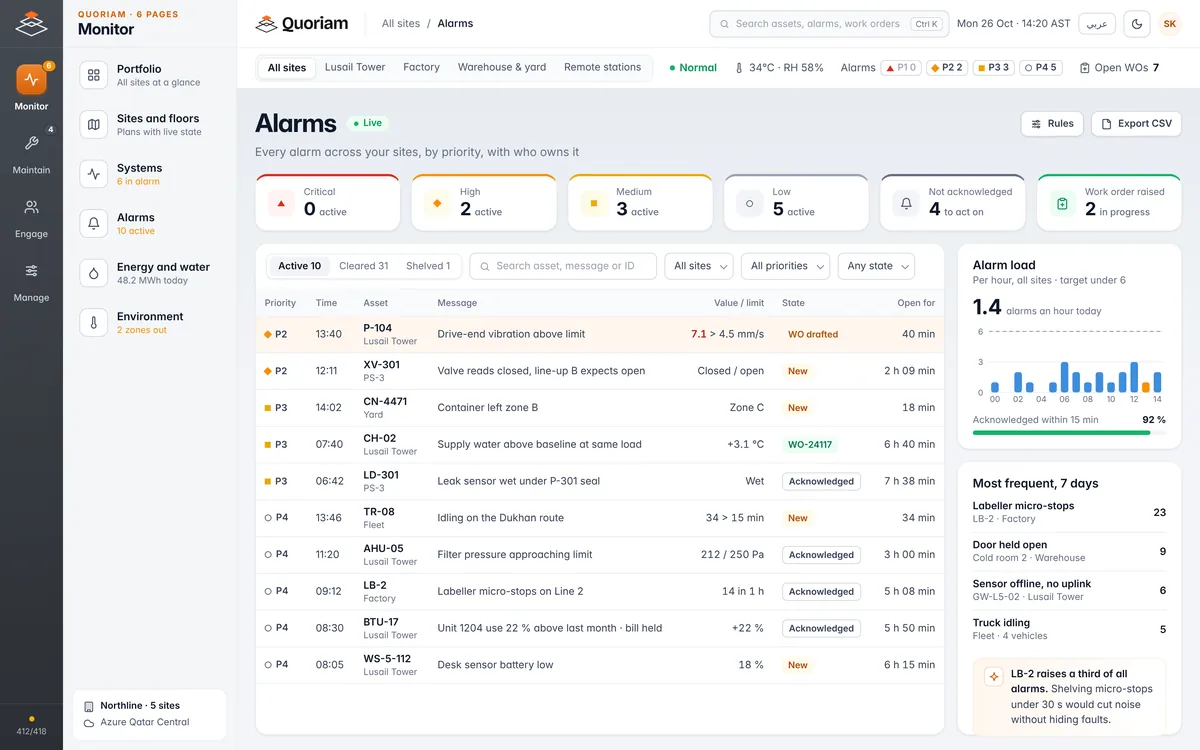
What your team sees.
Where the water is, how much has gone and who is on it.
Where it's used in Qatar.
Anywhere water can run for hours before anyone sees it.
Office and residential towers
Riser shafts, ceiling voids and FCU drain pans, where a leak finds the tenant below first.
Facilities and smart buildingsDistrict cooling plant
Energy transfer stations, chilled water pump rooms and cooling tower make-up lines.
Utilities and district coolingPump stations and tanks
Unmanned sites where a seal leak or an overflow can run for days between rounds.
Tank level monitoringWarehouses and data rooms
Under raised floors and below roof drains, where water meets stock or equipment.
Logistics and warehousing
Questions buyers ask.
Something else? Ask us during the free assessment.
How does a water leak detection system work?
It combines leak sensors and water meters. Rope and spot sensors alert the moment they get wet. Meters are checked every night between 01:00 and 04:00, and a meter that stays above its own night baseline points to a leak nobody can see. The alert names the sensor or zone, and the valve to close.
Rope or spot leak sensors: which do we need?
Both, in different places. A spot sensor alarms when water reaches its two probes, so it suits drain pans, sumps and tank overflows. A rope sensor detects water anywhere along its cable, so it suits riser floors, raised floors and pipe runs where the leak could start anywhere (Milesight).
How many leak sensors does a building need?
One per place water can collect: each riser shaft floor, plant room, critical drain pan and tank overflow. A tower often starts with the risers and plant rooms, then adds drain pans on floors with sensitive tenants. The free assessment walks the building and gives you the count and price.
What is night-flow analysis?
It compares each water meter's flow in the quietest hours with that meter's own normal. Few people use water between 01:00 and 04:00, so flow that stays high for several nights is usually a leak. Checking riser and zone meters separately narrows it to a few floors.
Can it shut off the water automatically?
The alert names the isolation valve and your technician closes it. Where the valve is motorised, it can be closed from the alert, or automatically on a confirmed leak. Automatic shut-off needs care in towers, because the wrong valve cuts water to floors with no leak.
Can it use our existing water meters and BMS?
Usually. Water meters with a pulse or M-Bus output can be read directly, and leak sensors already wired to the BMS can be read from it over BACnet or Modbus, read-only. We check every meter and sensor in the assessment before we quote.
What does it cost?
It depends on how many sensors and meters you need and what you already have. The free three-week assessment ends with a sensor plan and a fixed price.
Related.
Water leak detection is part of sub-metering on the Quoriam platform.
- Smart metering and sub-metering
Meter electricity, water and chilled water by tenant or line, and settle every bill on evidence.
- Water metering
Smart water meters read remotely, with consumption by building, floor or unit.
- Tank level monitoring
Water, diesel and chemical tank levels read remotely, with low-level and leak alarms.
Find the leak you're already paying for.
A free three-week assessment. We review your water meters and readings, then show you where sensors belong.
We take on two assessments a month.Quoriam is designed to pay back within six months. How we calculate payback