




- Home
- Solutions
- Smart metering and sub-metering
- BTU and chilled water metering
BTU Meters in Qatar
A BTU meter on every tenant and at the energy transfer station, read remotely and checked every day, so each district cooling bill rests on readings you can show.
Last updated
What is a BTU meter?
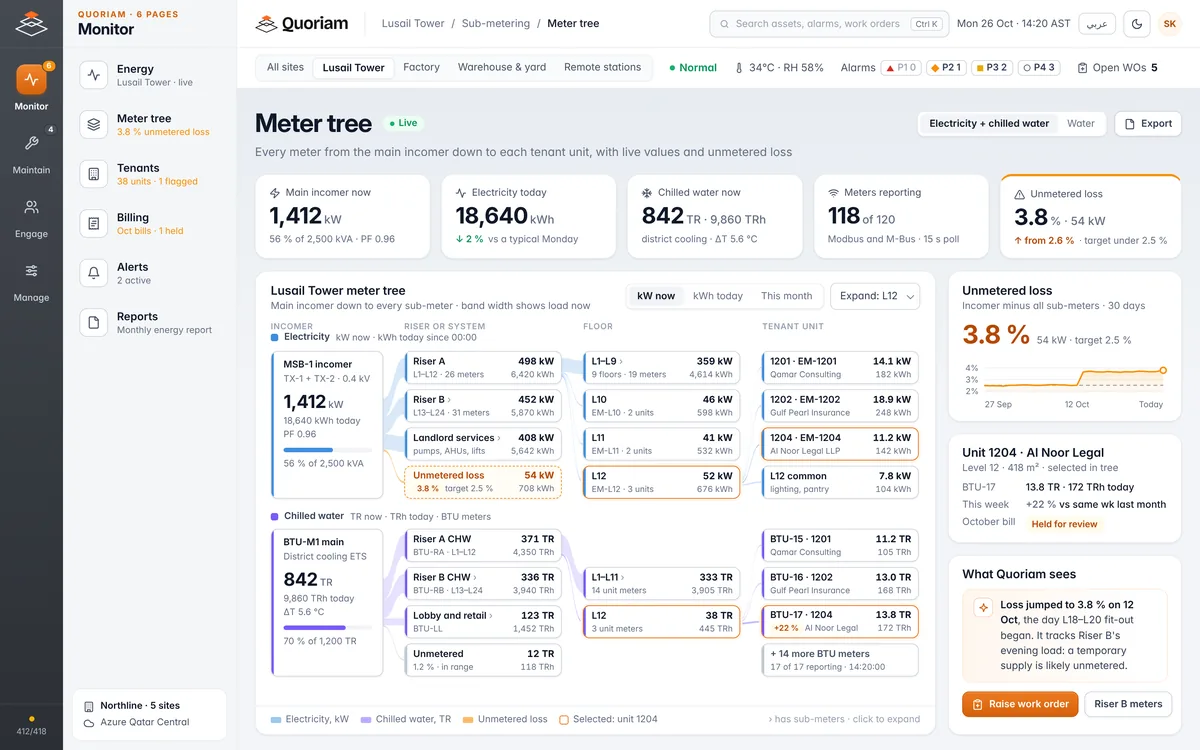
A BTU meter measures the cooling energy delivered in chilled water. A flow sensor counts the water passing, a matched pair of temperature sensors measures how much it warmed between supply and return, and a calculator turns the two into kWh or ton-hours. District cooling bills in Qatar are built on its readings.
It is also called a cooling meter or thermal energy meter. Our sub-metering page shows the BTU formula with a worked example. This page covers what makes the reading right or wrong.
District cooling in Qatar is regulated by Kahramaa under Law No. 19 of 2024. The law requires licensees to install meters in the energy transfer station room, and Kahramaa handles complaints and disputes between licensees, customers and consumers (Kahramaa). In Lusail, Marafeq's guideline has the sub-developer supply and install the tenant sub-meters, and sets what they must be.
No tenant meter
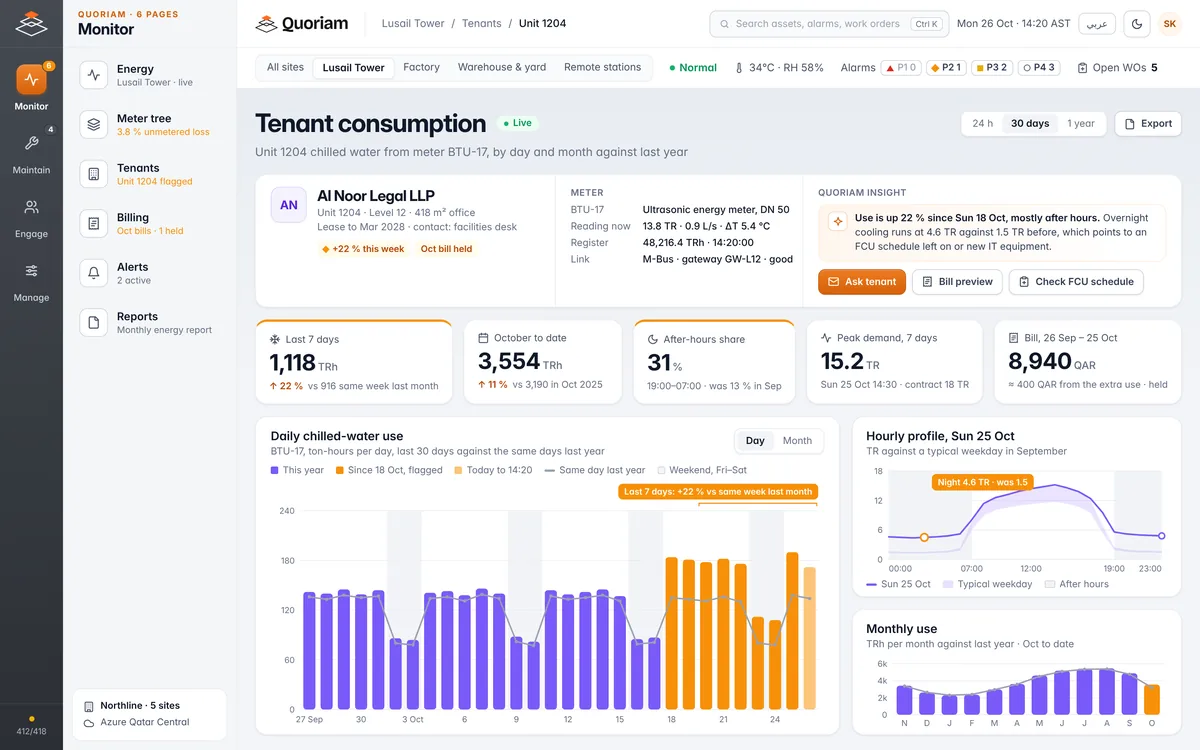
The ETS bill is shared by floor area. Nobody can show a tenant what they used.
Mechanical flow sensor
A turbine or impeller. Lower price, but it wears, loses accuracy at low flow and suffers in dirty water (Sanobaltic).
Ultrasonic flow sensor
No moving parts, so nothing to wear, and accurate at low and changing flow. Lusail's guideline asks for ultrasonic.
What goes wrong with BTU meters, and how it shows.
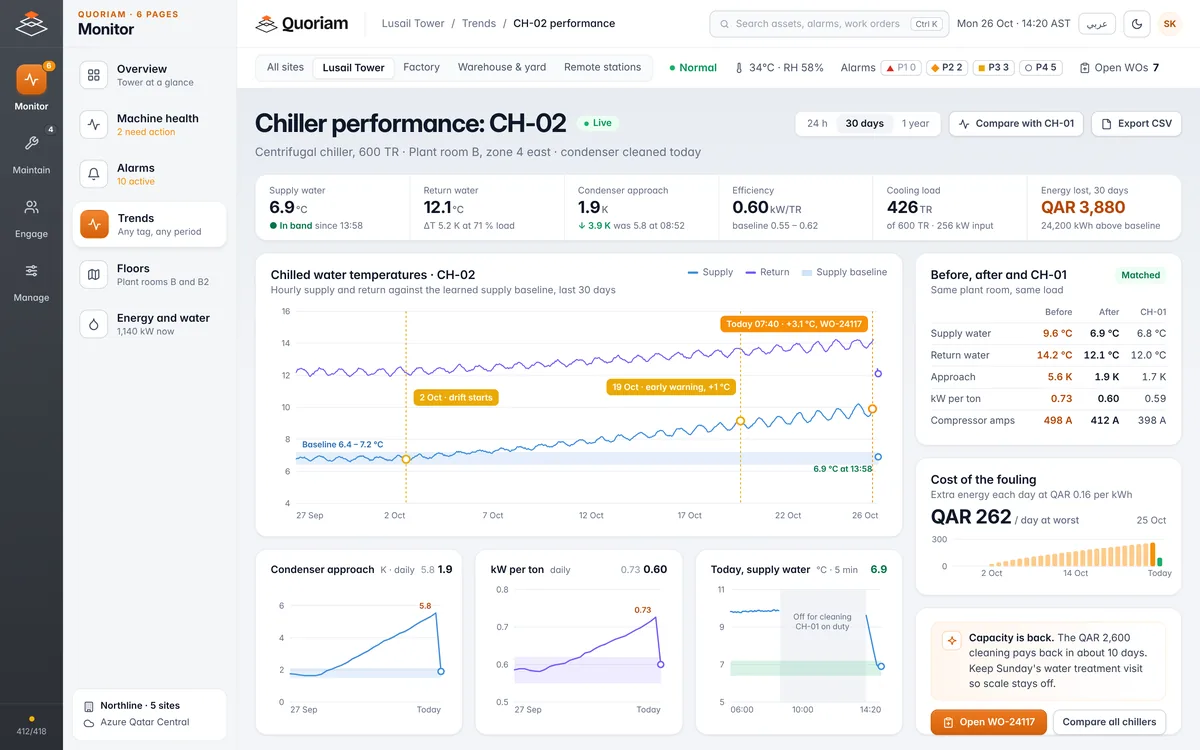
Most cooling bill disputes trace back to one of these. Each leaves a mark in the 15-minute data.
| Problem | What the data shows | What it does to the bill |
|---|---|---|
| Supply and return sensors swapped | ΔT near zero or negative while flow looks normal | Little or no energy registered |
| A sensor out of its thermowell | ΔT smaller than similar units at the same load | Under-billing every hour it lasts |
| Flow sensor sized too large | Flow sits mostly at the bottom of the meter's range | Wider error, because flow sensor error grows at low flow |
| Air or dirt in the pipe | Error flags and flow dropping out, then back | Gaps, filled by estimates the tenant can dispute |
| Meter stops reporting | No 15-minute readings from that meter | Estimated bills until someone notices |
| Tenant meters not adding up | Sum of tenant meters drifts from the main at the ETS | Cooling nobody pays for, or a meter reading high |
How accurate a BTU meter has to be.
EN 1434 sets an error limit for each part of the meter, and the limits add up. The flow part widens as flow drops, and the temperature pair and calculator parts widen as ΔT gets smaller, which is why a building running at low ΔT bills less precisely.
| Part of the meter | Error limit | At ΔT 5.5 °C, full flow | At ΔT 3 °C, a tenth of full flow |
|---|---|---|---|
| Flow sensor class 2 | ±(2 + 0.02 × qp/q), at most 5 | ±2.02 | ±2.20 |
| Temperature sensor pair | ±(0.5 + 3 × Δθmin/ΔT) | ±2.14 | ±3.50 |
| Calculator | ±(0.5 + Δθmin/ΔT) | ±1.05 | ±1.50 |
| Whole meter | Sum of the three | ±5.20 | ±7.20 |
qp is the meter's permanent flow and q the actual flow. The whole-meter total is summed before rounding. Flow and sensor pair limits from Kamstrup on EN 1434; the calculator limit and the sum from the Measuring Instruments Directive, Annex MI-004. Lusail's sub-meter guideline asks for EN 1434 class 2, Pt500 sensor pairs in thermowells, and supply and return sensors that can be swapped to check accuracy.
How it works on Quoriam.
Survey
We check every BTU meter: make, size against the real flow, accuracy class, sensor pockets and output. Undersized, oversized or mechanical meters go on the replacement list.
Connect
Meters are read over M-Bus or Modbus through an M-Bus master or gateway per riser, every 15 minutes.
Check every day
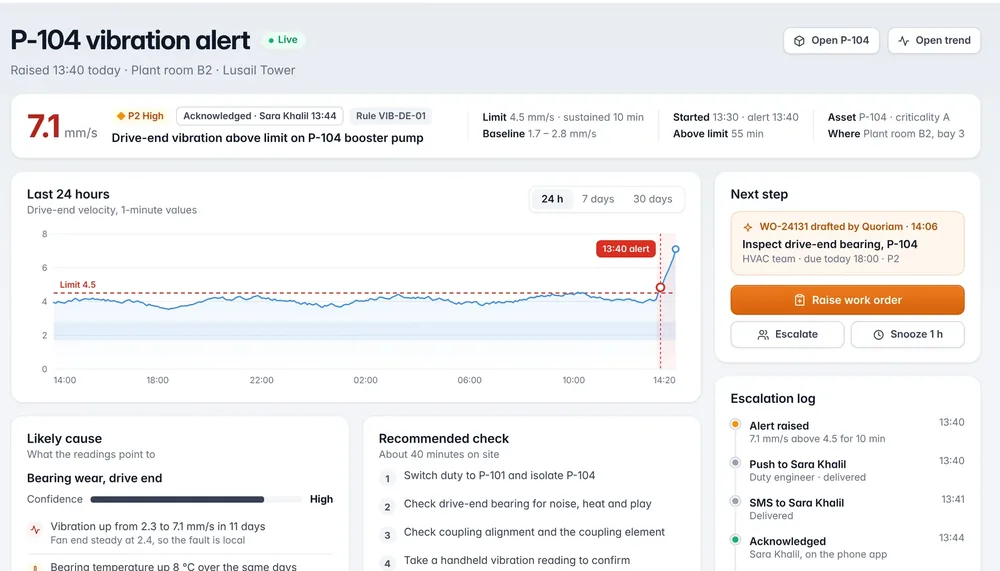
Quoriam compares each tenant with the main, watches ΔT and flow for the faults above and flags any gap in the readings before the billing run.
Bill
Readings feed tenant billing, with the register readings and the 15-minute profile behind every line.
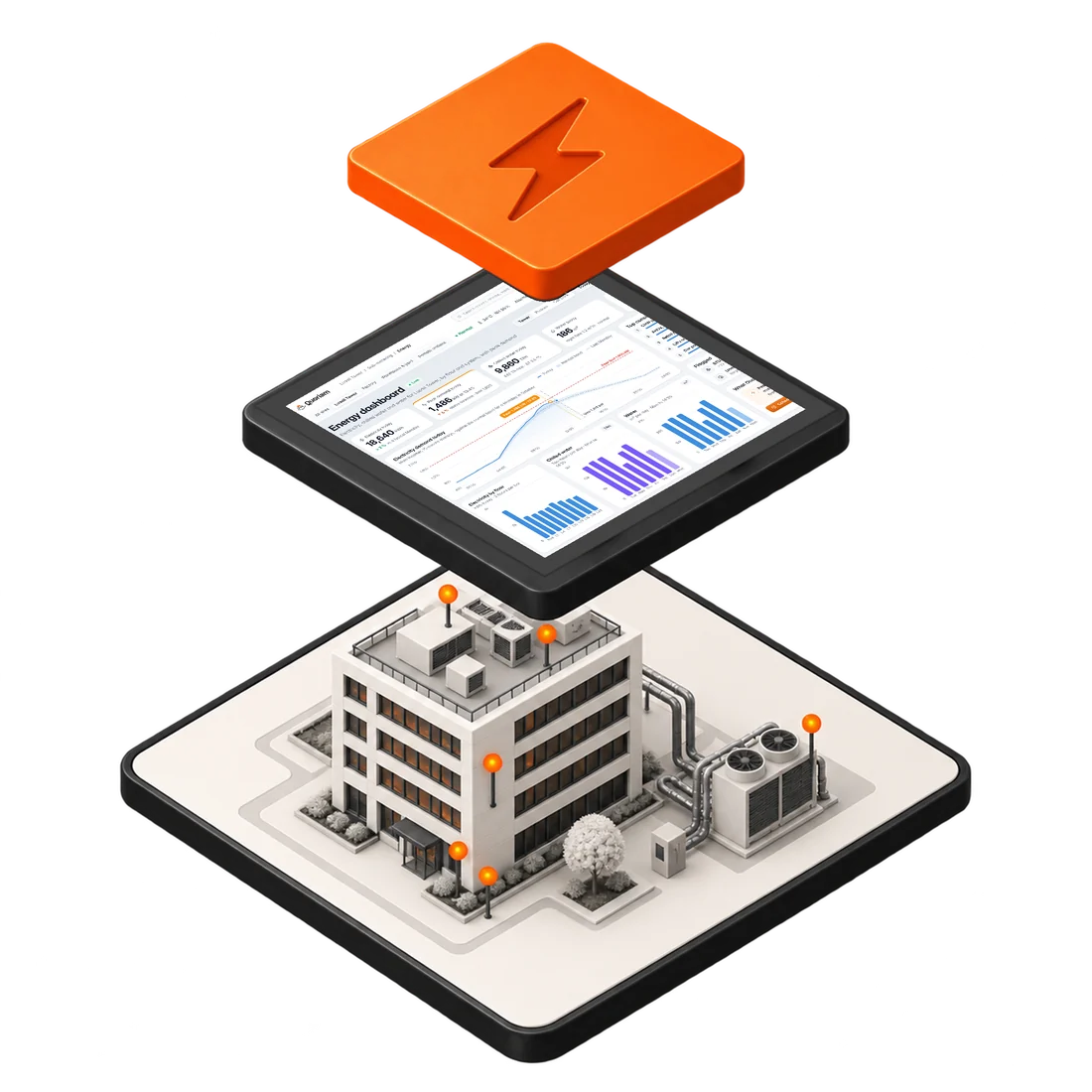
System view
For IT, OT and security reviewers: where the data goes, and how.
- At the metersBTU meters per tenant and at the ETS, existing and new
- In the riser or meter roomM-Bus master or gateway reading meters over M-Bus or Modbus
- NetworkSite LAN or cellular, encrypted and kept apart from the control network
- Quoriam platformOn your premises or cloud hosted in Qatar
- Your team and systemsAlerts, tenant statements and exports to finance
What your team sees.
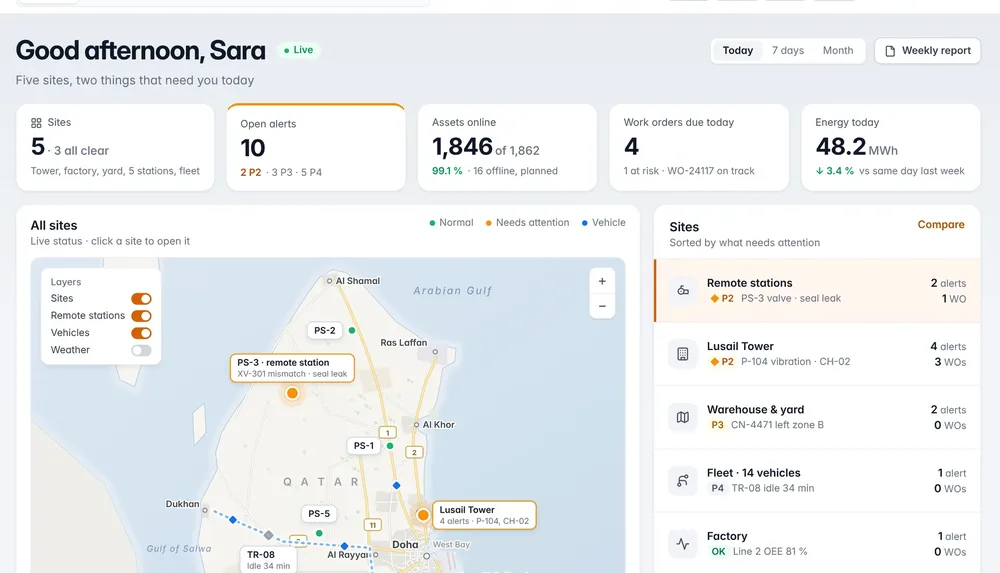
Every BTU meter, what it read and whether it can be trusted.
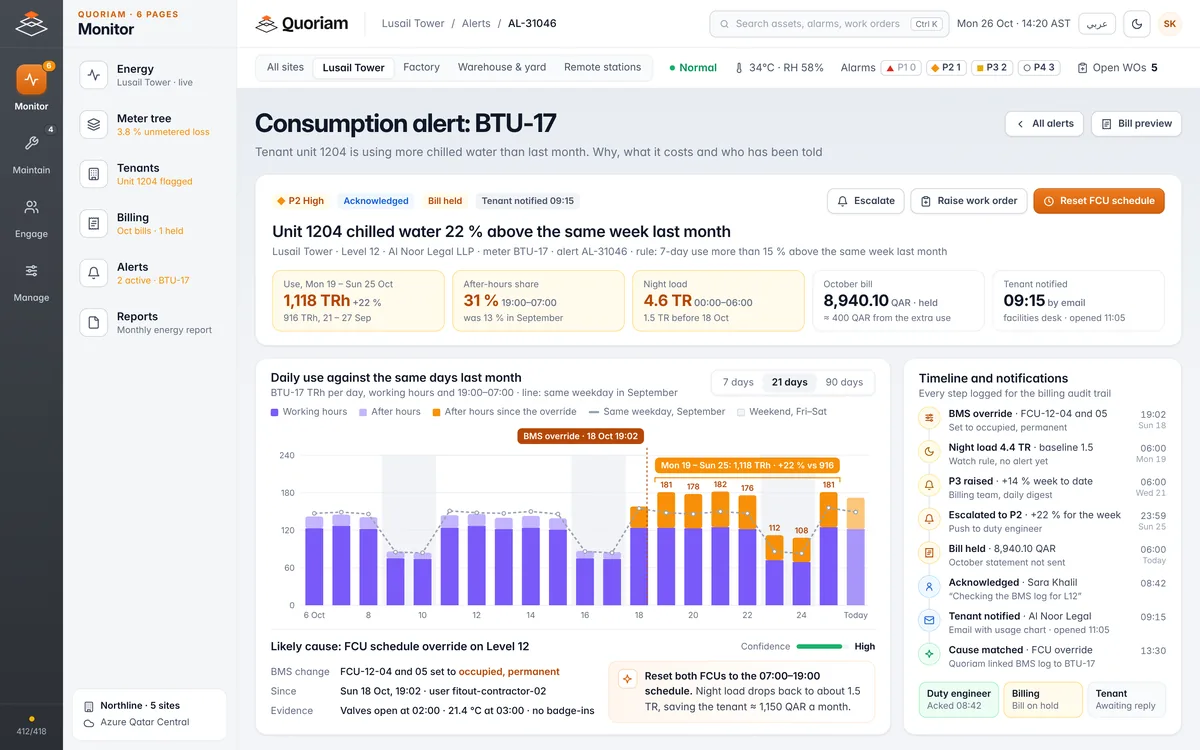
Where it's used in Qatar.
Anywhere chilled water is bought from a district cooling plant and shared out.
Office towers in Lusail and West Bay
A BTU meter per tenant, recharged monthly against the ETS bill.
Facilities and smart buildingsDistrict cooling and master developers
Meters at each building's ETS and across the network.
Utilities and district coolingResidential towers and compounds
A meter per apartment, so a family away for the summer pays for what they used.
Tenant billingMalls and mixed-use podiums
Retail units, food courts and common areas on separate meters.
HVAC and energy optimisation
Questions buyers ask.
Something else? Ask us during the free assessment.
How accurate is a BTU meter?
Under EN 1434, a class 2 meter with a 3 K minimum ΔT is allowed an error of about ±5.2% at full flow and a 5.5 °C ΔT. At a tenth of full flow and a 3 °C ΔT, the limit widens to about ±7.2%. The temperature pair carries most of it, which is why low ΔT hurts billing accuracy.
Ultrasonic or mechanical: which BTU meter should we fit?
Ultrasonic for billing. It has no moving parts, holds its accuracy at low and changing flow and copes better with dirty water. Mechanical meters cost less to buy but wear over time. Lusail's district cooling guideline asks for ultrasonic sub-meters to EN 1434 class 2.
Can you read our existing BTU meters?
Usually. Meters with an M-Bus or Modbus output are read directly; an existing AMR system can export to Quoriam where it supports it. We check every meter in the assessment, including the sensor pockets and sizing, before we quote.
A tenant disputes their cooling bill. What can we show them?
The opening and closing register readings, the 15-minute profile behind them, flow and ΔT at the time, and how their use compares with the same weeks last year. If the meter is in doubt, swapping the supply and return sensors is a quick check that Lusail's guideline builds in.
How many BTU meters does a building need?
One per unit you bill separately, plus the main at the ETS. Ideally add one per riser, so a gap between the tenants and the main can be traced to part of the building. Landlord areas such as lobbies and retail need their own. The free assessment counts it for your building.
What does it cost?
It depends on how many meters you have and how many need replacing. The free three-week assessment ends with a meter survey, a scope and a fixed price.
Related.
BTU metering is part of sub-metering on the Quoriam platform.
- Smart metering and sub-metering
Meter electricity, water and chilled water by tenant or line, and settle every bill on evidence.
- Tenant billing
Monthly utility bills per tenant, built from meter readings with an audit trail.
- HVAC and energy optimisation
Cooling matched to occupancy and weather, measured against the meter.
Check your BTU meters before your tenants do.
A free three-week assessment. We survey every BTU meter, check its readings against the main and tell you which ones to trust.
We take on two assessments a month.Quoriam is designed to pay back within six months. How we calculate payback