



- Home
- Solutions
- Environmental monitoring
- Cold chain monitoring
Cold Chain Monitoring in Qatar
Buffered probes, door contacts and compressor clamps on your cold rooms and freezers, so every alert says why the room warmed and every excursion is closed with a reason.
Last updated
What is cold chain monitoring?
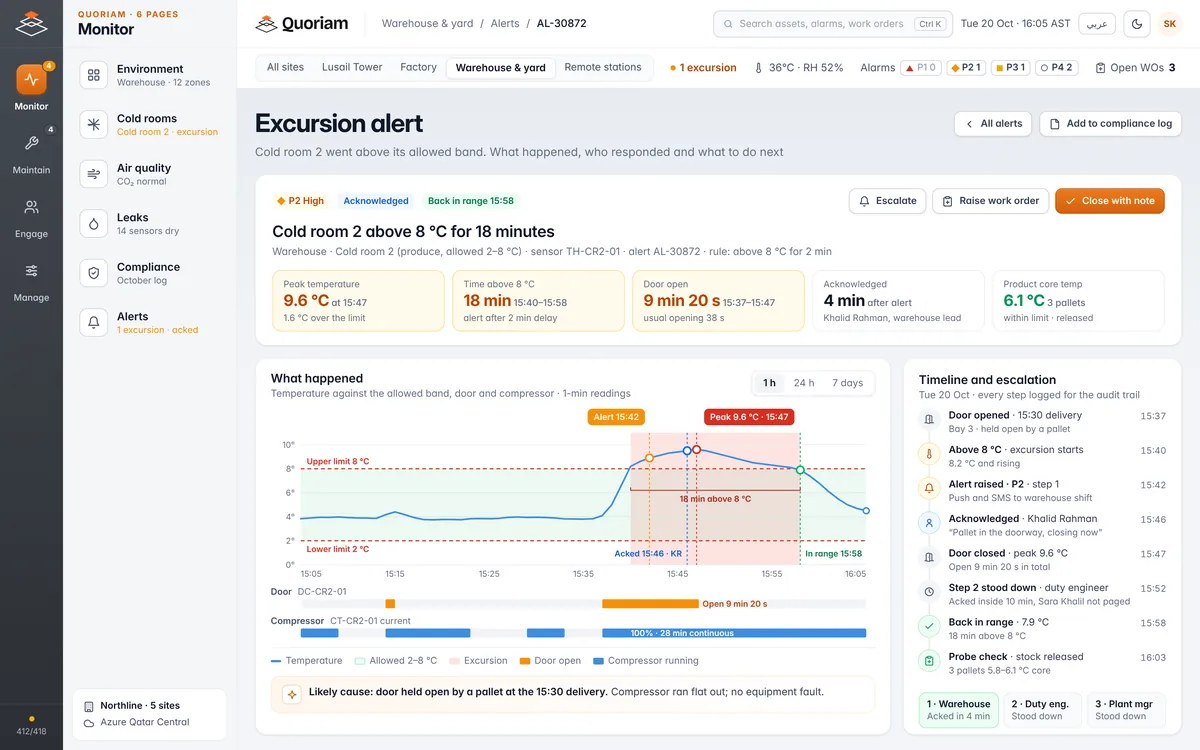
Cold chain monitoring tracks the temperature of cold rooms and freezers every few minutes, together with door openings, defrost cycles and compressor running. It tells a normal defrost or delivery apart from a real excursion, alerts the shift while the product is still safe, and records each excursion with its cause and the action taken.
Air in a cold room swings every time the door opens or the evaporator defrosts; the product, with far more mass, moves slowly. Cold chain monitoring measures what matters to the product and uses door, defrost and compressor signals to explain each swing. The truck is the other link in the chain, covered by refrigerated vehicle monitoring.
What it tells apart.
Five events that warm a cold room, and what the alert says about each.
| Event | What the readings show | What the alert says |
|---|---|---|
| Door held open | Air temperature climbing while the door contact shows open and the compressor runs flat out | Door open, room above band. Likely cause: a pallet in the doorway; no equipment fault |
| Normal defrost | A short rise in freezer air temperature at the scheduled time, compressor off | No alert. Logged as a defrost, so the record explains the spike |
| Defrost running long | Freezer above its band for longer than its usual defrost | Defrost overran. Check the defrost timer and heater |
| Refrigeration fault | Room warming with the door shut, the compressor running constantly or drawing no current | Equipment fault. Call the refrigeration engineer; plan where the stock goes |
| Power cut | Every room on one supply warming at once, every compressor at zero | Power lost to the rooms named, with the time it started |
What a cold chain probe should do.
Health authority guidance for medicine and vaccine stores. We use the same bar for food.
| Topic | Guidance | Source |
|---|---|---|
| Accuracy | ±0.5 °C or better | WHO and CDC |
| Probe | Detachable and buffered in glycol, glass beads, sand or Teflon, to best reflect product temperature | CDC |
| Placement | In the centre of the unit among the stock, away from walls, floor, ceiling, vents and the door | CDC |
| Recording | At least every 30 minutes, with current, minimum and maximum shown | CDC |
| Alarms | High and low set points, SMS or call-out to key staff, and event alarms for power failure and door opening | WHO |
| Outages | Sensors keep recording through network and power cuts, and send the backlog when the link returns | WHO |
| Calibration | Yearly for monitoring sensors (WHO); every two to three years for vaccine loggers (CDC) | WHO and CDC |
Sources: CDC, Temperature monitoring equipment; WHO Technical Report Series 961, Annex 9, Supplement 6, Temperature and humidity monitoring systems for fixed storage areas, 2015. Storage bands for food and medicines are on the environmental monitoring page.
How it works.
Fit
A buffered probe in each cold room and freezer, with the transmitter outside the freezer. A contact on every door, and a current clamp on each compressor.
Learn the room
The first weeks set each room's normal: how long deliveries hold the door open and how long a defrost lasts. Alarm delays are set from that, so routine events stay quiet.
Alert with the cause
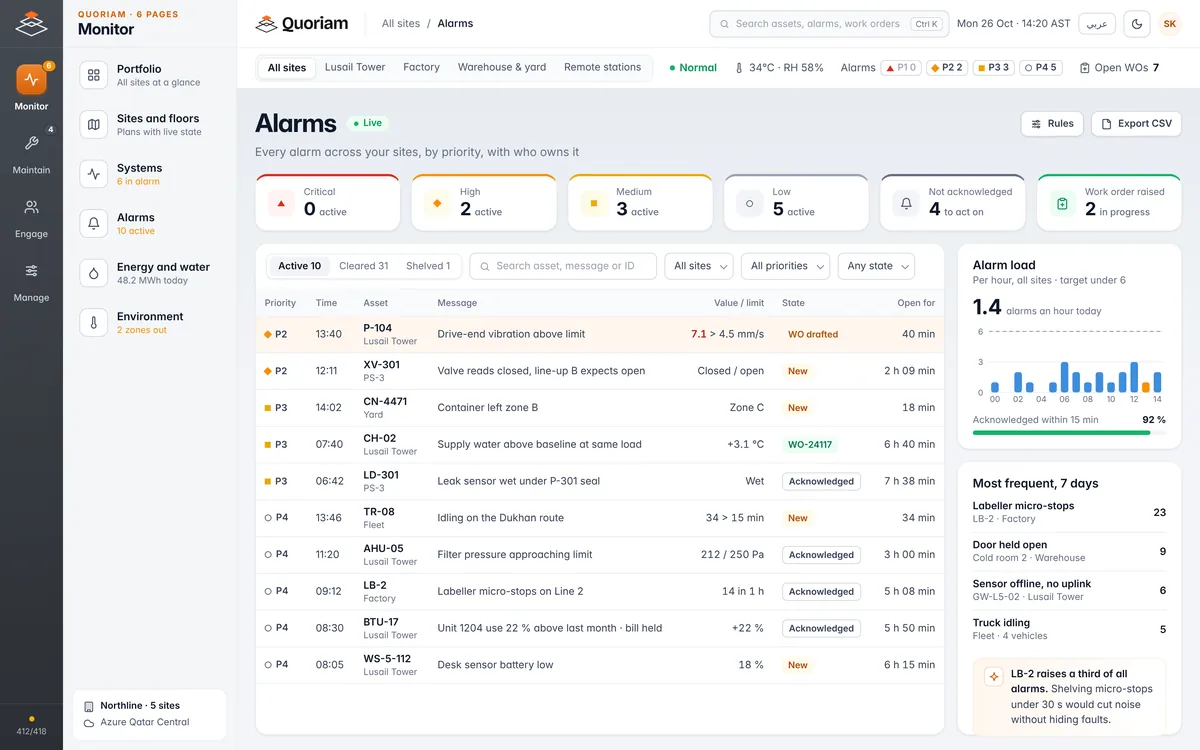
When a room leaves its band, the alert names the likely cause from the door, compressor and defrost signals, and escalates from the warehouse shift to the duty engineer.
Close with a reason
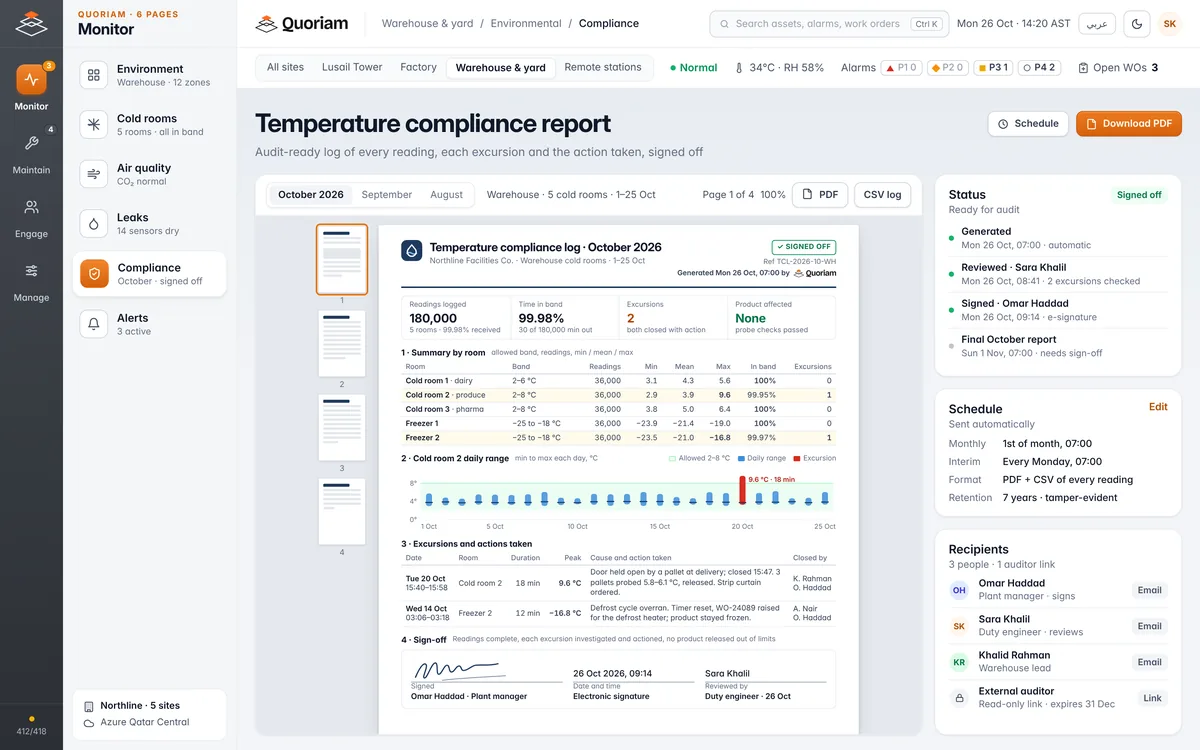
Each excursion is closed with the cause, the product check and the action, and goes into the monthly log.
System view
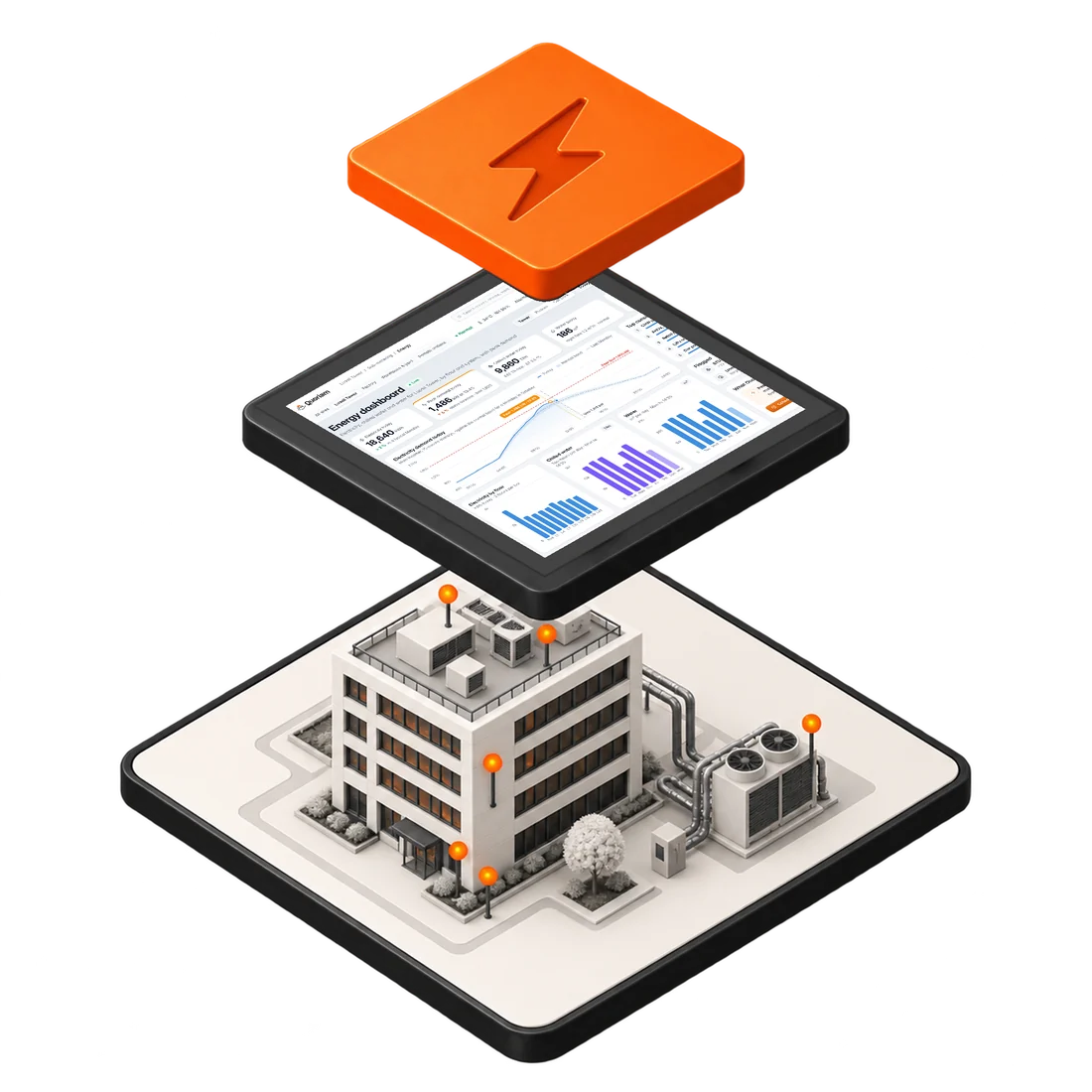
For IT, OT and security reviewers: where the data goes, and how.
- In the roomBuffered temperature probes, door contacts and compressor current clamps
- On siteLoRaWAN gateway; edge gateway reading refrigeration controllers
- NetworkSite LAN or cellular, encrypted and kept apart from the control network
- Quoriam platformOn your premises or cloud hosted in Qatar
- Your team and systemsApp, SMS and email alerts with escalation; monthly log by PDF and CSV; work orders
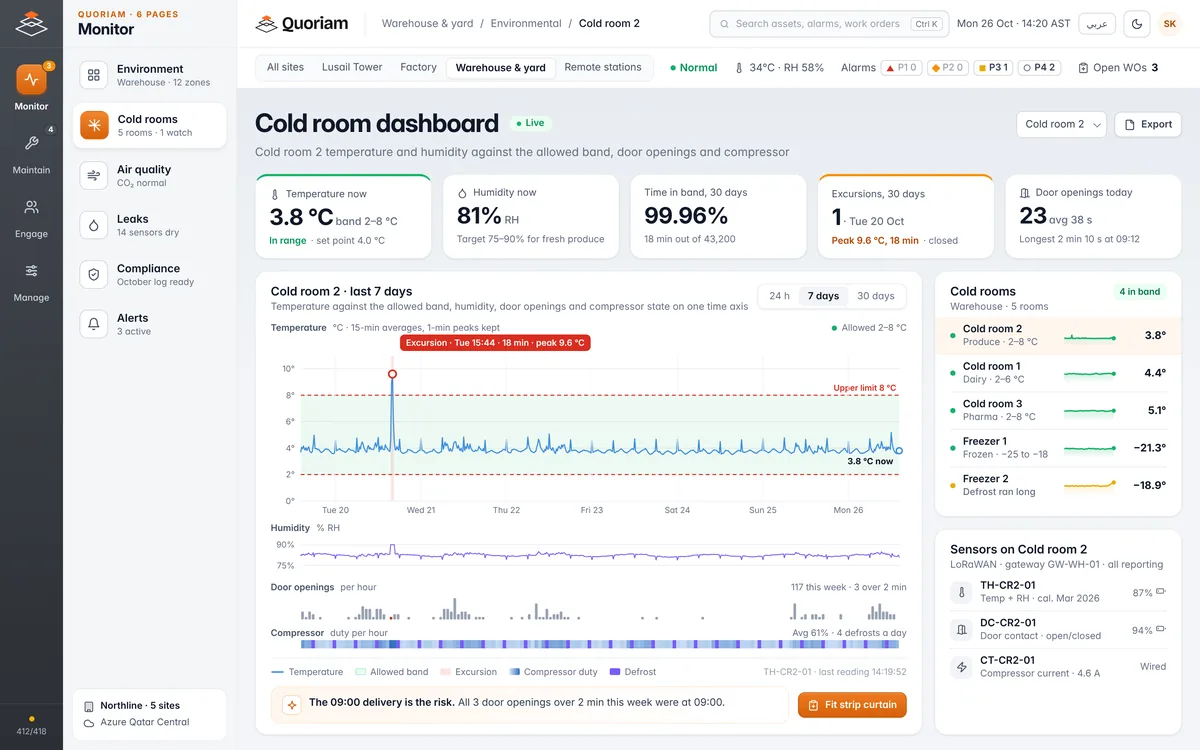
What your team sees.
Every swing explained, and the record ready for the auditor.
Or just ask.
Quoriam AI answers in plain language and turns the answer into an action.
Where it's used in Qatar.
Wherever chilled or frozen stock waits between the truck and the customer.
Food distribution and cold stores
Chilled and frozen rooms with busy loading bays.
Logistics and warehousingHospitals and pharmacies
Medicine and vaccine fridges, where an excursion means a quarantine decision.
HealthcareFarms and food producers
Packhouse cold rooms and finished-goods freezers.
Agriculture and foodHotels and central kitchens
Walk-in chillers and freezers checked by food safety inspectors.
Questions buyers ask.
Something else? Ask us during the free assessment.
What temperature should a cold room be kept at?
It depends on what it stores: 2 to 8 °C for medicines labelled for the fridge, 5 °C or below for chilled meat and dairy, and −18 °C or colder for frozen food, as the storage bands show. Qatar's Ministry of Public Health advises 4 °C or below for refrigerated food, as The Peninsula reported. Your licence and product labels come first.
How do you stop defrost cycles causing false alarms?
Two ways. A buffered probe reads closer to the product than the air does, so a short defrost moves it far less. And the alarm delay is set longer than the room's normal defrost, so only a defrost that runs long raises an alert.
How many sensors does a cold room need?
One buffered probe and one door contact cover most cold rooms, plus a current clamp on each refrigeration unit. Large rooms get a probe at each hot and cold spot found by mapping. The free assessment gives you the count and the price.
What hardware do you fit?
Wireless temperature probes with the transmitter outside the freezer, door contacts, clamp-on current sensors for the compressors, and a gateway such as the Quoriam Edge QE35 on LoRaWAN or cellular.
Can it read our refrigeration controllers?
Yes, where they offer BACnet or Modbus. Set point, compressor state and the controller's own alarms then sit next to the probe readings, so the engineer sees both before driving out. Quoriam reads the controller and does not change its settings.
Does it cover our refrigerated trucks?
Yes, on the same platform. Refrigerated vehicle monitoring logs the load temperature in every reefer truck, with alarms on the road. Each delivery then arrives with its own temperature record, and one log runs from the truck to the cold room door.
What does it cost, and can we pilot it first?
The price depends on the number of rooms, doors and refrigeration units. The free three-week assessment ends with a fixed price, and a pilot on a few of your busiest rooms can come first, so you see the alerts before you commit.
Related.
Cold chain monitoring is part of environmental monitoring on the Quoriam platform.
- Environmental monitoring
Log temperature, humidity and air quality in cold rooms, warehouses and offices, ready for audit.
- Refrigerated vehicle monitoring
Load temperature in every reefer truck, with alarms on the road.
- Temperature and humidity monitoring
Continuous temperature and humidity logs for warehouses, server rooms and labs.
- Logistics and warehousing
Fleets, cold rooms and yard equipment.
Know why every room warmed.
A free three-week assessment. We walk your cold rooms and freezers, review your excursion records, and show you which doors, defrosts and units put stock at risk.
We take on two assessments a month.Quoriam is designed to pay back within six months. How we calculate payback