







- Home
- Solutions
- Fleet telematics
- Refrigerated vehicle monitoring
Reefer Truck Temperature Monitoring in Qatar
Probes in the load space and sensors on the doors of every refrigerated truck, read on the road, so a warming load is caught while it can still be saved.
Last updated
What is reefer truck temperature monitoring?
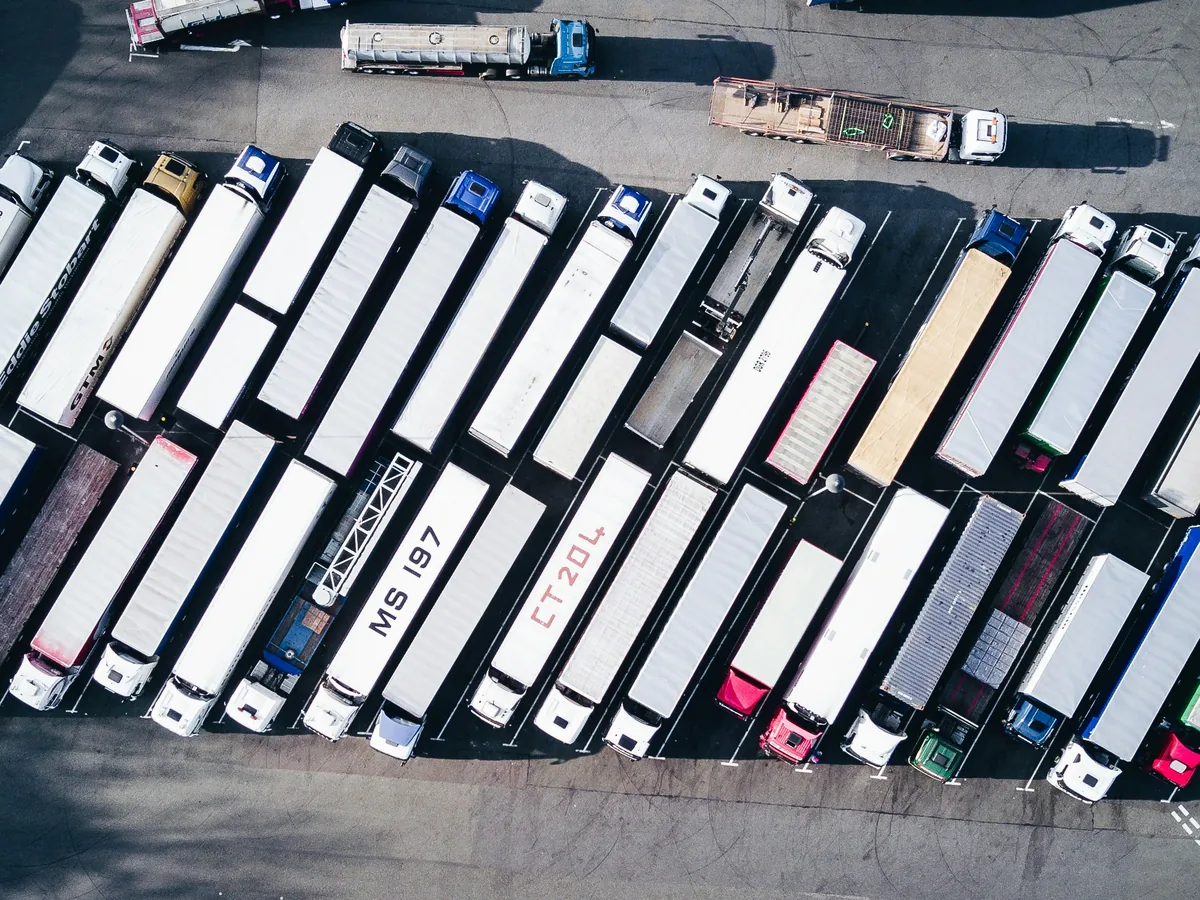
Reefer truck temperature monitoring puts probes in the load space of each refrigerated truck and reads them on the road, together with the door state and GPS position. It alerts the driver and the depot when the load leaves its band, such as above 5 °C for chilled dairy, and keeps a time-stamped record of every trip.
A data logger tells you after the trip what went wrong. A live system tells the driver while the load can still be saved. On Quoriam the trucks sit on the same platform as your cold chain monitoring, so one record runs from the cold room to the delivery.
What it catches.
The risks that spoil a refrigerated load in a Doha summer, and what the sensors see for each.
| Risk | What the sensors see | What happens next |
|---|---|---|
| Door left open at a drop | Door sensor open longer than your limit, rear probe climbing | Driver and depot alerted with the drop and the minutes open |
| Refrigeration unit failed or off | Load temperature rising steadily with the doors shut | Depot alerted with the truck's position, to divert or transfer the load |
| Loaded before pre-cooling | Probes above the band while still inside the depot geofence | Alert before the truck leaves the depot |
| Frozen load warming | Probe above −18 °C, or above the band you set | Alert with the trend, so you know how long it has been warming |
| Probe or tracker silent | No reading for longer than the reporting interval | Gap flagged, so the record never hides it |
Load temperatures, by the rules.
The limits most reefer loads are set to. Your product labels and licence conditions come first.
| What is carried | Limit | Source |
|---|---|---|
| Chilled dairy, red meat and chicken | 5 °C or below | SFDA |
| Packed fish and crustaceans | 0 °C or below | SFDA |
| Fresh fish | −1 to 3 °C | Qatar Ministry of Municipality |
| Refrigerated food on delivery vehicles | 0 to 4 °C | Qatar Ministry of Municipality |
| Frozen food on delivery vehicles | −18 °C | Qatar Ministry of Municipality |
| Medicines labelled for the refrigerator | 2 to 8 °C | WHO; Ph. Eur. |
| Load space before loading | Pre-cooled to 10 °C or below | SFDA |
SFDA figures are from the Saudi Food and Drug Authority's General Requirements for Food Transport, a GCC reference, which also asks for a thermometer readable from outside that represents the whole load space, and for readings to be recorded continuously and kept. Qatar figures are from Ministry of Municipality standards reported by The Peninsula for perishable food and delivery vehicles. Medicines: WHO and Ph. Eur. via ECA. Check the rules for your licence in Qatar.
How it works.
Fit
Wired probes go in the load space, one per compartment and two in long bodies, at the front bulkhead and by the rear doors. Door sensors go on the rear and side doors, all read by the truck's GPS tracker.
Set the band
Each compartment gets its band from what it carries, with a short delay so a normal door opening at a drop doesn't raise an alarm.
Alert on the road
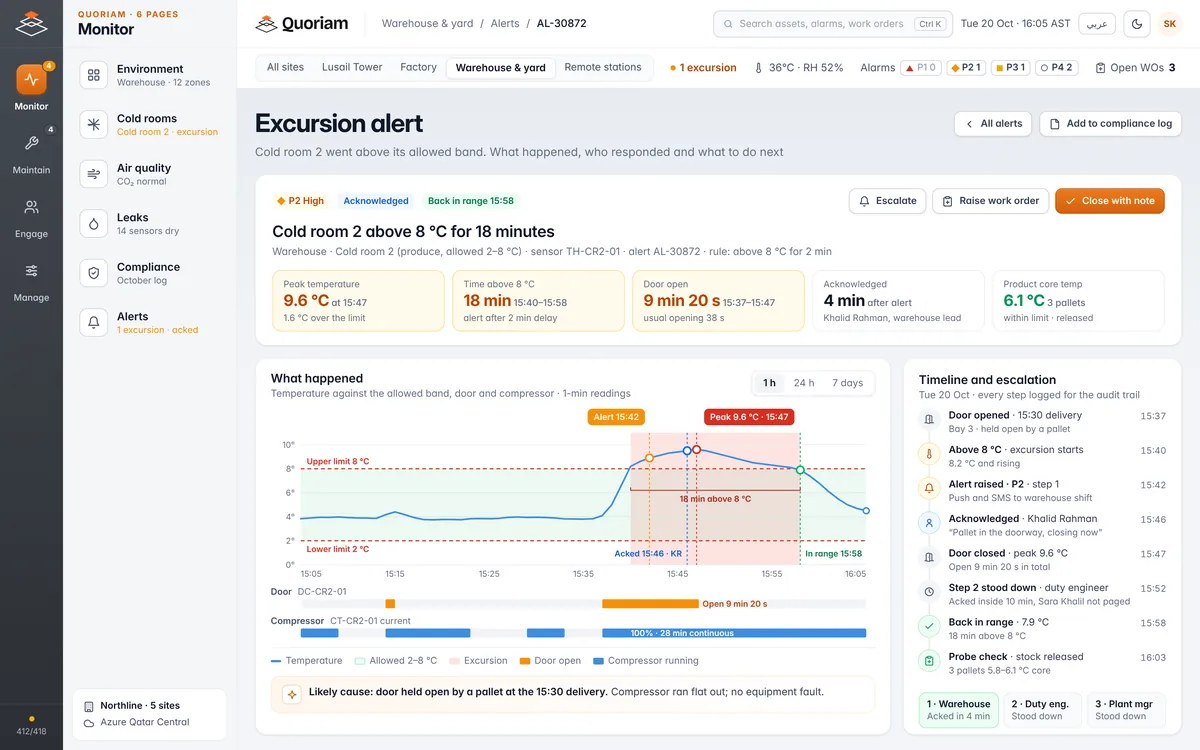
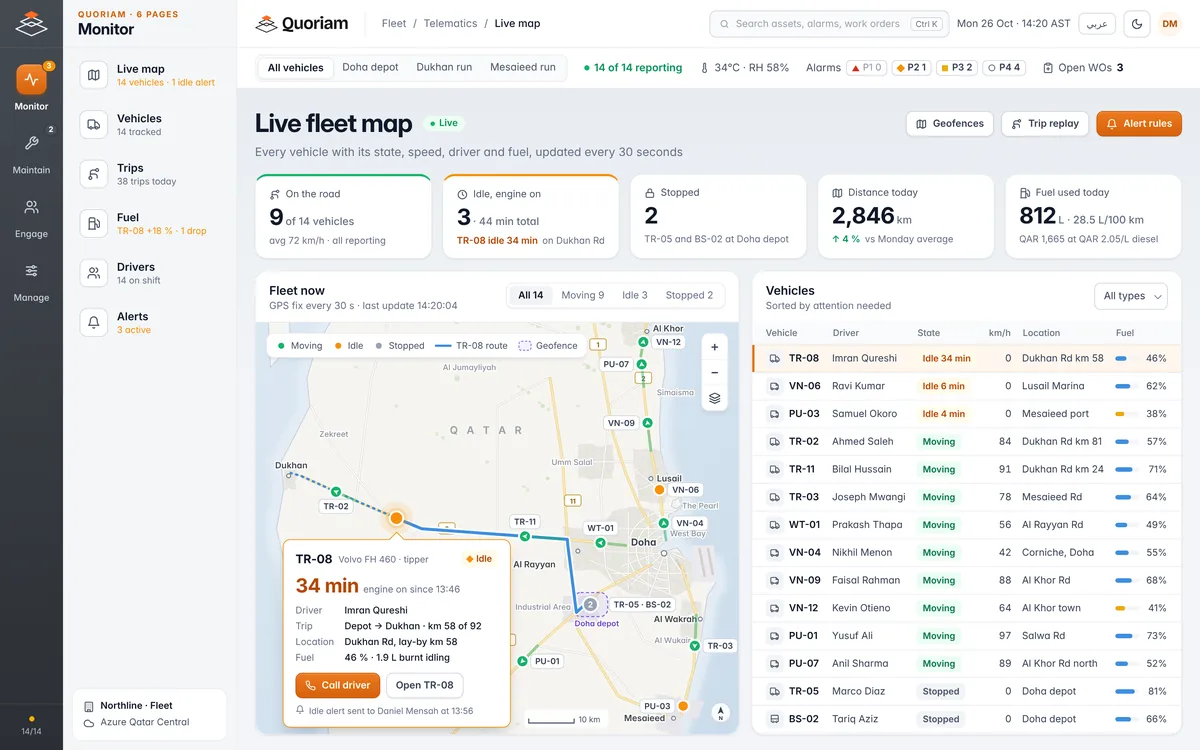
When a probe leaves its band, the driver and depot get the reading, door state and location, such as RF-03 at 6.2 °C with the rear door open 11 minutes. Unanswered alerts escalate.
Record
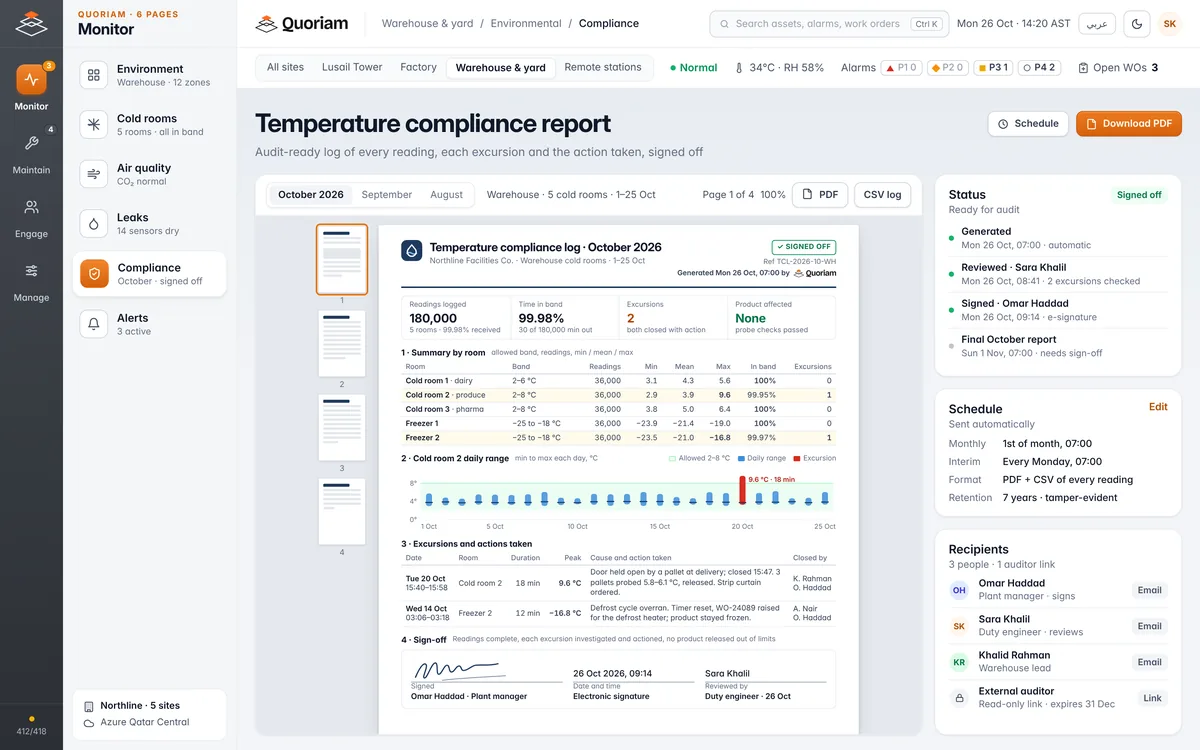
Every trip keeps its readings, door openings and alerts, ready to show the receiver.
System view
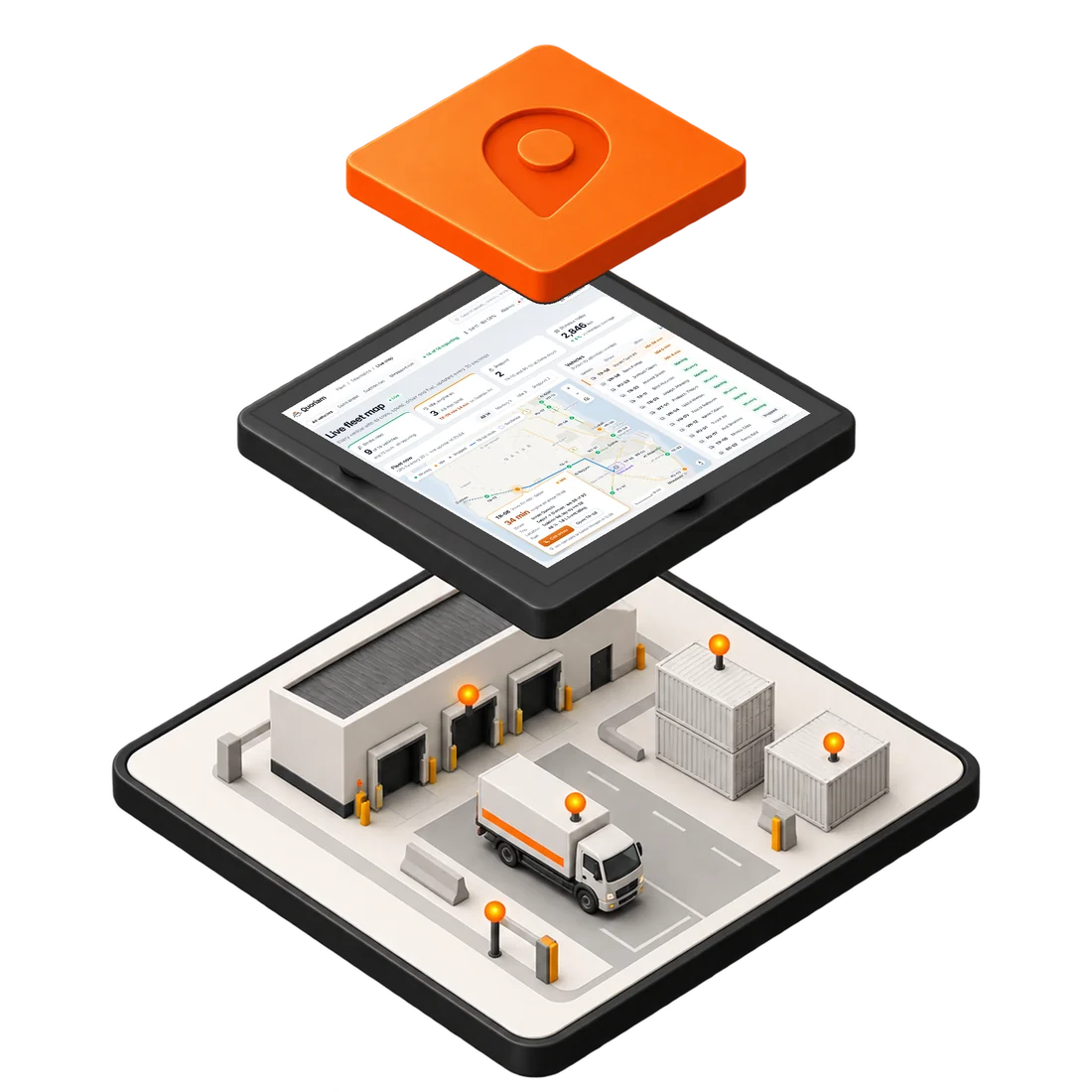
For IT, OT and security reviewers: where the data goes, and how.
- In the truckLoad temperature probes and door sensors, wired to the GPS tracker
- From the reefer unitSetpoint and unit alarms where the controller shares them
- NetworkCellular from each tracker, encrypted in transit
- Quoriam platformOn your premises or cloud hosted in Qatar
- Your team and systemsApp, SMS and email alerts with escalation; trip records and monthly logs by PDF and CSV
What your team sees.
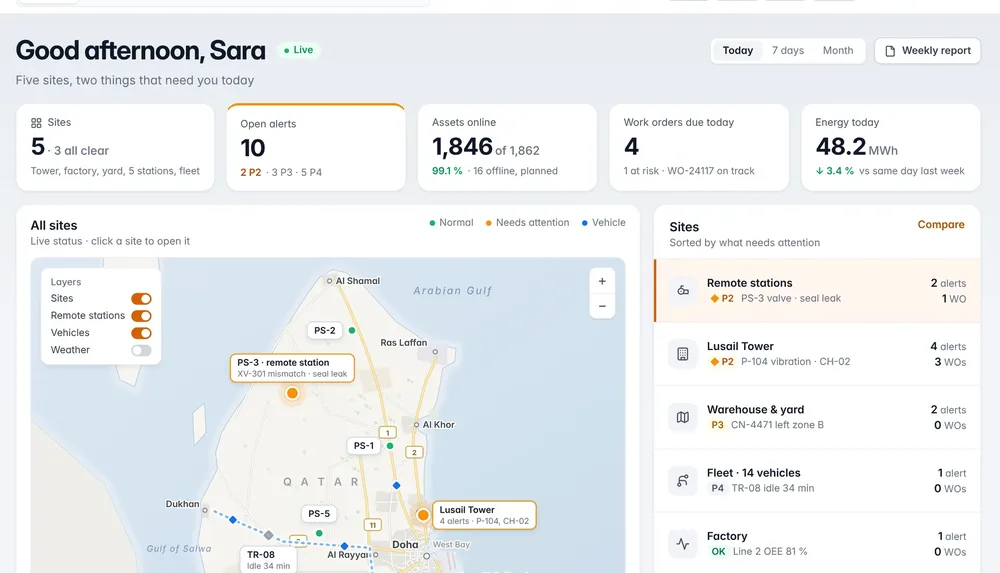
The truck on the map, and the same alert and log your cold rooms use.
Where it's used in Qatar.
Wherever a chilled or frozen load crosses Doha in 45 to 50 °C heat.
Food distribution and catering
Dairy, meat, fish and produce from importers and central kitchens to supermarkets, hotels and camps.
Agriculture and foodLogistics and cold stores
Fleets moving loads between Hamad Port, cold stores and customers.
Logistics and warehousingMedicines and medical supplies
Refrigerated vans carrying 2 to 8 °C stock to pharmacies, clinics and hospitals.
Healthcare
Questions buyers ask.
Something else? Ask us during the free assessment.
What temperature should a reefer truck keep chilled and frozen food at?
It depends on the food. The SFDA's General Requirements for Food Transport set 5 °C or below for chilled dairy and meat and 0 °C for packed fish, with the load space pre-cooled to 10 °C before loading. In Qatar, the Ministry of Municipality asks delivery vehicles to carry refrigerated food at 0 to 4 °C and frozen food at −18 °C (The Peninsula). Product labels and your licence come first.
How many probes does a reefer truck need?
At least one per compartment. A long body gets two, at the front bulkhead and by the rear doors, because the doors are where warm air gets in at every drop. That also meets the SFDA's ask for a reading that represents the whole load space. The free assessment counts it for your fleet.
What hardware do you fit?
A GPS tracker in the cab, wired temperature probes in the load space, and door sensors on the rear and side doors, all read by the tracker. Where the refrigeration unit's controller shares its setpoint and alarms, we read those too.
Does it replace the thermometer on the reefer unit?
No. The SFDA guidance asks for a thermometer readable from outside the load space, so keep it. Quoriam adds the live alerts and the stored record. For quick-frozen food sold into the EU, recorders must meet EN 12830 and records are kept for a year under Regulation (EC) No 37/2005.
Can it link to our cold rooms and warehouse system?
Your cold rooms can run on the same platform through environmental monitoring, with the same bands, alerts and monthly log, so a load's record runs from the cold room to the customer. Sending trip records into a warehouse management or ERP system depends on what it accepts.
What does it cost, and can we pilot it?
It depends on how many trucks and compartments you monitor and whether they already have trackers. The free three-week assessment ends with a scope and a fixed price. A pilot on part of the fleet proves it on your own routes before you fit every truck.
Related.
Refrigerated vehicle monitoring is part of fleet telematics on the Quoriam platform.
- Fleet telematics
Track vehicles, fuel and driver behaviour, with servicing scheduled from the same data.
- Cold chain monitoring
Cold rooms and freezers logged every few minutes, with alarms before stock is at risk.
- Fuel monitoring
Fuel used, idling and drain alerts per vehicle and route.
- Driver behaviour monitoring
Speeding, harsh braking and idling scored per driver, every week.
Keep the cold chain unbroken on the road.
A free three-week assessment. We review your reefer fleet, routes and rejected deliveries with your team, then recommend the probes, bands and alerts for each truck.
We take on two assessments a month.Quoriam is designed to pay back within six months. How we calculate payback