



- Home
- Solutions
- Remote operations monitoring
- Fire pump monitoring
Fire Pump Monitoring in Qatar
Every fire pump start, test and controller alarm recorded as it happens, so you know each pump is ready and can show when it was last tested.
Last updated
What is fire pump monitoring?
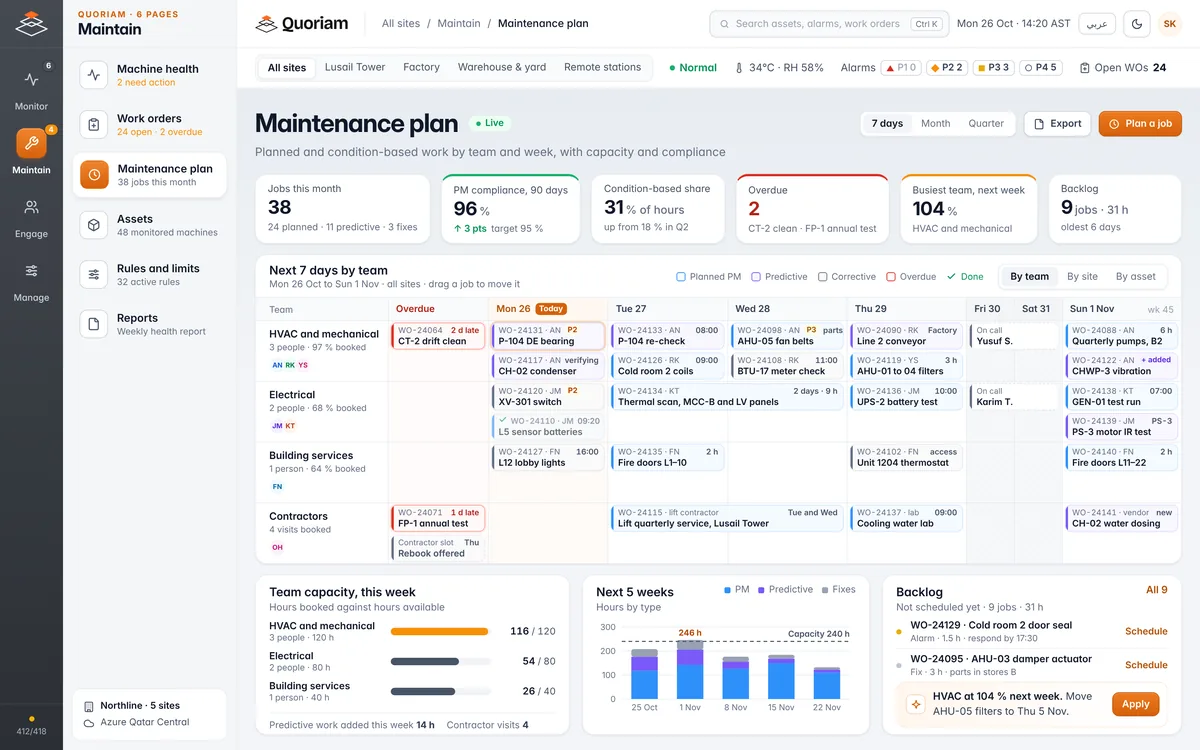
Fire pump monitoring reads the fire pump controller's signals around the clock: pump running, power available, phase reversal, failure to start and, on diesel pumps, the engine and battery alarms. It logs every weekly or monthly churn test with its run time and pressures, and alerts when a test is missed or a pump is not ready to start.
A fire pump may run for a few minutes a week and otherwise sit idle for years, which is why its tests matter. In Qatar, building owners are responsible for maintaining fire detection and suppression systems, and Civil Defence inspects them against its Technical Requirements Guide, launched in 2022 (The Peninsula, July 2026).
Fire pump monitoring sits alongside your fire alarm system and does not replace it. The controller's alarms stay wired to the fire alarm panel as they are today; Quoriam reads a spare set of contacts and adds the record, the test schedule and the alerts.
What it watches.
The controller signals and readings we connect, and when each one reaches you.
| Signal | What it tells you | When you hear about it |
|---|---|---|
| Pump running | Every start, with its time, run length and pressures | Every start, with a planned test told apart from a real demand |
| Power available, phase reversal | Whether an electric pump could start if called | At once, because a pump without power cannot start |
| Failed to start | The controller called the pump and it did not run | At once, at the highest priority |
| Diesel engine and battery | Low oil pressure, high water temperature, overspeed, battery or charger failure | At once, with the alarm the controller raised |
| Controller off or in manual | The pump will not start automatically | When it is left that way, for example after a test |
| Missed or short test | No run in the test window, or a run shorter than required | The day the test window closes |
Test frequencies, by NFPA 25.
The fire pump tests NFPA 25 sets out, and what each one records.
| Test | Diesel pump | Electric pump |
|---|---|---|
| No-flow (churn) test | Weekly, at least 30 minutes | Monthly, at least 10 minutes; weekly for high-rise buildings, limited-service controllers, vertical turbine pumps and some other cases |
| Annual flow test | No flow, 100% and 150% of rated flow | No flow, 100% and 150% of rated flow |
| Annual test readings | Suction and discharge pressure, flow, engine speed | Suction and discharge pressure, flow, voltage and current per phase |
| When to investigate | Pressure more than 5% below the acceptance test curve | Pressure more than 5% below the acceptance test curve |
Sources: NFPA 25, 2023 edition, chapter 8, as summarised by InspectPoint and Koorsen. The authority having jurisdiction may enforce another edition.
How it works.
Connect
Wire the controller's spare dry contacts to a Quoriam Edge gateway, and add suction and discharge pressure transmitters and a fire water tank level where they are missing.
Set the schedule
Enter each pump's test frequency and minimum run time, and the annual flow test date, so Quoriam knows when a run is a test and when one is missing.
Record and alert
Every run is logged with its start, length and pressures. A missed test, a short run or a controller alarm goes to the duty engineer.
Report
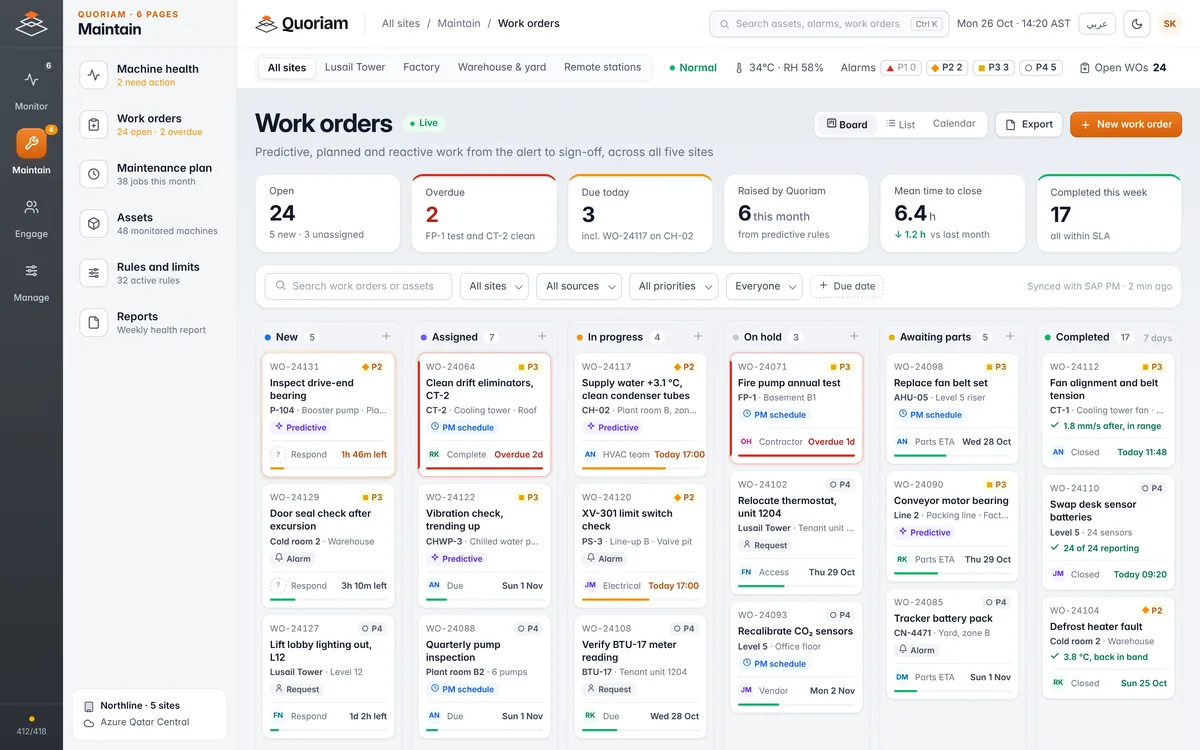
Export the test log for your fire safety file, and raise the annual flow test as a work order for your contractor.
System view
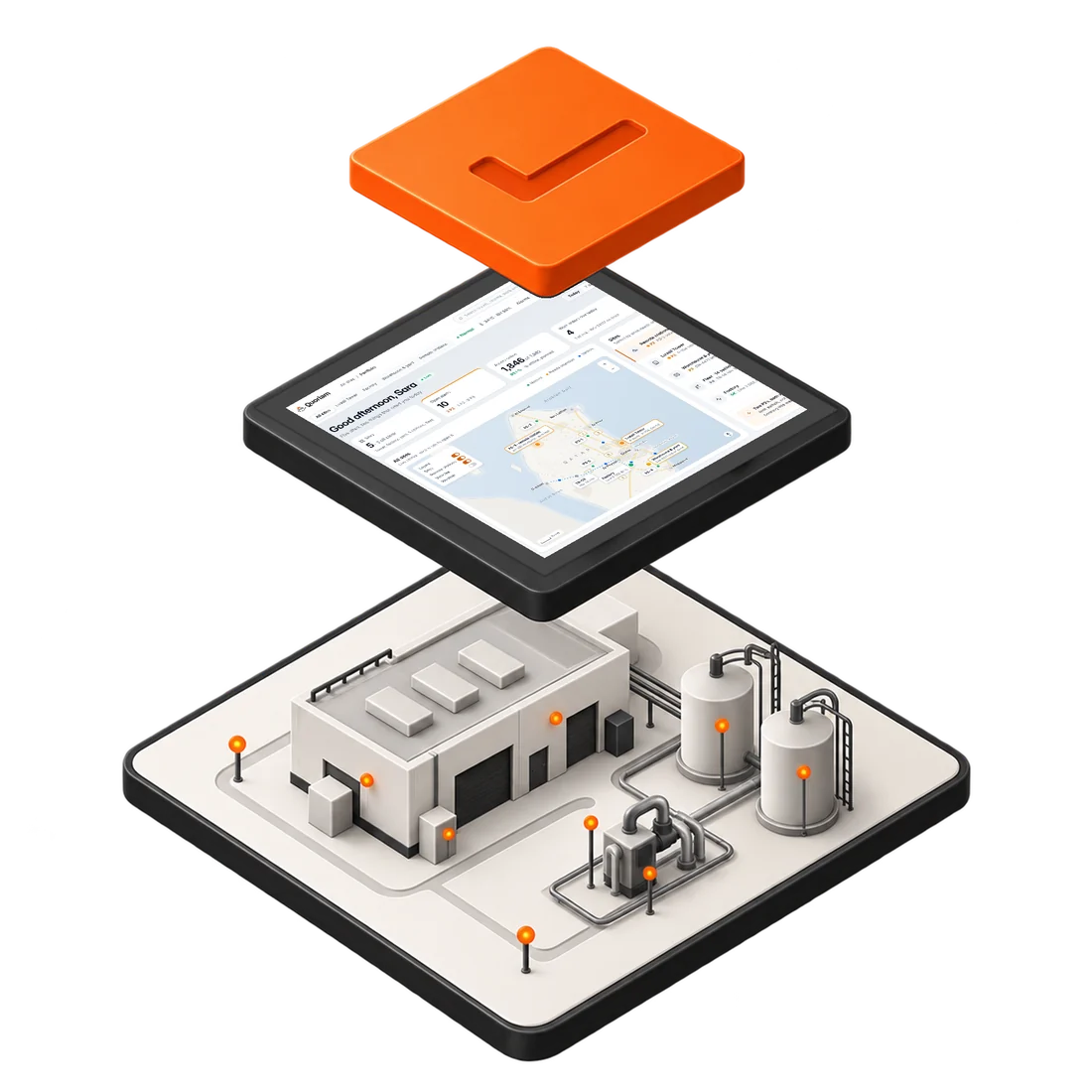
For IT, OT and security reviewers: where the data goes, and how.
- In the pump roomFire pump controller contacts, suction and discharge pressure, fire water tank level
- GatewayQuoriam Edge gateway over 4G, fibre or the site LAN
- NetworkCellular, fibre or site LAN, encrypted and kept apart from the control network
- Quoriam platformOn your premises or cloud hosted in Qatar
- Your team and contractorsApp, SMS and email alerts; test records and work orders
What your team sees.
The test that is due, the water behind it and every alarm on record.
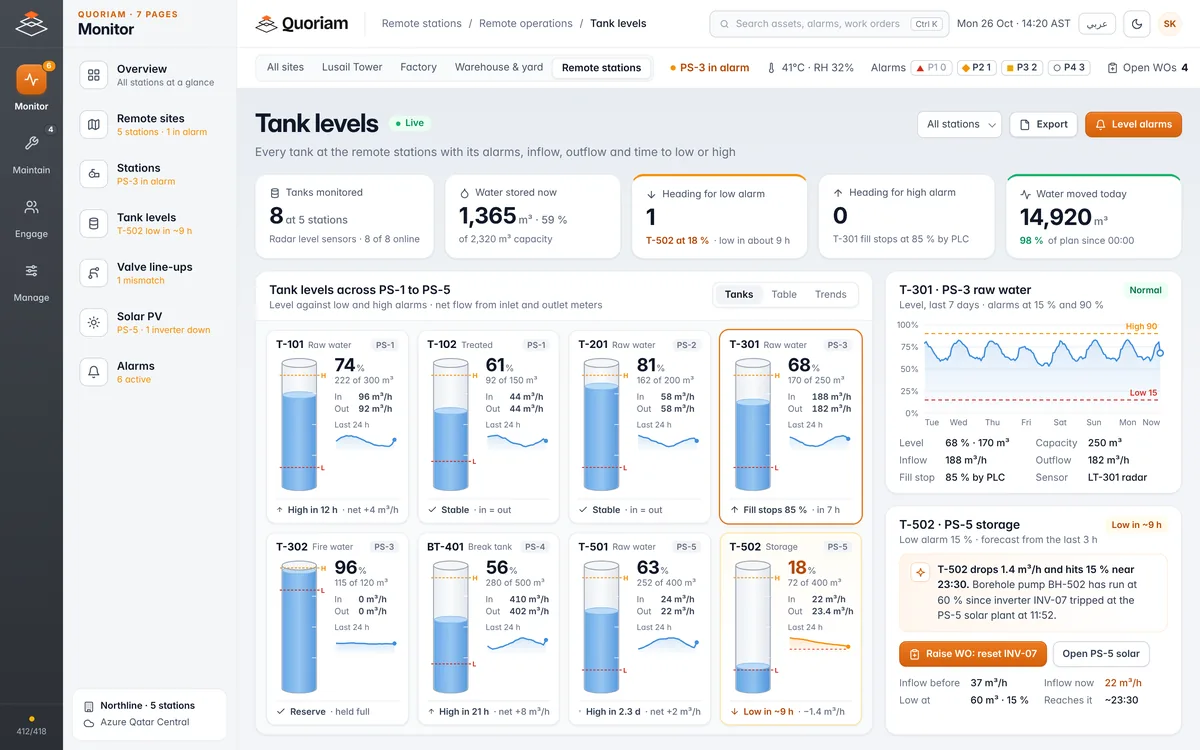
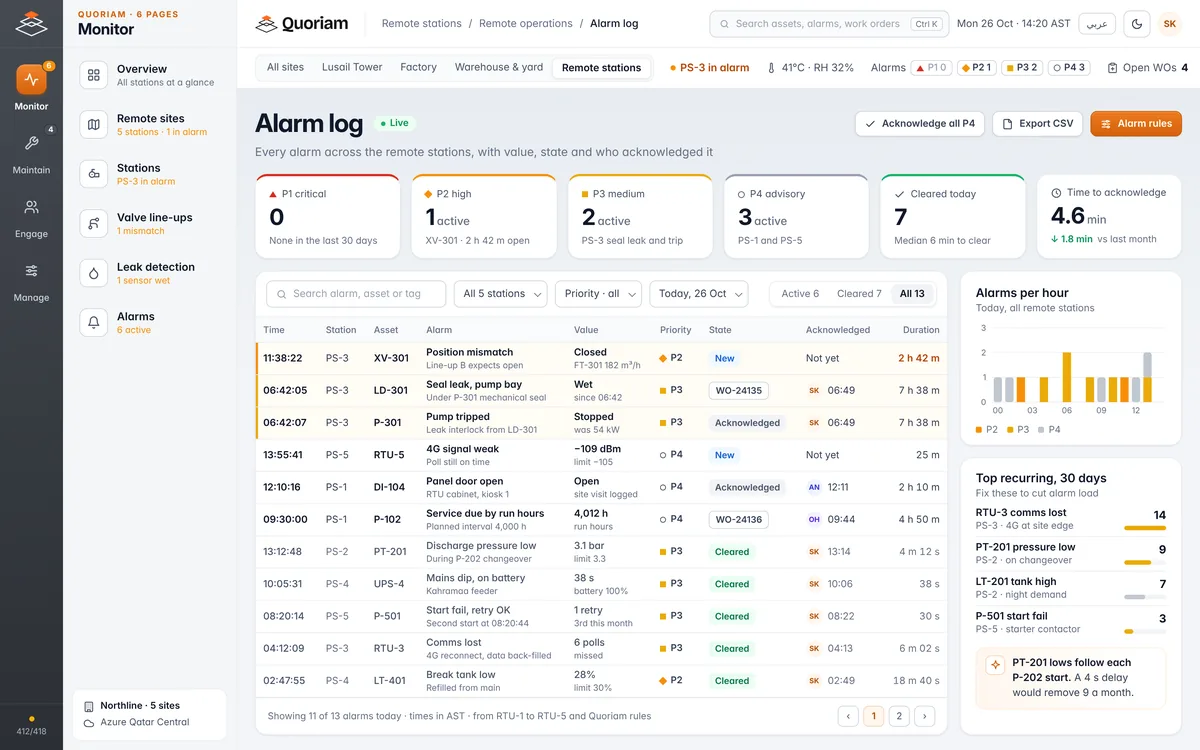
Or just ask.
Quoriam AI answers questions about your fire safety work in plain language and turns the answer into an action.
Where it's used in Qatar.
Wherever a fire pump has to start first time, and someone has to prove it will.
Towers and commercial buildings
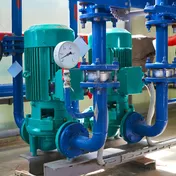
Electric and diesel fire pumps in basement pump rooms.
Facilities and smart buildingsWarehouses and logistics parks
Sprinkler pumps fed from on-site fire water tanks.
Logistics and warehousingOil, gas and energy
Diesel fire water pumps at process and storage sites.
Oil, gas and energyRemote sites
Fire water tanks and pumps at unmanned stations.
Tank level monitoring
Questions buyers ask.
Something else? Ask us during the free assessment.
How often should a fire pump be tested?
Under the 2023 edition of NFPA 25, a diesel fire pump runs a no-flow test weekly for at least 30 minutes. An electric pump runs monthly for at least 10 minutes, or weekly if it serves a high-rise, uses a limited-service controller or drives a vertical turbine. Both get an annual flow test, per InspectPoint's summary of NFPA 25.
Which signals can you read from our fire pump controller?
Most controllers offer dry contacts for pump running, power available and phase reversal on electric pumps, and for running, battery failure and engine alarms on diesel pumps, as in this published controller specification. We wire spare contacts to a gateway and add pressure transmitters.
Does it replace our fire alarm panel or our test contractor?
No. The controller's alarms stay on your fire alarm system, and your team or contractor still runs and inspects each test as your maintenance contract requires. Quoriam records every run, flags a missed or short test and keeps the history in one place.
Can Quoriam start or stop the fire pump?
No. Starting stays with the controller, by its pressure switch or its own weekly test timer, and stopping stays with your technician. Quoriam only reads the controller's contacts and the pressures, and never sends a command to the fire pump or its controller.
Will these records satisfy Civil Defence?
Quoriam gives you a dated record of every start, test, alarm and acknowledgement, with run times and pressures, which you can export for the fire safety file and show at an inspection. Whether it meets a specific inspection requirement is for Civil Defence and your fire consultant to confirm. Quoriam records tests and alarms for your fire safety file and does not certify compliance with NFPA, which stays with your fire consultant and the authority.
What does it cost?
It depends on the number of fire pumps, the controller makes and what is already wired. The free three-week assessment ends with a scope and a fixed price for your buildings or sites. A pilot on a few sites can come first.
Related.
Fire pump monitoring is part of remote operations monitoring on the Quoriam platform.
- Remote operations monitoring
Valves, tanks, pumps and solar arrays across remote sites on one screen, with alarms on any change.
- Tank level monitoring
Water, diesel and chemical tank levels read remotely, with low-level and leak alarms.
- Pump station monitoring
Run status, pressure, flow and power at unmanned pump stations.
- Generator monitoring
Run hours, fuel, battery and alarms on standby gensets, so they start when needed.
Know every fire pump will start.
A free three-week assessment. We review your fire pumps, their controllers and how you record tests today, then recommend what to connect first.
We take on two assessments a month.Quoriam is designed to pay back within six months. How we calculate payback