
- Home
- Solutions
- Fleet telematics
- Fuel monitoring
Fuel Monitoring System in Qatar
Fuel level, fuel used and idling for every truck, van and bus, with an alert the moment a parked vehicle's tank starts to drop.
Last updated
What is a fuel monitoring system?
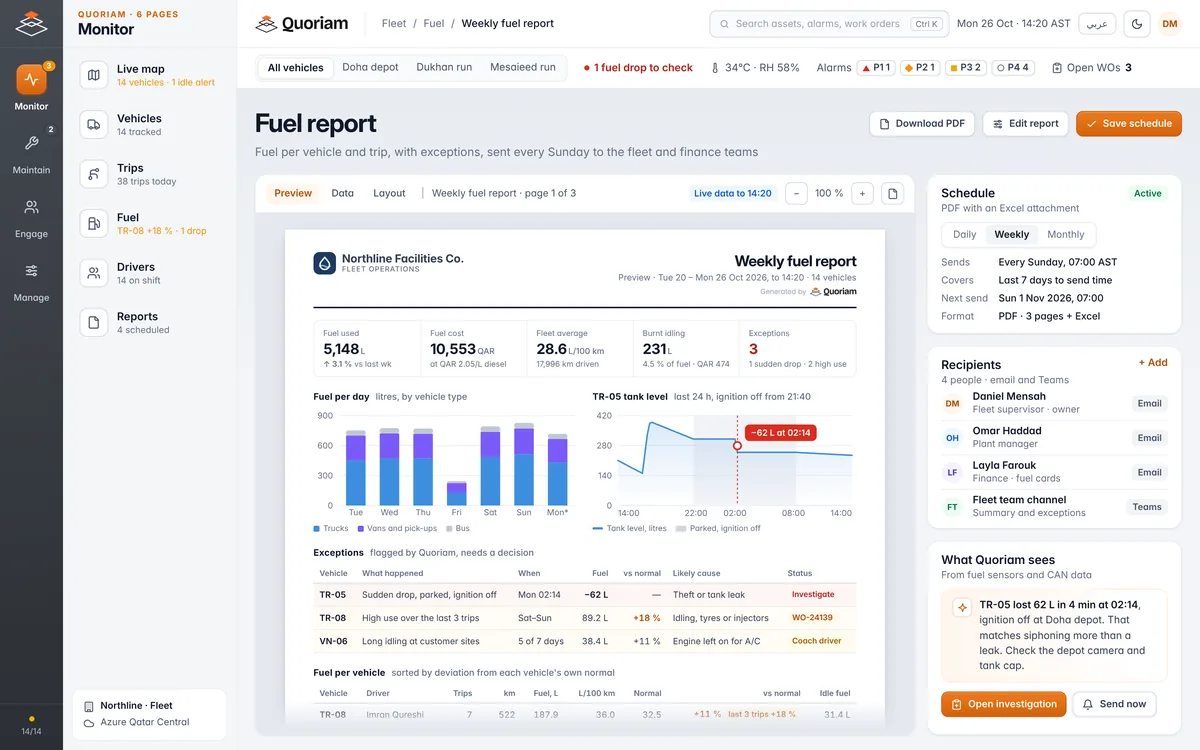
A fuel monitoring system measures the fuel in each vehicle's tank and the fuel each trip burns, using the vehicle's CAN bus data or a level sensor fitted in the tank. It flags sudden drops while the vehicle is parked, idling that burns fuel standing still, and vehicles using more than their own normal for the route.
It is the part of fleet telematics that follows the litres. Fuel cards tell you what was bought. A fuel monitoring system tells you what reached the tank, what the engine burnt, and where the rest went, vehicle by vehicle and trip by trip.
What it catches.
The five fuel events most fleets set alerts for first.
| Event | What the data shows | What catches it |
|---|---|---|
| Drain or theft from the tank | Level falls by more than your limit within minutes, while the vehicle is parked with the ignition off | Fuel level sensor. CAN bus data often misses it |
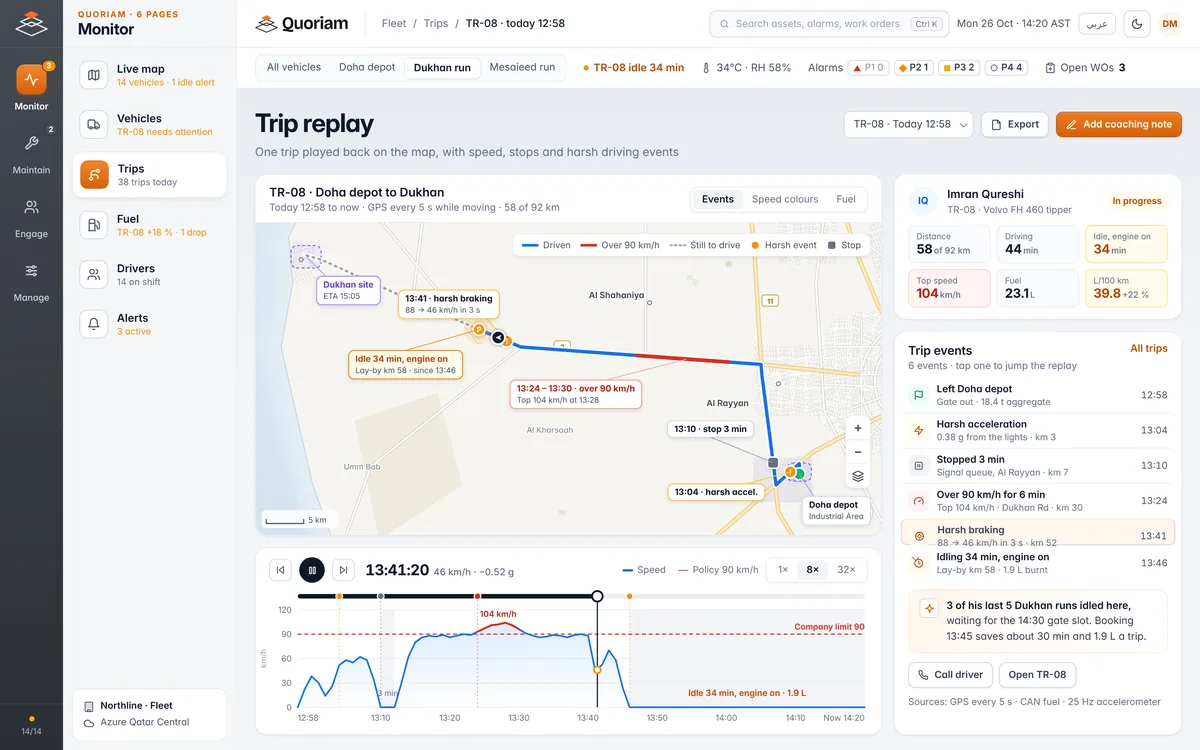
| Idling with the engine on | Ignition on, speed zero, fuel still burning, for longer than your idle limit | GPS tracker on ignition, with fuel used from the CAN bus |
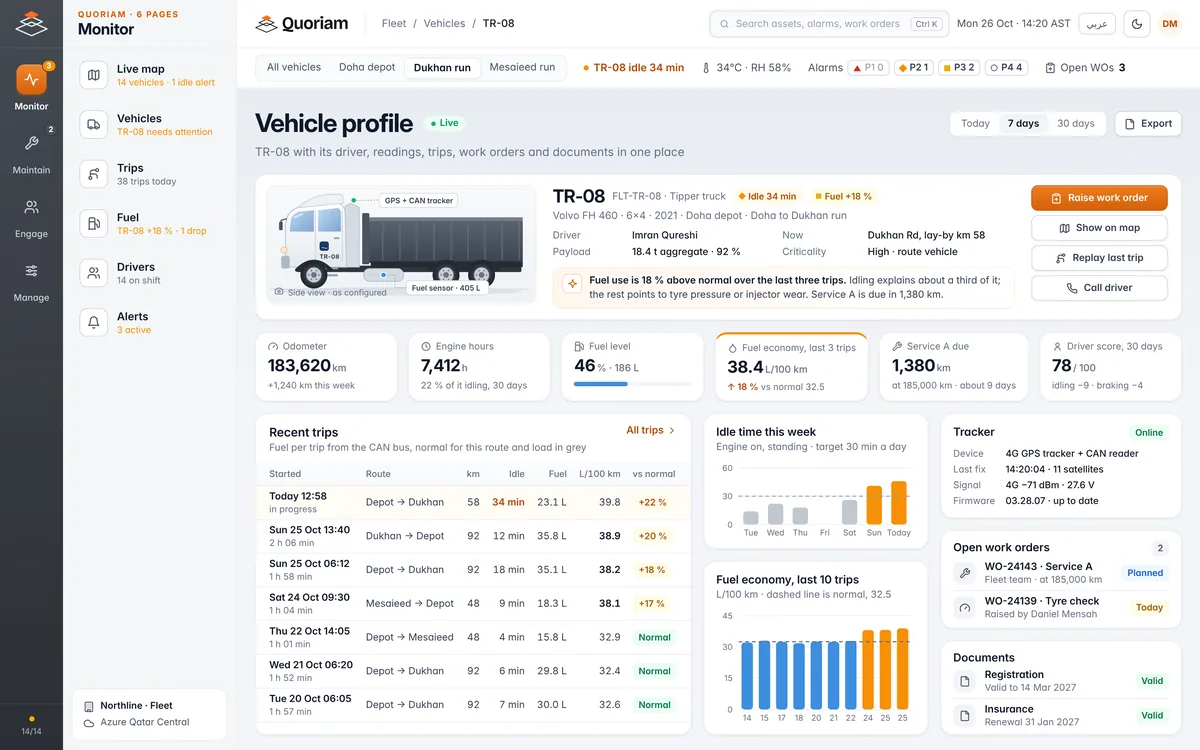
| Fuel use above normal | Litres per 100 km above the vehicle's own normal for that route and load | CAN bus data or fuel level sensor |
| Refuel recorded | Level rises while stationary, logged with litres, time and location | Fuel level sensor, or CAN bus with less precision |
| Card fill bigger than the tank rise | Litres on the fuel card higher than the rise the sensor saw at that time and place | Fuel level sensor and card data |
CAN bus data or a fuel level sensor.
Both read the tank. They differ in how closely, and that decides whether a drain gets caught.
| Source | How it measures | Typical error | Best for |
|---|---|---|---|
| Vehicle CAN busFactory float gauge | A float and resistor in the tank. The tracker reads the value the vehicle puts on its CAN bus | 10 to 20% | Fuel per trip and per 100 km, idling cost |
| Capacitive fuel level sensorFitted in the tank | A probe cut to the tank's depth. Fuel between two tubes changes its capacitance with the level | 1 to 2% | Drains, theft and refuel volumes |
Relative error figures as given by Navixy's guide to fuel level sensor types. A sensor only reaches its accuracy once the tank is calibrated: filled in measured portions, ideally a twentieth of the tank each, with the reading logged after each one (Navixy, tank calibration).
How it works.
Fit
A GPS tracker on ignition reads fuel used and level from the CAN bus. Where you need to catch drains, we fit a fuel level sensor through the top of the tank, cut to its depth and sealed.
Calibrate
We fill each tank in measured portions and log the sensor at every step, so the platform turns the reading into litres for that tank's shape.
Set the rules
You set the drain limit for a parked vehicle, the idle limit, and how far above its normal a vehicle can run.
Alert and report
Drains alert the fleet supervisor at once. High use and idling go into the weekly report with the likely cause.
System view
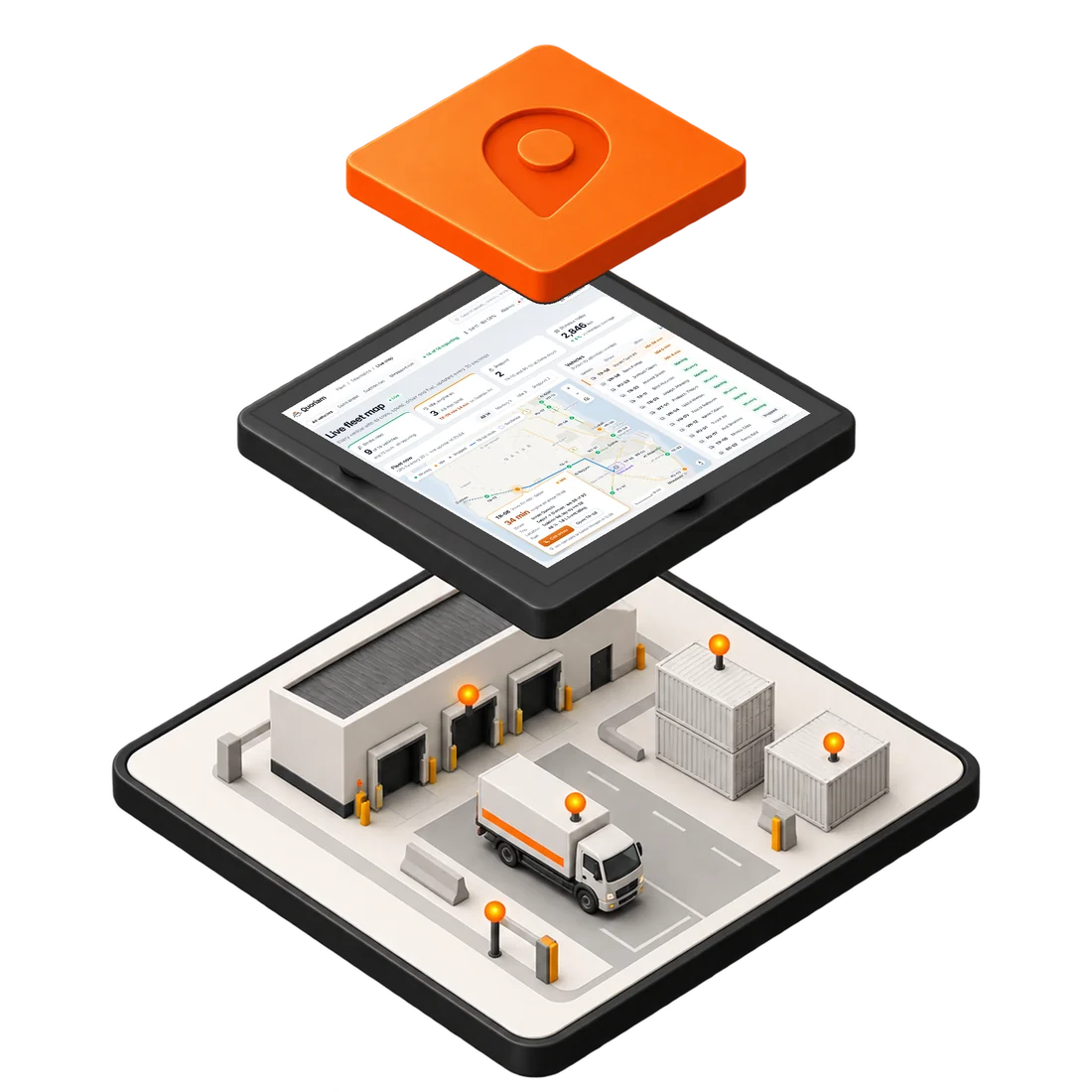
For IT, OT and security reviewers: where the data goes, and how.
- In the vehicleGPS tracker on ignition and CAN bus; fuel level sensor in the tank where fitted
- From the vehicleFuel level, fuel used, ignition, speed and position
- NetworkCellular from each tracker, encrypted in transit
- Quoriam platformOn your premises or cloud hosted in Qatar
- Your team and systemsApp, SMS and email alerts; weekly fuel reports to fleet and finance
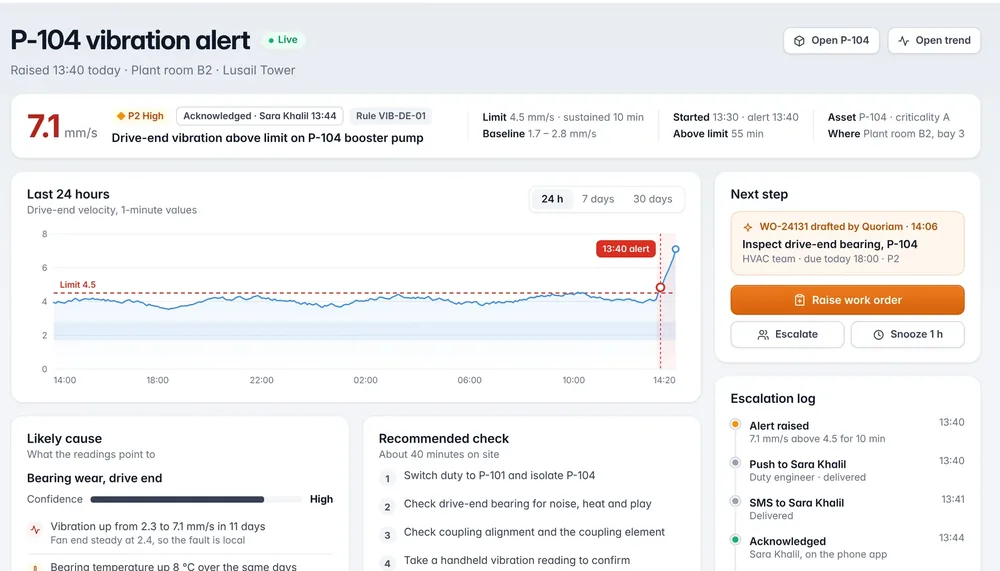
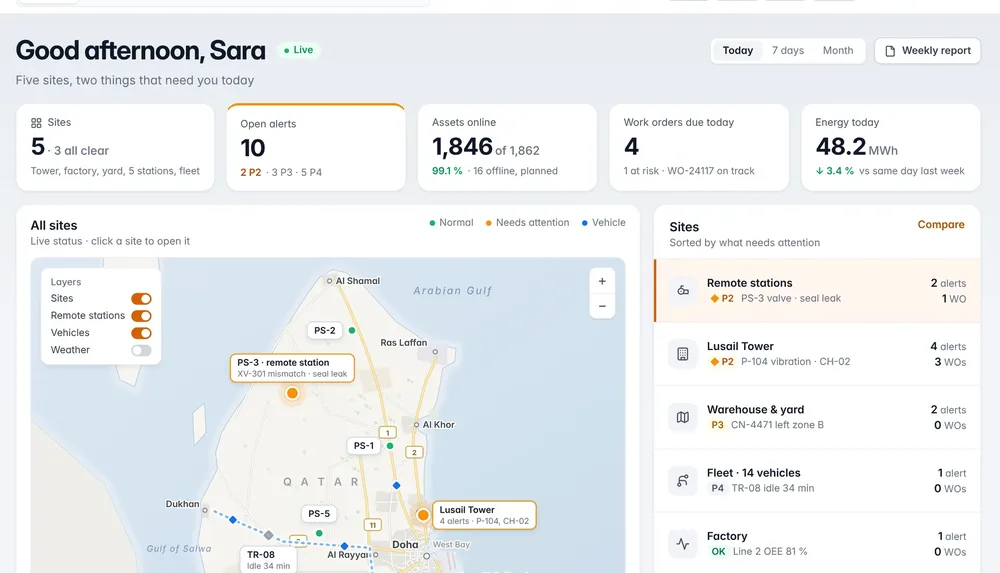
What your team sees.
Fuel per vehicle and trip, and the exceptions that need a decision.
Or just ask.
Quoriam AI answers fuel questions in plain language.
Where it's used in Qatar.
Wherever diesel is a large line in the monthly costs.
Construction and aggregates
Tippers and mixers on the runs to Dukhan and Mesaieed, idling in queues at gates and quarries.
ConstructionLogistics and distribution
Trucks and vans that park overnight at depots and customer yards, where tanks are easiest to drain.
Logistics and warehousingOil, gas and energy contractors
Crew buses and service vehicles on long runs to Ras Laffan and Mesaieed.
Oil, gas and energy
Questions buyers ask.
Something else? Ask us during the free assessment.
How does a fuel monitoring system detect fuel theft?
It watches the tank level while the vehicle is parked with the ignition off. A fall of more than your limit within minutes raises an alert with the time, place and litres lost. A small theft can hide inside the error of a factory gauge, so drain alerts need a sensor in the tank.
Is CAN bus fuel data good enough, or do we need a fuel sensor?
CAN bus data is good for fuel used per trip, per 100 km and while idling. The factory float gauge behind it has a relative error of 10 to 20%, against 1 to 2% for a calibrated capacitive sensor, according to Navixy. Fit sensors on the vehicles where drains cost most.
How much fuel does idling waste?
Plenty, and more in a Qatar summer. US Department of Energy figures put idling at 0.44 to 0.97 gallons an hour, about 1.7 to 3.7 litres, for trucks and buses with no air conditioning or other load. At QAR 2.05 a litre for diesel in October 2026, every idling hour has a price.
What hardware do we need?
One GPS tracker per vehicle, wired to ignition and reading the CAN bus. Add a capacitive fuel level sensor in the tank on vehicles where you want drain and refuel alerts. Fitting a sensor means drilling the top of the tank, so we do it at a planned stop, with the tank calibrated afterwards.
Can it reconcile our fuel card transactions?
That is the aim: each card fill matched against the rise the tank sensor saw at the same time and place, with mismatches flagged for finance. The weekly fuel report already goes to finance as a PDF with an Excel attachment.
What does it cost, and can we pilot it?
It depends on how many vehicles you track and how many need a tank sensor. The free three-week assessment ends with a scope and a fixed price for your fleet. You can then prove it on part of the fleet in a pilot before fitting every vehicle.
Related.
Fuel monitoring is part of fleet telematics on the Quoriam platform.
- Fleet telematics
Track vehicles, fuel and driver behaviour, with servicing scheduled from the same data.
- Driver behaviour monitoring
Speeding, harsh braking and idling scored per driver, every week.
- Refrigerated vehicle monitoring
Load temperature in every reefer truck, with alarms on the road.
- Tank level monitoring
Water, diesel and chemical tank levels read remotely, with low-level and leak alarms.
Find out where your diesel goes.
A free three-week assessment. We review your vehicle list, fuel card statements and routes with your team, then recommend which vehicles need a tank sensor and which only need the CAN bus.
We take on two assessments a month.Quoriam is designed to pay back within six months. How we calculate payback