

- Home
- Solutions
- Asset tracking and geofencing
- People tracking
Worker Tracking System in Qatar
Lone worker monitoring, man-down alerts and muster counts for people on large or hazardous sites: help reaches someone who is hurt or alone, and in an evacuation you know who is still inside.
Last updated
What is a worker tracking system?
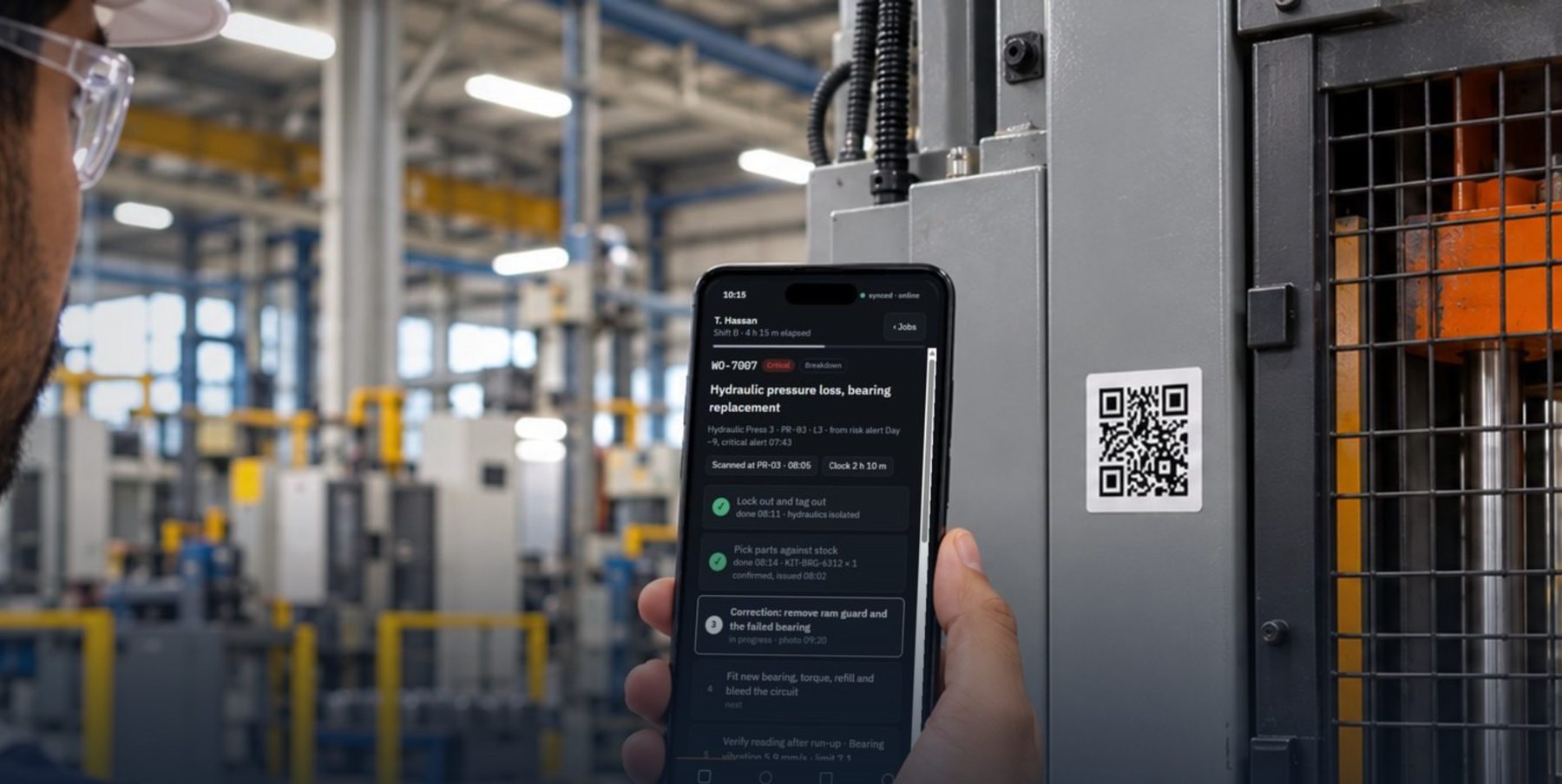
A worker tracking system gives each person on a large or hazardous site a wearable badge. Gateways and GPS place the badge by zone during the shift. If a lone worker misses a check-in, presses SOS or stops moving after a fall, a supervisor gets an alert, and in an evacuation the muster count shows who is unaccounted for.
Most sites start with lone worker monitoring: people working alone in a plant room, a remote pump station or a tank farm, where a fall could go unnoticed for hours. In an evacuation, the same badges give the muster count: everyone heard at a muster point is ticked off, and the emergency team gets the list of people still missing.
It is a safety system, and it should be run as one. Badges are located on shift and on site only, for purposes your workers are told about in advance, under rules your HSE, HR and legal teams agree first.
What it catches, and what happens.
The events most sites set up first.
| Event | What the system sees | What happens |
|---|---|---|
| Missed check-in | No check-in at the agreed interval | Reminder on the badge, then a supervisor alert with the last known zone |
| SOS | The worker presses the badge's alarm button | Immediate alert with the zone, escalating until someone acknowledges |
| Man-down | An impact followed by no movement for a set time | Pre-alarm on the badge the worker can cancel, then the supervisor alert |
| Restricted area | A badge is heard in a zone the person has no permit for | Alert to the area authority for that zone |
| Evacuation | The site alarm is raised and badges arrive at muster points | Live muster count, with the list of people not yet accounted for |
| Outdoor work in ban hours | Badges in an outdoor zone during the summer midday ban | Alert to the supervisor to bring the crew into shade |
Qatar's heat stress rules.
Summer work in Qatar has legal limits. Zone schedules help supervisors keep to them.
| Rule | What it says | When it applies |
|---|---|---|
| Midday outdoor work ban | No outdoor work from 10:00 to 15:30 | 1 June to 15 September |
| WBGT limit | All work stops at a workplace when the wet-bulb globe temperature exceeds 32.1 °C | Any time of day |
| Risk assessment | Employers prepare a heat stress risk assessment | Mandatory |
WBGT combines air temperature, humidity, solar radiation and wind speed. Sources: ILO, May 2021 and Qatar Tribune, June 2026. Quoriam can log WBGT where a heat stress sensor is fitted.
How it works.
Agree the rules
With your HSE and HR teams, and worker representatives where you have them, we agree who wears a badge, when, what is recorded, who can see it and how long it is kept.
Badge and cover
Workers collect a badge at the start of the shift and return it at the end. Gateways cover plant rooms, buildings and muster points; GPS covers open and remote areas.
Alert
Missed check-ins, SOS and man-down alarms go to the supervisor on duty in the app and by SMS, then escalate to the next person if nobody acknowledges.
Muster and review
In a drill or an evacuation, the muster count runs live, and the timeline goes into the drill or incident record.
System view
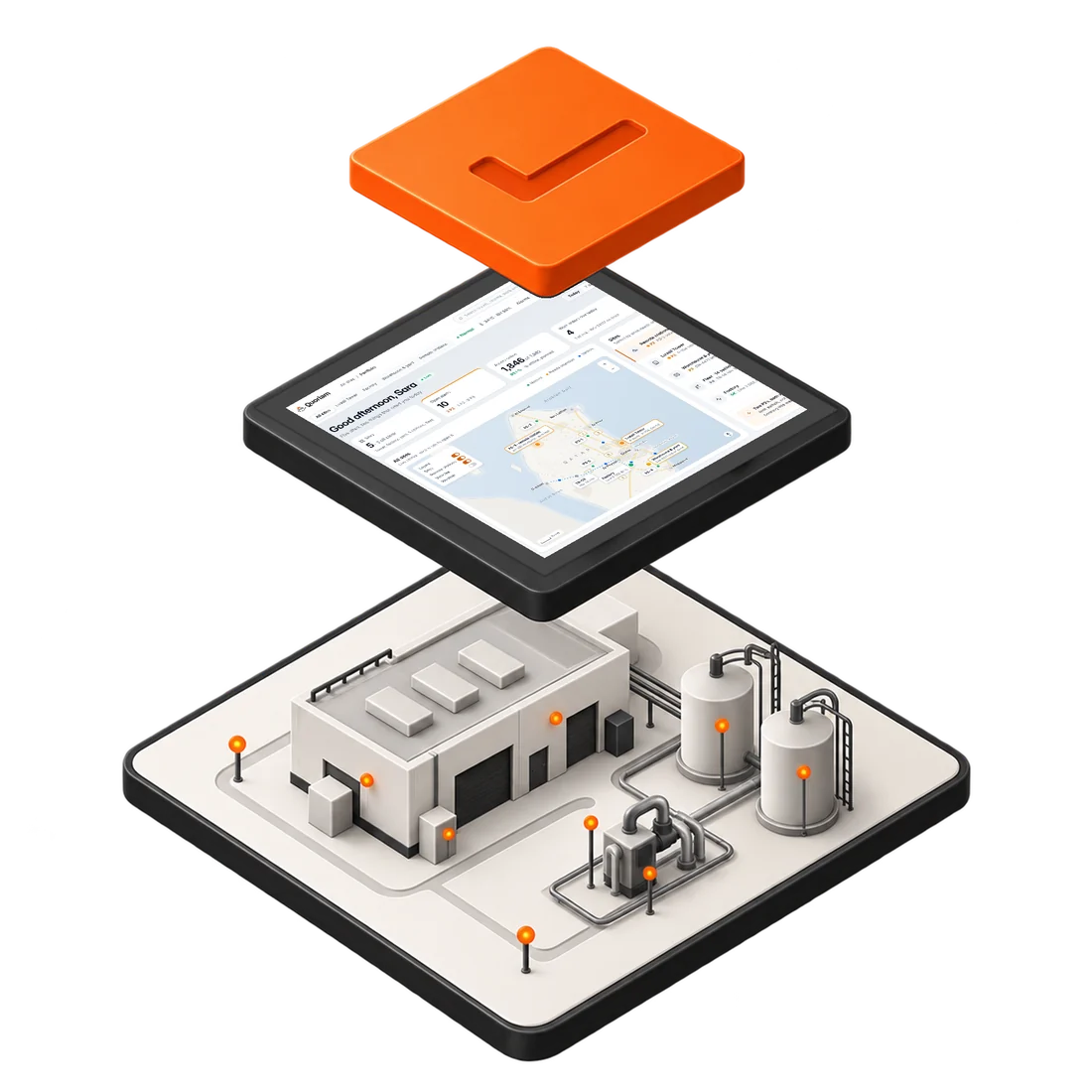
For IT, OT and security reviewers: where the data goes, and how.
- On the workerBadge with SOS button and motion sensor
- On siteBLE gateways in buildings and at muster points; LoRaWAN or cellular for open areas
- NetworkSite LAN and cellular, encrypted and kept apart from the control network
- Quoriam platformCloud or on-premise
- Your teamAlerts to supervisors and the emergency team; muster lists; drill records
What your team sees.
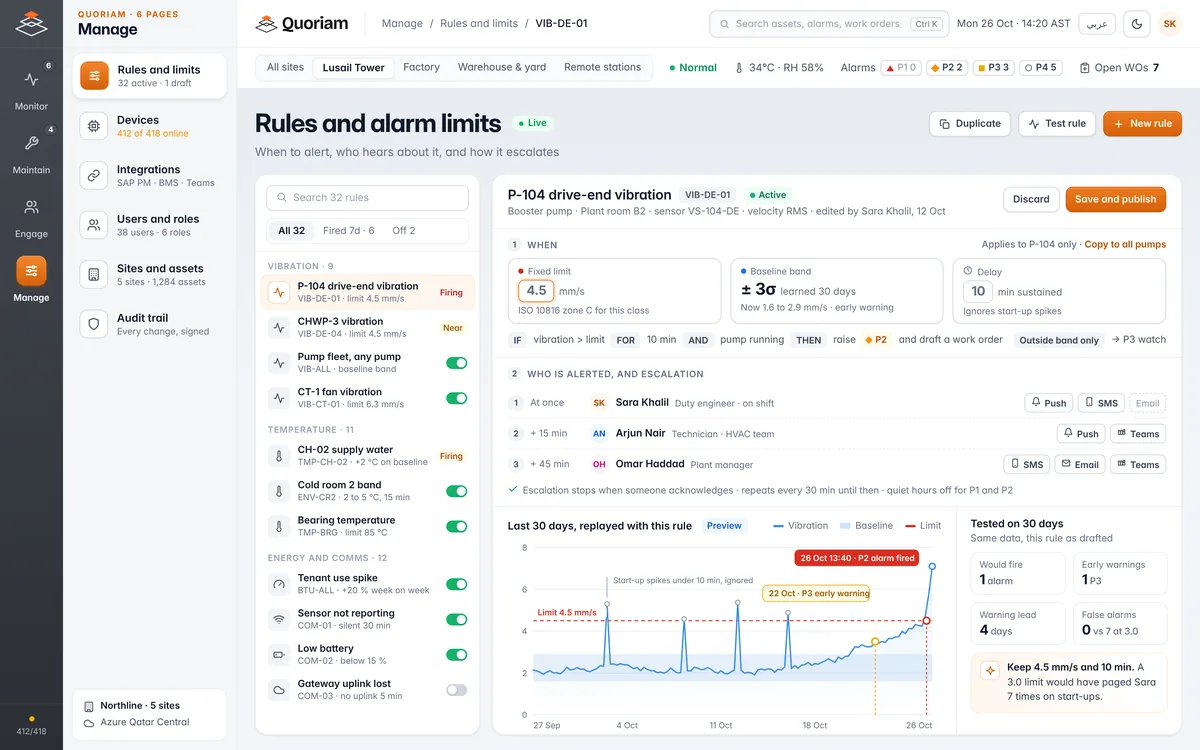
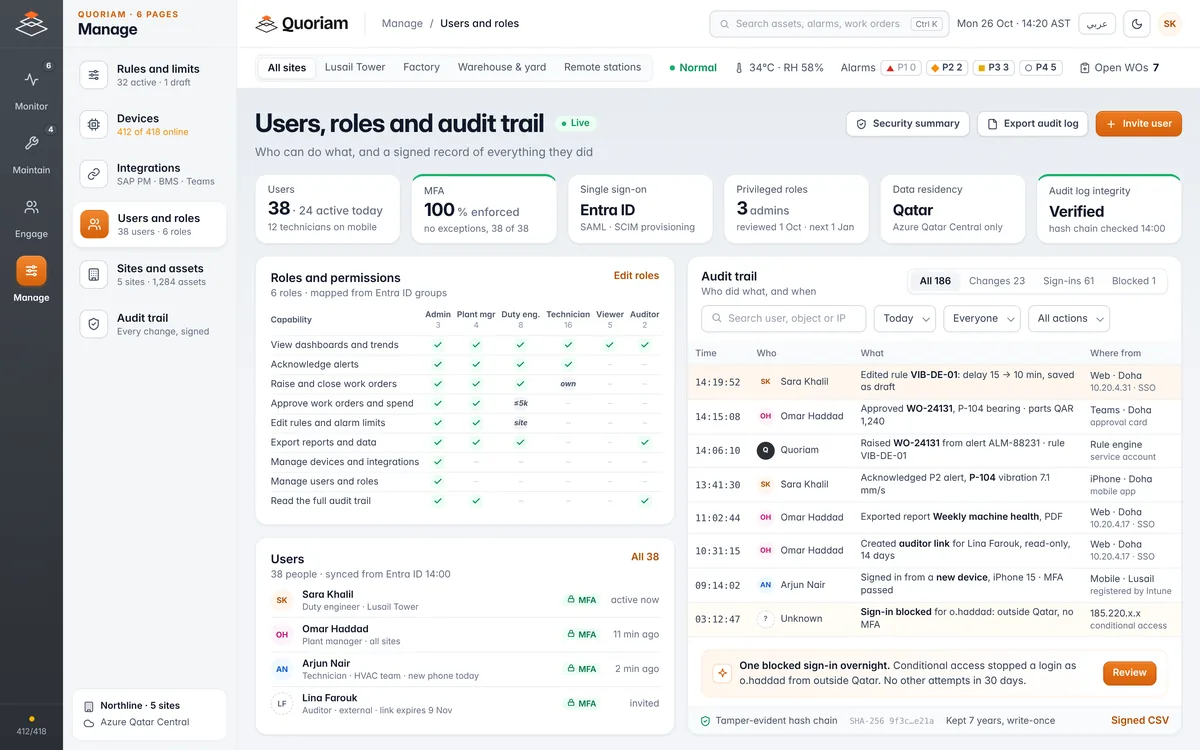
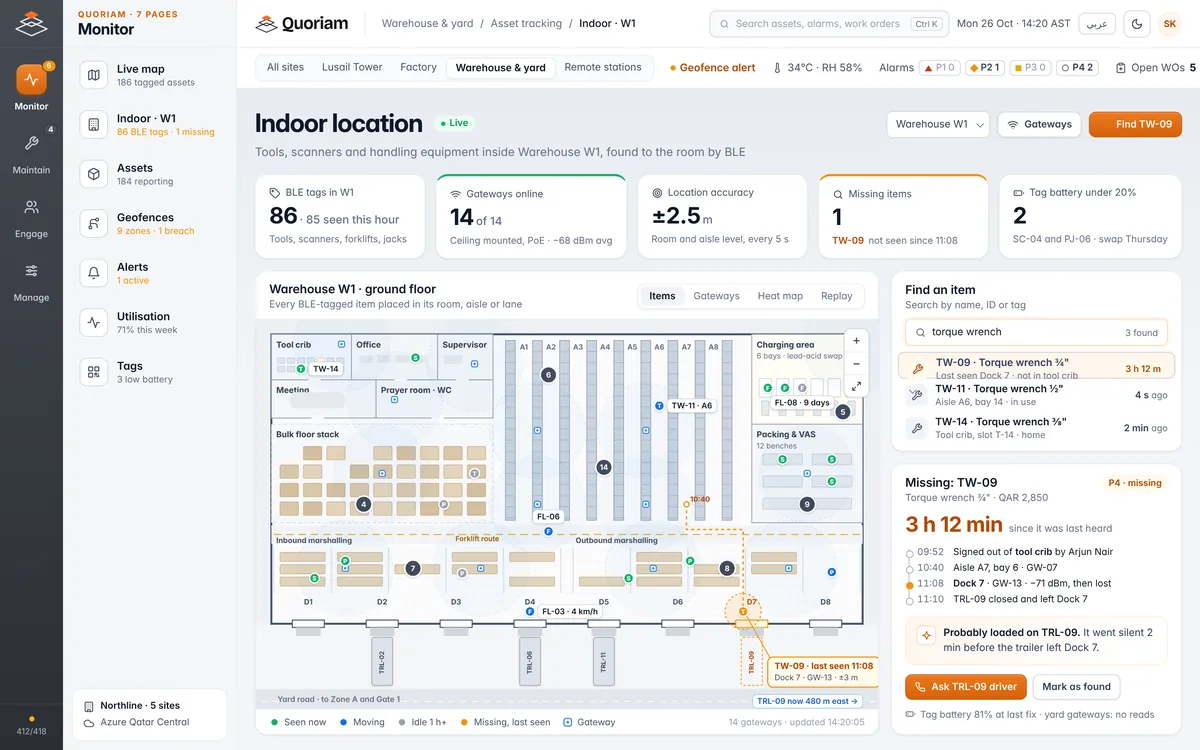
Who is alerted, who can see what, and where a badge was last heard.
Where it's used in Qatar.
Large sites where people work alone, in heat or in hazardous areas.
Oil, gas and energy
Process areas, tank farms and substations at Ras Laffan and Mesaieed.
Oil, gas and energyConstruction sites
Many contractors, and a muster list that changes daily.
ConstructionRemote stations
Pump stations and utility sites visited by one technician on a round.
Remote operations monitoringCold stores and plant rooms
Freezers, chiller plants and basements where nobody hears a call for help.
Environmental monitoring
Questions buyers ask.
Something else? Ask us during the free assessment.
Is it legal to track workers in Qatar?
Qatar's personal data protection law, Law No. 13 of 2016, sets conditions such as consent, telling people what is collected and why, and keeping only what is needed (Dentons summary). Tracking should be agreed with your legal and HR teams before rollout. We set badges to work on shift and on site only.
How does man-down detection work?
The badge has a motion sensor. A hard impact, or a long spell with no movement, starts a short pre-alarm on the badge so a worker who is fine can cancel it. If nobody cancels, the supervisor gets an alert with the worker's last known zone. Timings are agreed with your HSE team.
What hardware do workers wear?
A badge on a lanyard or clip with an SOS button and a motion sensor. Indoors, BLE gateways locate it by zone; outdoors and on remote sites, a GPS badge or the worker's phone can be used. Badges are charged and issued at the start of each shift.
How many gateways do we need?
Enough to cover the buildings, plant rooms and muster points where you need location, which depends on floor area and walls. Open areas may need only a few gateways or GPS badges. The free assessment walks your site with the HSE team and counts them.
Can it be used in hazardous areas?
Yes, with badges and gateways certified for the zone, ATEX, IECEx or both, to your site's specification. We specify certified equipment where it is needed and give you each certificate before anything goes on site, as we do for hazardous area monitoring.
Can it connect to our access control or permit system?
Quoriam can read who is on site from your access control system and which permits are open, so muster lists and restricted-zone rules stay current. We agree each connection, and what data it carries, with your IT and HSE teams during the assessment.
What does a pilot cost?
It depends on how many people wear badges and how much of the site needs coverage. Most sites start with lone workers in one area and a muster drill. The free three-week assessment ends with a scope and a fixed price.
Related.
People tracking is part of asset tracking on the Quoriam platform.
- Asset tracking and geofencing
Know where equipment, tools and containers are, and get an alert the moment one leaves its zone.
- ATEX and hazardous area monitoring
Certified wireless sensors for Zone 1 and Zone 2 areas at LNG, oil, gas and chemical sites.
- Tool and equipment tracking
BLE tags on tools and mobile equipment, found by zone across sites and stores.
Know everyone is safe.
A free three-week assessment. We walk your site with your HSE team, then recommend where lone-worker and muster coverage is needed first, and the rules to agree.
We take on two assessments a month.Quoriam is designed to pay back within six months. How we calculate payback