




- Home
- Solutions
- Remote operations monitoring
- Valve position monitoring
Valve Position Monitoring in Qatar
Open, closed or in between, for every critical valve at your remote sites, checked against the line-up so nobody has to walk the valve pits to prove it.
Last updated

What is valve position monitoring?
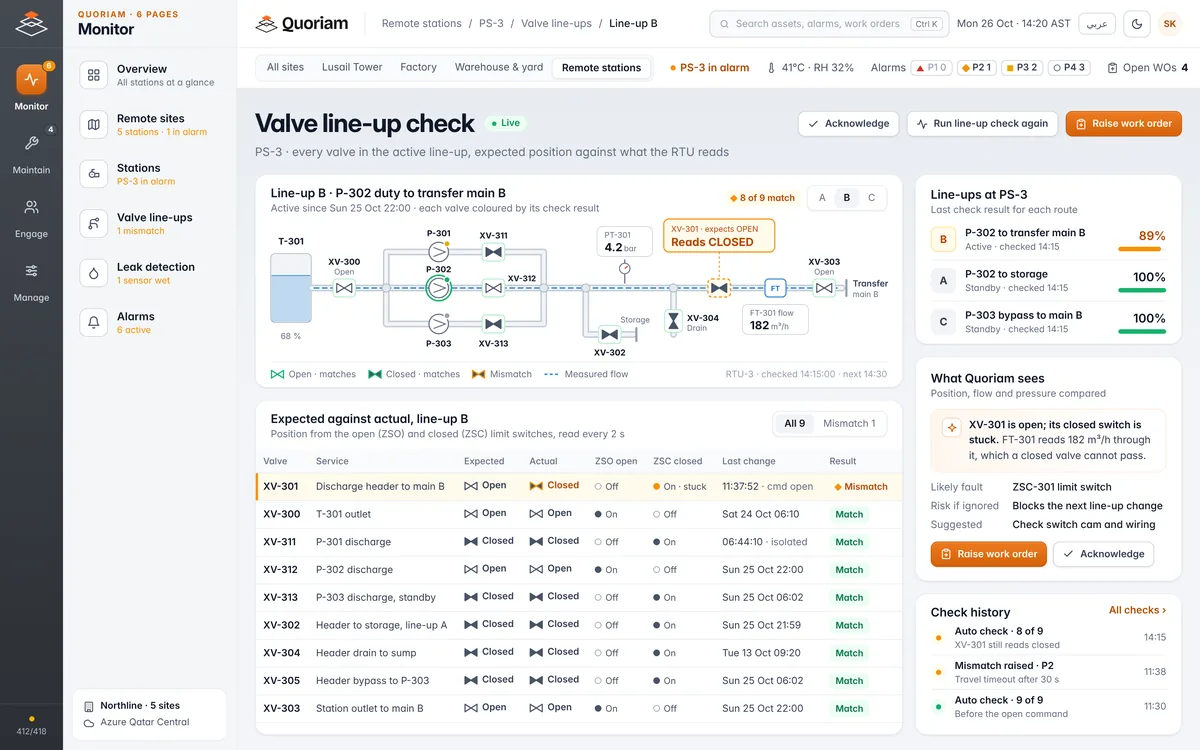
Valve position monitoring reports whether each valve is open, closed or in between, using limit switches or a position transmitter on the valve. Checked against the active line-up, it flags any valve in the wrong position, a valve slow to travel after a command, or a switch that disagrees with the flow, without a site round.
Most valves on a pipeline or in a plant are operated by hand, and checklists are how sites keep them right during start-up, flushing and line-up changes. Phoenix Contact notes that incorrect operation of manual valves can stop production or cause major accidents. In an Emerson customer survey, 90% reported valve alignment issues in the previous year.
Position feedback turns that checklist into a live check. It is one part of remote operations monitoring, where each valve's position sits beside the pressures and flows that confirm it.
What it catches.
What the position signals show, and what the alert tells the technician.
| Problem | What Quoriam sees | When you hear about it |
|---|---|---|
| Valve in the wrong position | Position disagrees with the active line-up | At once, and before anyone changes the line-up |
| Slow or failed travel | No change of position within the travel time after the control system commands a move | When the travel timeout passes, 30 seconds in the example on screen |
| Stuck or faulty limit switch | The closed switch is made, yet the flow meter shows the valve passing | With the likely fault, so the technician brings a switch, not a valve |
| Valve left part open | Neither the open nor the closed switch is made | At once, with the time it stopped moving |
| Unplanned operation | A manual valve moves with no line-up change or work order | As it moves, with the time it changed |
Ways to get position feedback.
Four ways to know where a valve is. Many sites use more than one.
| Method | How it reports | Best for |
|---|---|---|
| Open and closed limit switches | Two contacts, made at the open and closed end positions, wired to the RTU or PLC | Actuated valves already wired to a control panel |
| Retrofit limit switches on manual valves | End-position switches fitted to the valve, read by nearby I/O | Manual valves close to a panel, for checklists at start-up and flushing |
| Position transmitter | Continuous position, from fully closed to fully open | Control valves and valves set part open |
| Wireless position monitor | Battery-powered, linkage-less position over a WirelessHART mesh | Manual and remote valves where new cable is costly |
Wireless monitors cut cabling, engineering and I/O cost; one maker quotes 5 to 10 years of battery life. Sources: Phoenix Contact, valve monitoring and Emerson Fisher 4320 announcement.
How it works.
Connect or fit
Read existing limit switches from the RTU or PLC over a read-only link. Fit switches or wireless monitors on the critical valves that have nothing.
Enter the line-ups
List the position every valve should be in for each line-up, so Quoriam can compare expected with actual every few seconds.
Alert and act
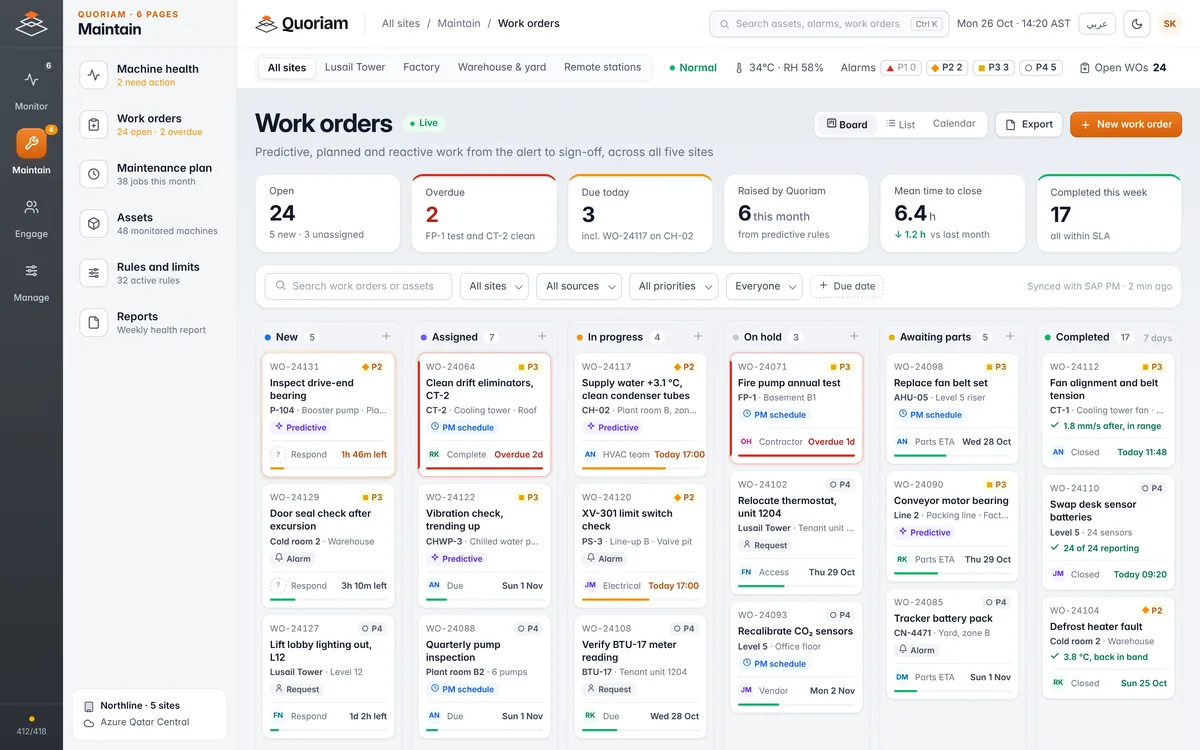
A mismatch goes to the duty engineer with the flow and pressure that show which reading is wrong, ready to become a work order.
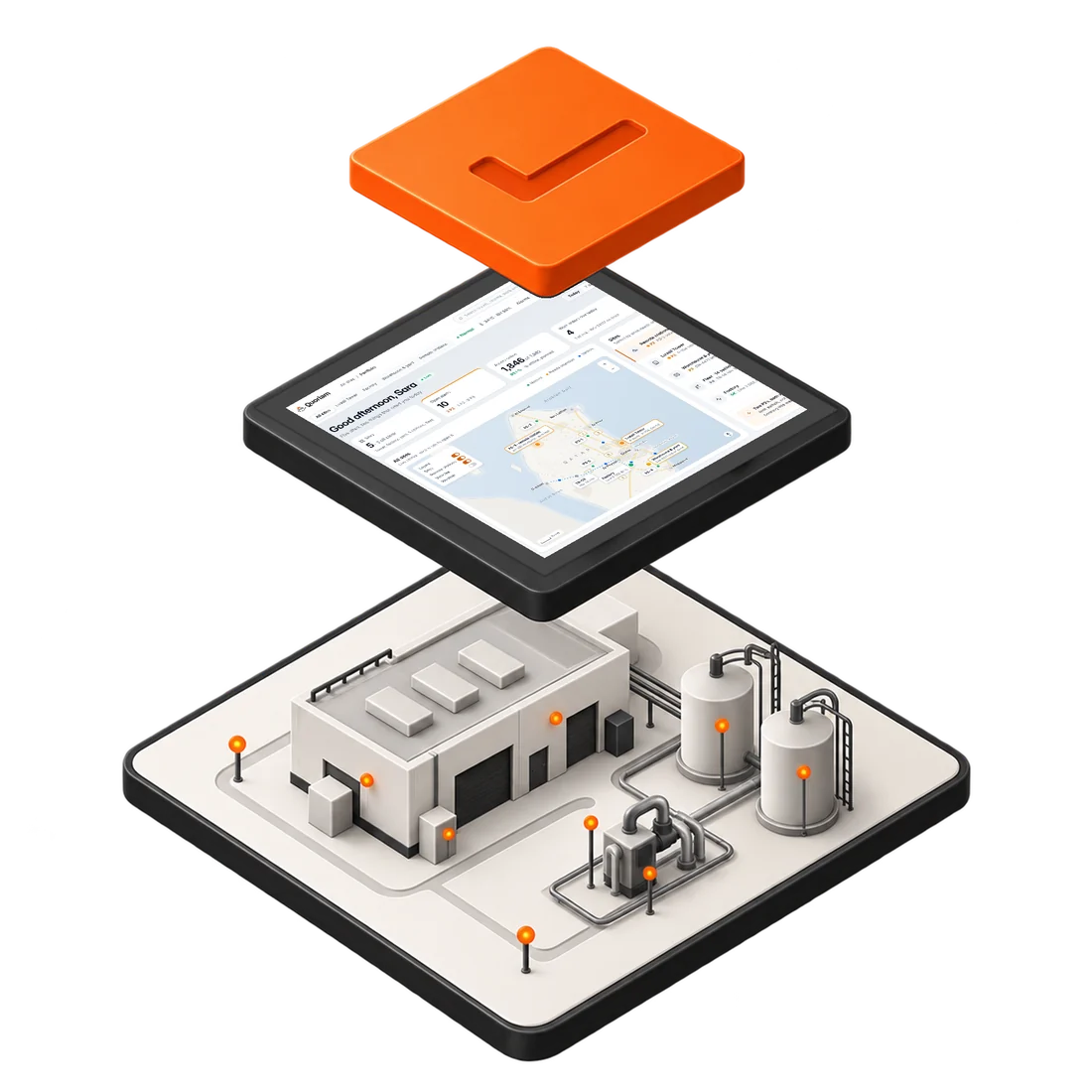
System view
For IT, OT and security reviewers: where the data goes, and how.
- On the valveLimit switches, a position transmitter or a wireless position monitor
- At the stationExisting RTU or PLC, or a Quoriam Edge gateway over 4G or fibre
- NetworkCellular, fibre or site LAN, encrypted and kept apart from the control network
- Quoriam platformOn your premises or cloud hosted in Qatar
- Your team and systemsApp, SMS and email alarms; work orders to Quoriam or your CMMS
What your team sees.
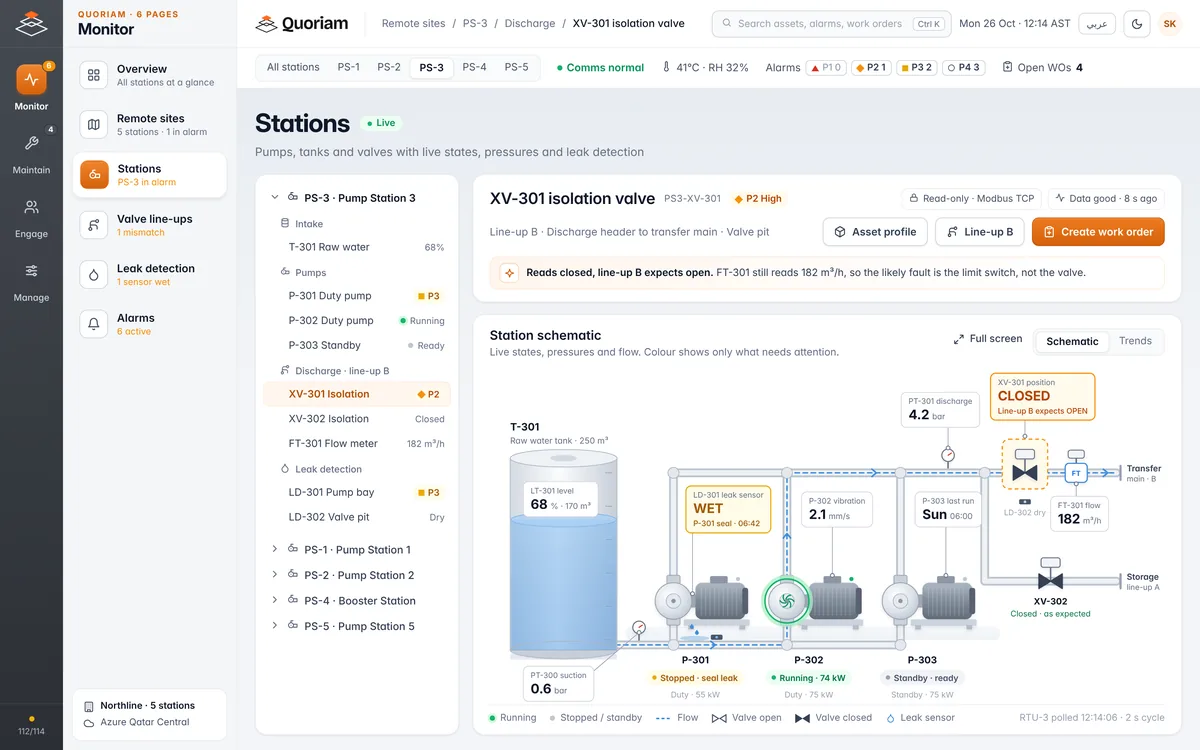
The line-up, the valve in its station and the work order that fixes it.
Or just ask.
Quoriam AI answers questions about your valves in plain language and turns the answer into an action.
Where it's used in Qatar.
Wherever a valve in the wrong place sends product or water the wrong way.
Oil, gas and energy
Manifolds, tank farm line-ups and loading lines.
Oil, gas and energyHazardous areas
Valves inside Zone 1 and Zone 2, with certified switches and wireless monitors.
ATEX and hazardous area monitoringWater transmission
Isolation and transfer valves on mains between stations and reservoirs.
Utilities and district coolingPump stations
Suction, discharge and bypass valves that decide which pump feeds which main.
Pump station monitoring
Questions buyers ask.
Something else? Ask us during the free assessment.
What is the difference between a limit switch and a valve position transmitter?
A limit switch tells you a valve has reached an end position, fully open or fully closed. Most on-off valves carry two, one for each end. A position transmitter reports the position continuously, so you can see a valve at 40% open. Use switches for isolation valves and transmitters for control valves or valves set part open.
Can you monitor manual valves?
Yes. A manual valve can take retrofit limit switches wired to nearby I/O, or a battery-powered wireless position monitor that needs no new cable. Wireless suits valves spread along a pipeline or far from a panel. In a classified area we use devices certified for the zone; see ATEX and hazardous area monitoring.
How many valves should we monitor?
Start with the valves that change in a line-up, the main isolations and any valve whose wrong position would cause a spill, an overpressure or a dry main. That is often a small share of the total. The free assessment lists them station by station with what each needs.
Can it use the valve positions our SCADA already reads?
Yes. Quoriam reads open and closed switches and position transmitters from your RTUs, PLCs or SCADA over Modbus TCP or OPC UA, so valves already wired need nothing new. On the PS-3 screen, XV-301 is read over a read-only Modbus TCP link.
Can Quoriam open or close the valves?
No. Valve commands stay with your control system and your operators, as they do today. Quoriam compares what each valve reports with what the active line-up expects, alarms on any difference, and records who acknowledged the alarm and what they did about it.
What does it cost?
It depends on how many valves you choose, how many already have feedback and how far the rest are from a panel. The free three-week assessment ends with a scope and a fixed price for your sites. A pilot on a few sites can come first.
Related.
Valve position monitoring is part of remote operations monitoring on the Quoriam platform.
- Remote operations monitoring
Valves, tanks, pumps and solar arrays across remote sites on one screen, with alarms on any change.
- ATEX and hazardous area monitoring
Certified wireless sensors for Zone 1 and Zone 2 areas at LNG, oil, gas and chemical sites.
- Pump station monitoring
Run status, pressure, flow and power at unmanned pump stations.
- Tank level monitoring
Water, diesel and chemical tank levels read remotely, with low-level and leak alarms.
Prove every line-up without the walk.
A free three-week assessment. We review your valves and line-ups and what already reports a position, then recommend where feedback will save the most site rounds.
We take on two assessments a month.Quoriam is designed to pay back within six months. How we calculate payback