






- Home
- Solutions
- Environmental monitoring
- Temperature and humidity monitoring
Temperature and Humidity Monitoring in Qatar
Calibrated sensors in your warehouses, server rooms, labs and pharmacy stores: an alert while there's time to act, and a record that stands up to an auditor.
Last updated
What is a temperature and humidity monitoring system?
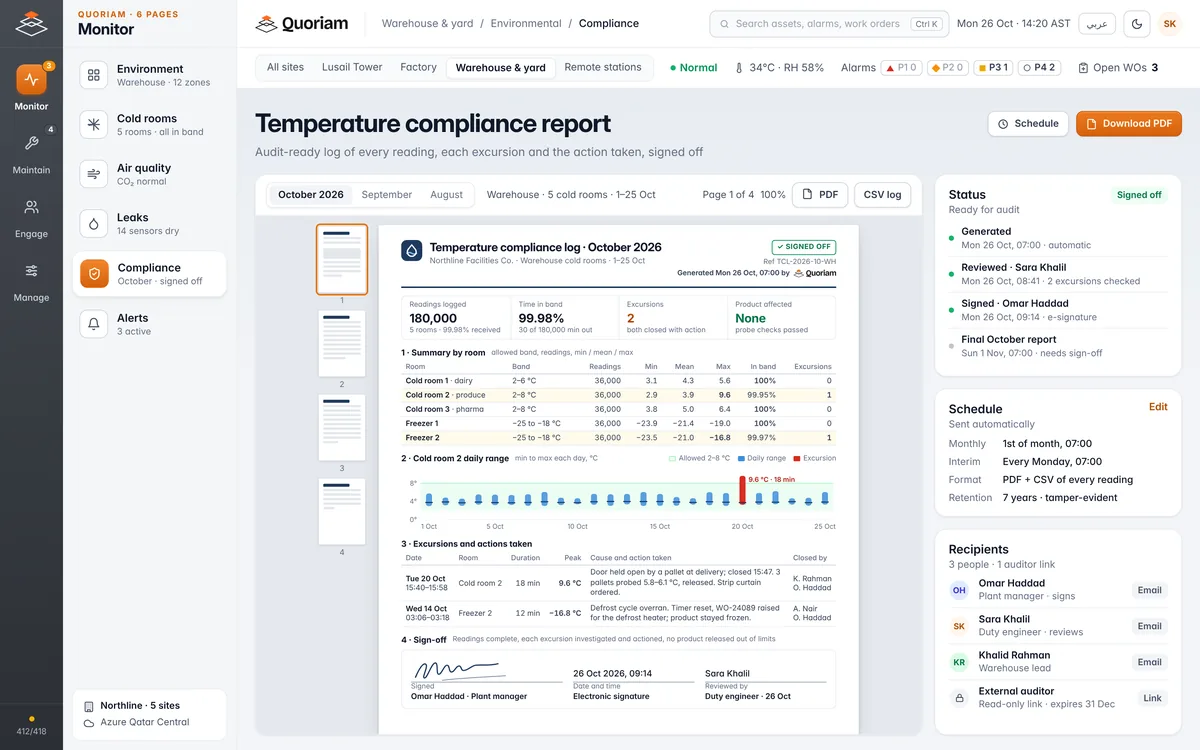
A temperature and humidity monitoring system places wireless sensors at the warmest and coolest spots of each warehouse, server room, lab or pharmacy store, and checks every reading against that space's limits as it arrives. It alerts the right person when a zone drifts out of band, and keeps a time-stamped record of every reading for audits.
It is the everyday half of temperature control. Mapping is the other half: a one-off survey with many temporary loggers that finds where a store runs warmest and coolest. Monitoring then watches those spots every few minutes, so the record shows what the room did between inspections.
What it catches, space by space.
The problems we look for first, and how the readings give each one away.
| Space | What goes wrong | What the sensors see |
|---|---|---|
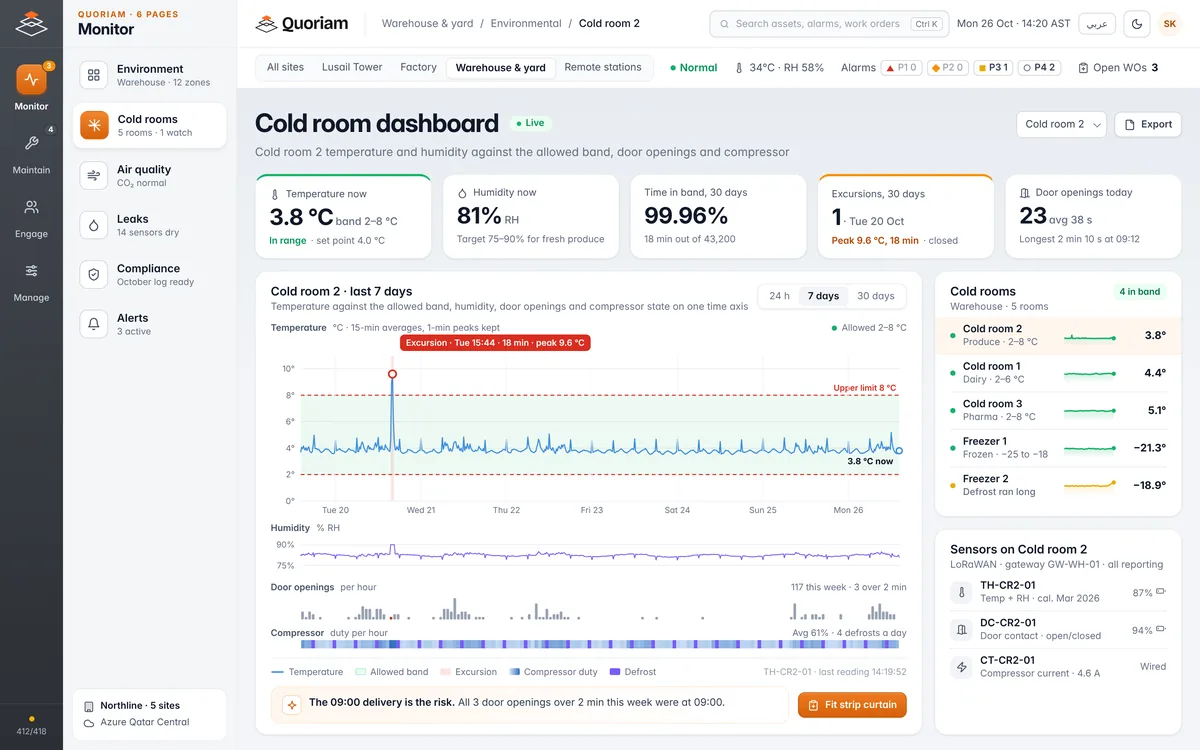
| High-bay warehouse | Upper racking runs hotter than the floor on summer afternoons | High and low sensors drifting apart from midday |
| Dock and staging area | Hot, humid air pours in through open dock doors | Temperature and humidity rising together in step with deliveries |
| Server or comms room | A cooling unit trips, or hot exhaust reaches the rack inlets | Inlet temperature climbing fast, towards the 5 °C-in-15-minutes rate limit |
| Lab or pharmacy fridge | A door seal fails, or the compressor starts to struggle | The daily average creeping up for days while still inside the band |
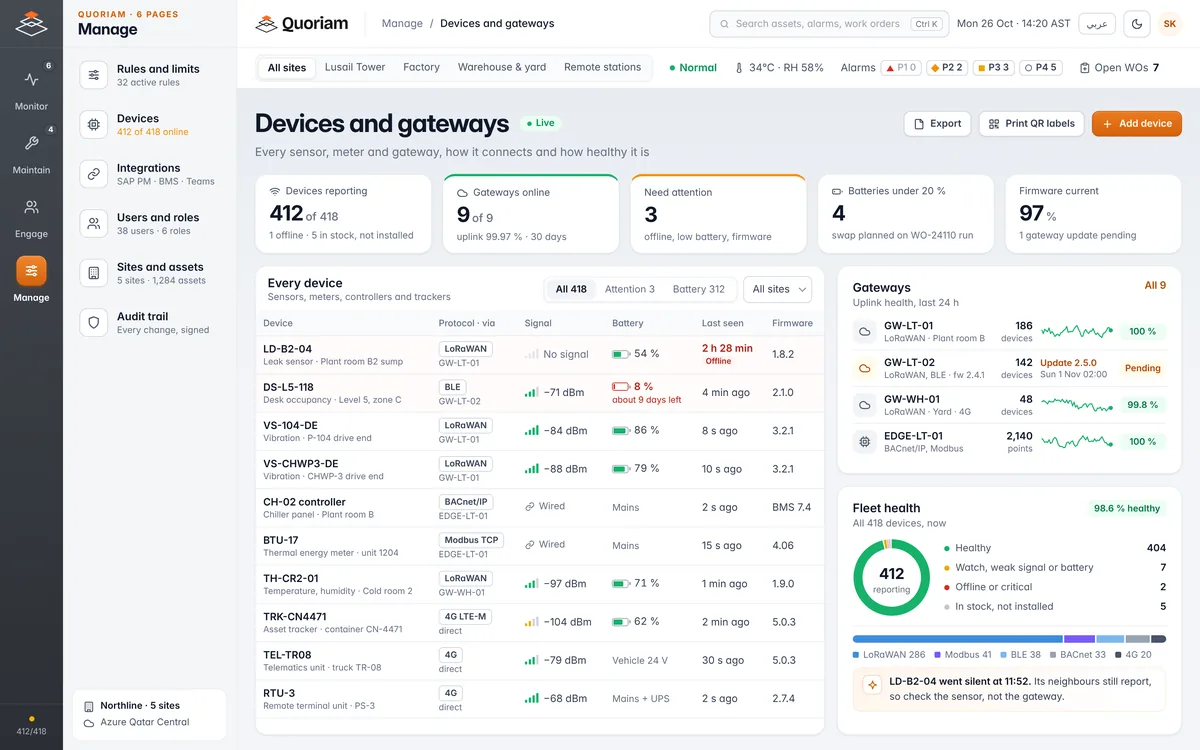
| The sensor itself | Flat battery, lost signal or calibration overdue | A gap in the record, flagged before the audit finds it |
Server room limits, by the guideline.
Most server rooms run to ASHRAE's thermal guidelines. Your equipment class sets the alarm limits.
| Envelope | Temperature | Humidity |
|---|---|---|
| RecommendedClasses A1 to A4 | 18 to 27 °C | −9 °C to 15 °C dew point, and 70% RH or lower |
| AllowableClass A1 | 15 to 32 °C | −12 °C dew point and 8% RH, to 17 °C dew point and 80% RH |
| AllowableClass A2 | 10 to 35 °C | −12 °C dew point and 8% RH, to 21 °C dew point and 80% RH |
| Rate of change | No more than 20 °C in an hour, and 5 °C in any 15 minutes | No separate limit |
Source: ASHRAE TC 9.9, Thermal Guidelines for Data Processing Environments, 5th edition, reference card. Keep RH at 50% or lower where corrosion coupon tests fail. The ranges refer to air entering the IT equipment, as Data Center Frontier explains, so that is where the sensors go.
Mapping and calibration, by the WHO guidance.
WHO's method for medicine stores. We apply it to any store that must prove its temperatures.
| Topic | What the guidance says |
|---|---|
| Sensor accuracy | ±0.5 °C or better for temperature; ±5% RH for humidity |
| Calibration | Monitoring sensors calibrated every year |
| Sensor position | At the hot and cold spots found by mapping, where door openings won't cause frequent alarms |
| Mapping grid | A logger every 5 to 10 m; at floor level, 1.2 m and 3.0 m where the ceiling is 3.6 m or lower |
| Mapping length | At least seven days in a warehouse; 24 to 72 hours in a cold room |
| Re-mapping | After any significant change, and periodically, for example every three years |
Source: WHO Technical Report Series 961, Annex 9, Supplement 8, Temperature mapping of storage areas, and Supplement 6, Temperature and humidity monitoring systems for fixed storage areas, 2015.
How it works.
Find the spots
We start from your last mapping report. If there isn't one, the store is mapped first.
Fit
Wireless temperature and humidity sensors go at the hot and cold spots, at the rack inlets in server rooms and inside each lab fridge. A LoRaWAN gateway sends readings to the Quoriam platform.
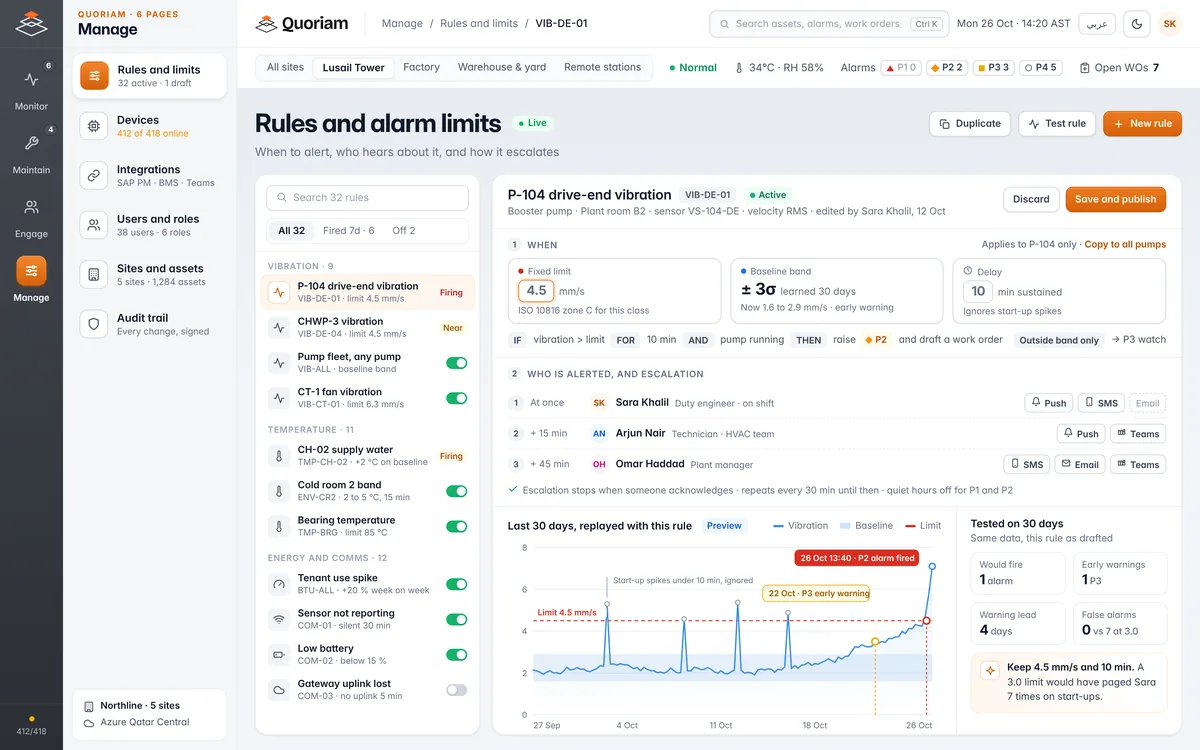
Set limits and delays
Limits come from the product label, your procedures or the ASHRAE envelope, with a short delay so a door opening doesn't page anyone. Alerts escalate until acknowledged.
Keep the record
Every reading, alert and acknowledgement goes into the monthly report. Each sensor's calibration date is on its record.
System view
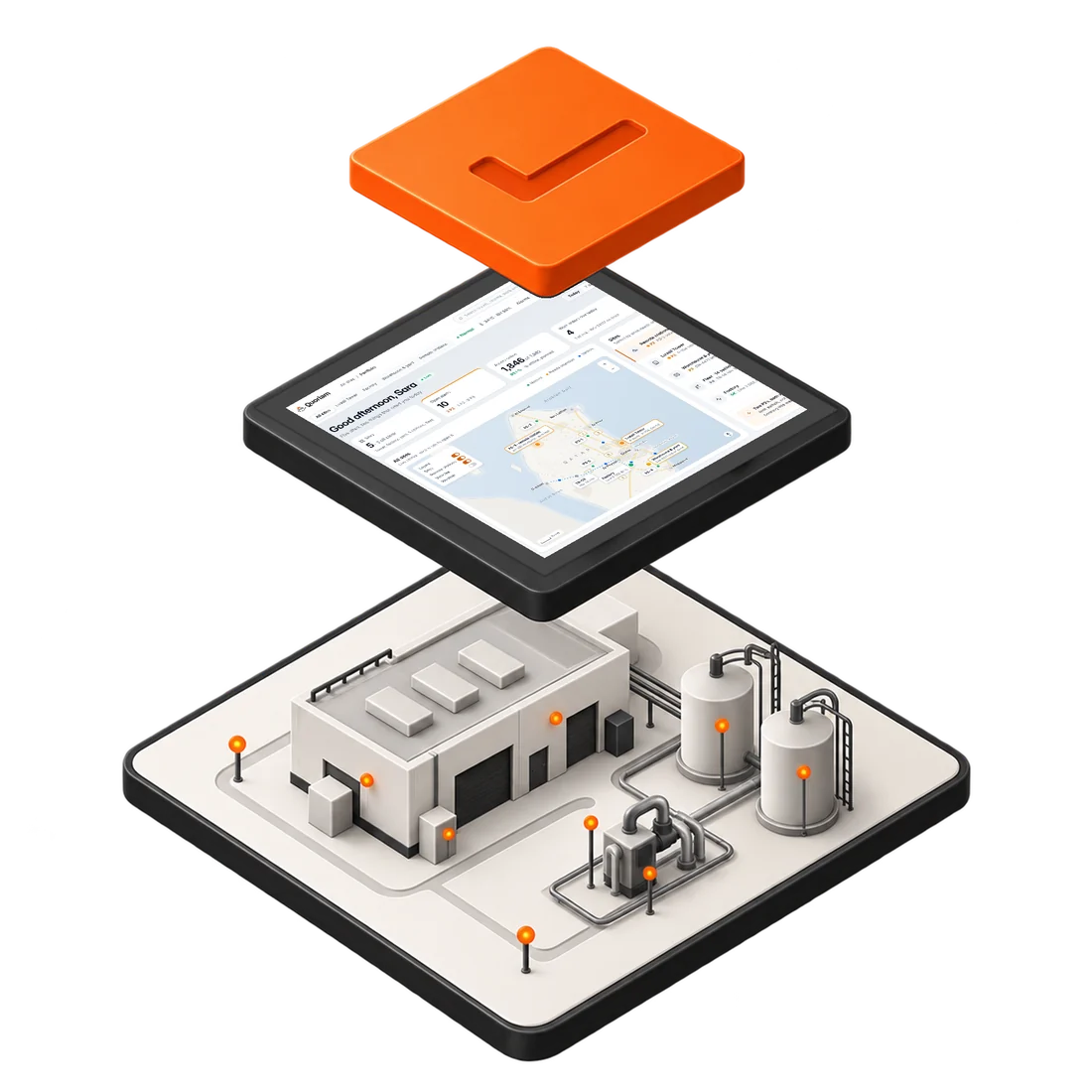
For IT, OT and security reviewers: where the data goes, and how.
- In the spaceWireless temperature and humidity sensors; probes inside fridges
- On siteLoRaWAN gateway; edge gateway for BMS readings where needed
- NetworkSite LAN or cellular, encrypted and kept apart from the control network
- Quoriam platformOn your premises or cloud hosted in Qatar
- Your team and systemsApp, SMS and email alerts with escalation; reports by PDF and CSV
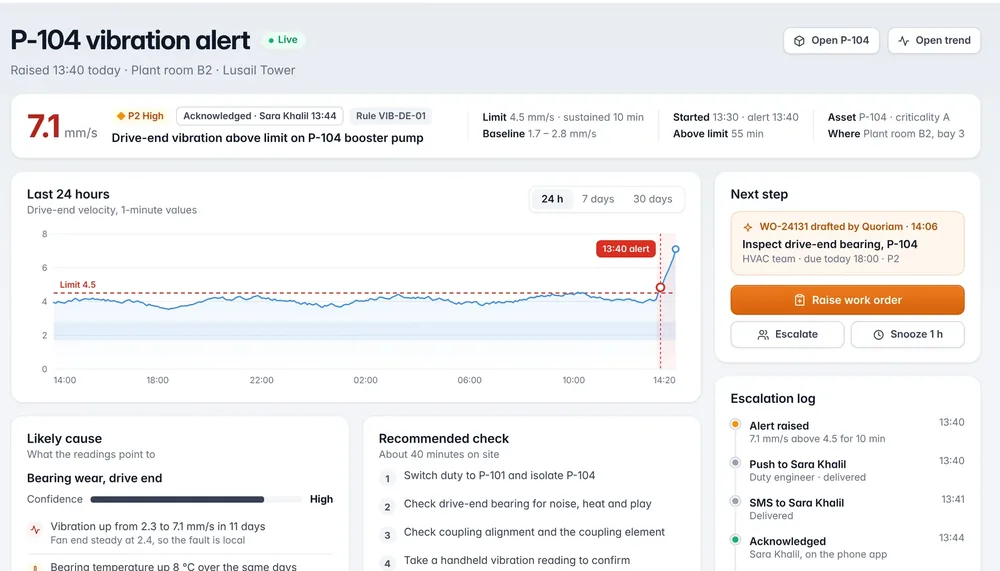
What your team sees.
The limits, the rooms and the sensors themselves.
Where it's used in Qatar.
Anywhere a tripped cooling unit puts stock, equipment or a licence at risk.
Warehouses and distribution centres
High-bay racking and dock areas that heat up through the summer.
Logistics and warehousingServer and comms rooms
Rack inlet temperature and humidity against the ASHRAE envelope.
Facilities and smart buildingsPharmacies and labs
Medicine stores and lab fridges, where the record matters as much as the temperature.
Healthcare
Questions buyers ask.
Something else? Ask us during the free assessment.
What is the right temperature and humidity for a server room?
ASHRAE's thermal guidelines recommend 18 to 27 °C at the air inlet of the IT equipment, with a dew point between −9 °C and 15 °C and relative humidity no higher than 70%, or 50% where corrosion is a risk. Your equipment class sets the wider allowable range. We set the alarm limits from both.
How many sensors does a warehouse need?
Fewer than a mapping study, which uses a logger every 5 to 10 metres. Permanent sensors go at the hot and cold spots the mapping finds, plus the dock and high racking. The free assessment gives you the count and the price.
How often do the sensors need calibrating?
WHO guidance for medicine stores asks for monitoring sensors to be calibrated every year, accurate to ±0.5 °C and ±5% RH. We follow your own procedure if it is stricter.
What hardware do you fit?
Battery-powered wireless temperature and humidity sensors, probes for fridges and freezers, and a gateway, such as the Quoriam Edge QE35 on LoRaWAN or cellular. Each is chosen for where it goes, from a dusty dock to a lab fridge.
Can it use our BMS or existing loggers?
Yes for the BMS: Quoriam reads its temperature and humidity points over BACnet and Modbus, so well-placed sensors aren't duplicated. Both kinds of reading share one log and one set of alarms.
Will an auditor accept the electronic record?
That is the auditor's call. WHO guidance expects an audit trail, defined user levels and, for pharmaceutical stores, 21 CFR Part 11 and GAMP. Quoriam records every reading, every change to a limit and every sign-off.
What does it cost, and can we pilot it first?
The price depends on the number of zones, rooms and gateways. The free three-week assessment ends with a fixed price, and a pilot on a few of your riskiest zones can come first, so you see real alerts before you commit.
Related.
Temperature and humidity monitoring is part of environmental monitoring on the Quoriam platform.
- Environmental monitoring
Log temperature, humidity and air quality in cold rooms, warehouses and offices, ready for audit.
- Cold chain monitoring
Cold rooms and freezers logged every few minutes, with alarms before stock is at risk.
- Indoor air quality
CO2, particles and VOCs by floor and room, against the limits your building targets.
- Logistics and warehousing
Fleets, cold rooms and yard equipment.
Find the hot spots before the auditor does.
A free three-week assessment. We walk your stores and server rooms, review your mapping and records, and recommend where sensors should go first.
We take on two assessments a month.Quoriam is designed to pay back within six months. How we calculate payback