
- Home
- Solutions
- Asset tracking and geofencing
- Container tracking
Container Tracking System in Qatar
GPS trackers on your containers and trailers, and zones on your yard plan: where every box is, how long it has sat there and whether anyone opened its doors.
Last updated
What is a container tracking system?
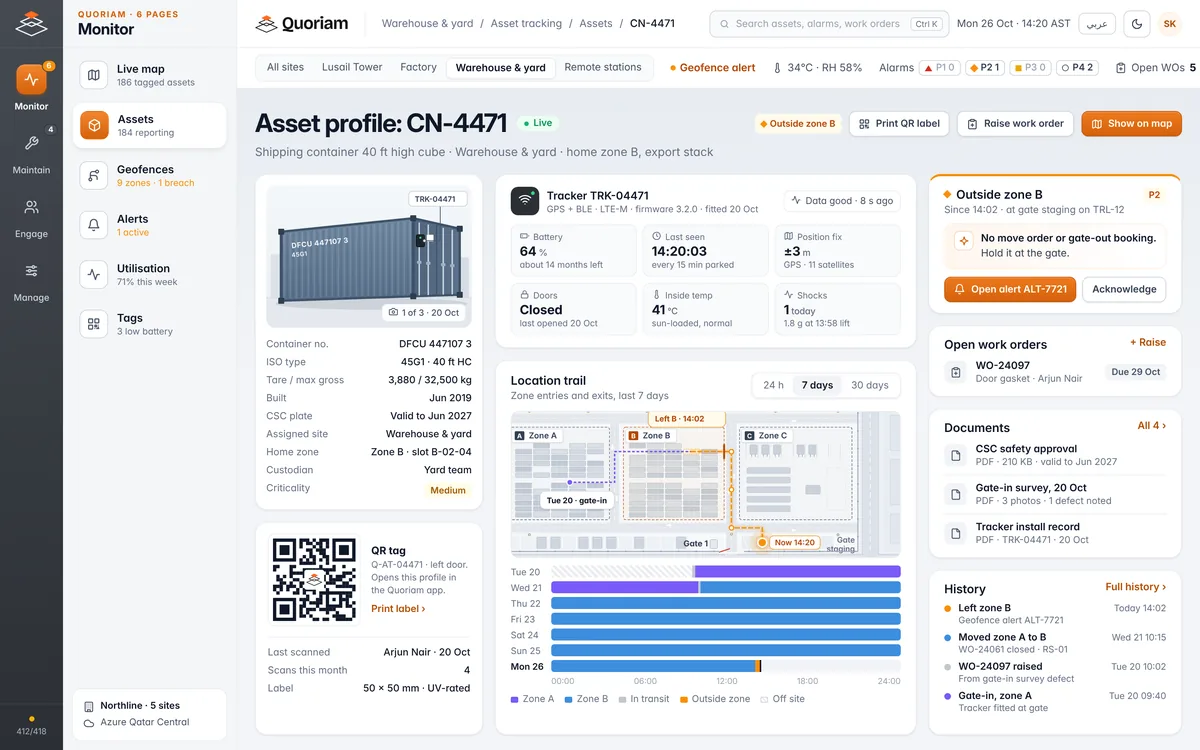
A container tracking system fits a battery-powered GPS tracker to each container or trailer. The tracker reports its position over the cellular network, and the platform checks it against zones drawn on your yard plan. It alerts on boxes that leave without a move order, doors opened in storage and containers held past their free days.
Shipping lines track their boxes between ports. A container tracking system for your yard or site picks up where theirs stops: in the laydown area, on a trailer to Ras Laffan, or parked at a customer's gate. It covers owned and leased containers, site offices, trailers and flat racks.
Each container is registered in Quoriam under its ISO 6346 number, so the alert, the move order and the storage invoice all name the same box.
What it tells you, and what you do.
The rules most yards switch on first.
| Event | What the tracker sees | What you do |
|---|---|---|
| Container leaves its zone unplanned | Position crosses the zone edge, past a small buffer, with no move order or gate-out booking | Hold it at the gate before it leaves the yard |
| Container over its dwell time | Days in one zone above your rule, such as storage charges from day 22 | Move, return or invoice it before more days accrue |
| Doors opened in storage | Door sensor changes state while the container is parked | Check the seal and the contents |
| Trailer parked too long | No movement for longer than your limit, such as four hours with the engine off | Call the driver or free the bay |
| Shock on a lift | Acceleration spike above the set limit | Inspect for damage before it is loaded again |
Reading a container number.
Every freight container carries an ISO 6346 number. Quoriam stores it against the tracker.
| Part | Example | What it means |
|---|---|---|
| Owner code | ABC | Three letters registered with the Bureau International des Containers (BIC) |
| Category identifier | U | U for a freight container, J for detachable container equipment, Z for a trailer or chassis |
| Serial number | 123456 | Six digits assigned by the owner |
| Check digit | 0 | Calculated from the first ten characters, so a wrong letter or digit shows up straight away |
Each character is converted to a number, weighted by its position and summed; the remainder after dividing by 11 is the check digit, and a remainder of 10 gives 0. Source: ISO 6346, as summarised by Identec Solutions.
How it works.
Fit
A tracker goes on each container, on the door end or a corner post, with a door sensor where the contents matter. We register it under the container's ISO 6346 number and its home zone.
Draw the yard
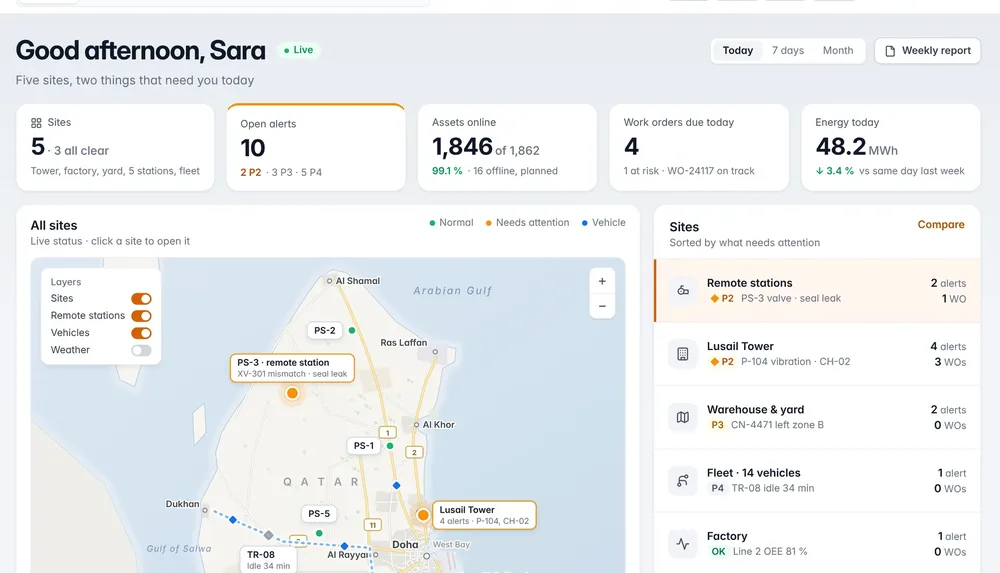
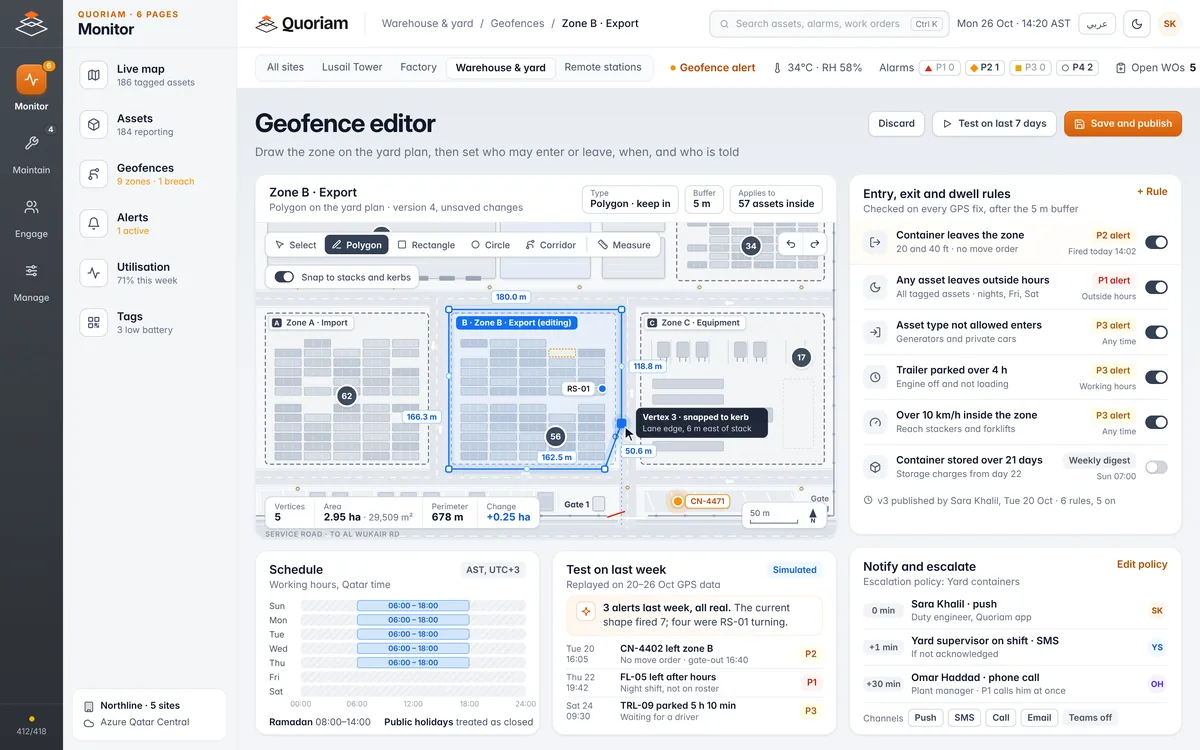
Zones go on your yard plan: import, export, empties, equipment and gate staging. Each zone gets a buffer of a few metres, so normal GPS drift doesn't fire alerts.
Set and test the rules
Before a rule goes live, Quoriam replays it on last week's positions, so you see how often it would have fired.
Act
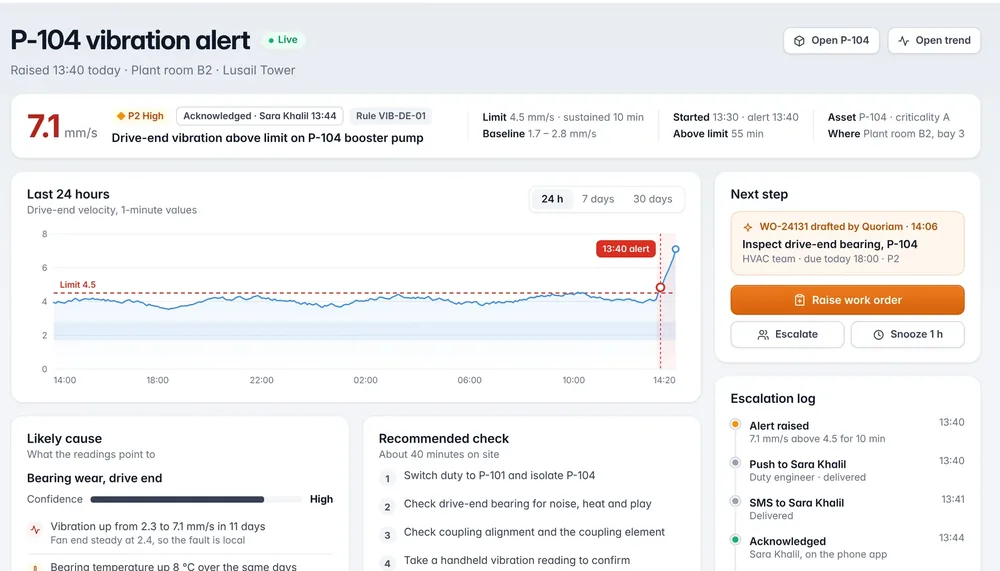
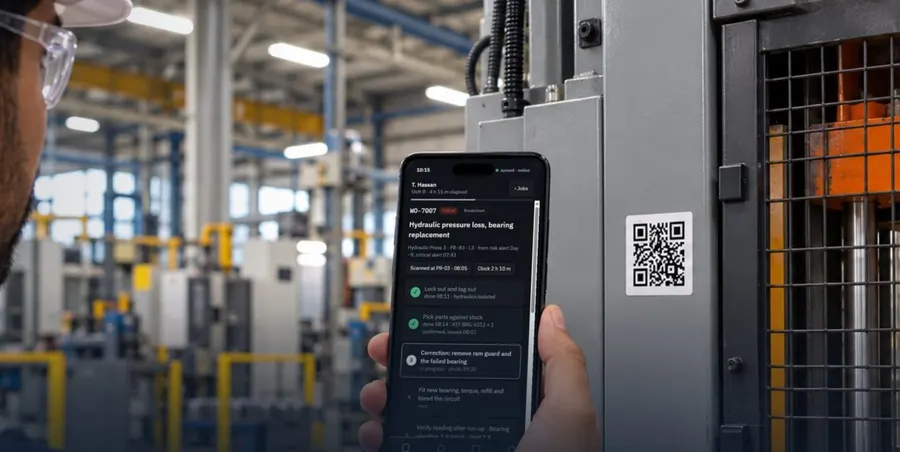
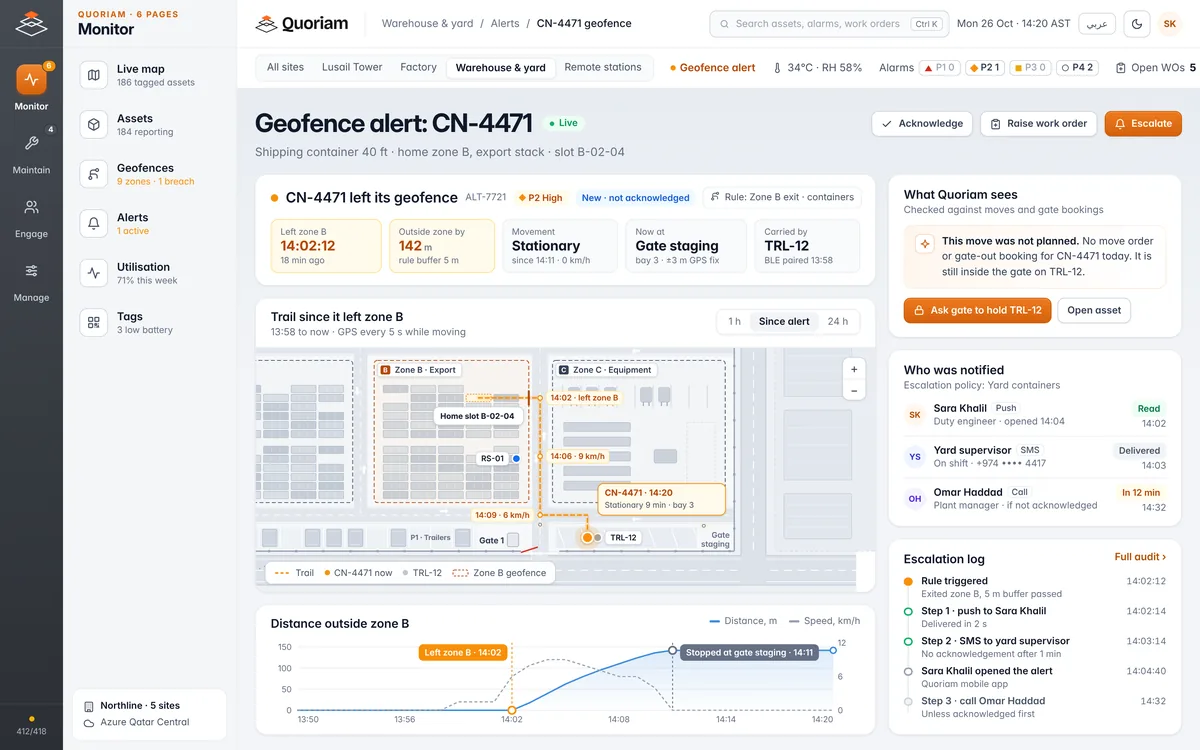
The duty engineer gets the alert with the trail, and can ask the gate to hold the trailer, raise a work order or acknowledge a planned move.
System view
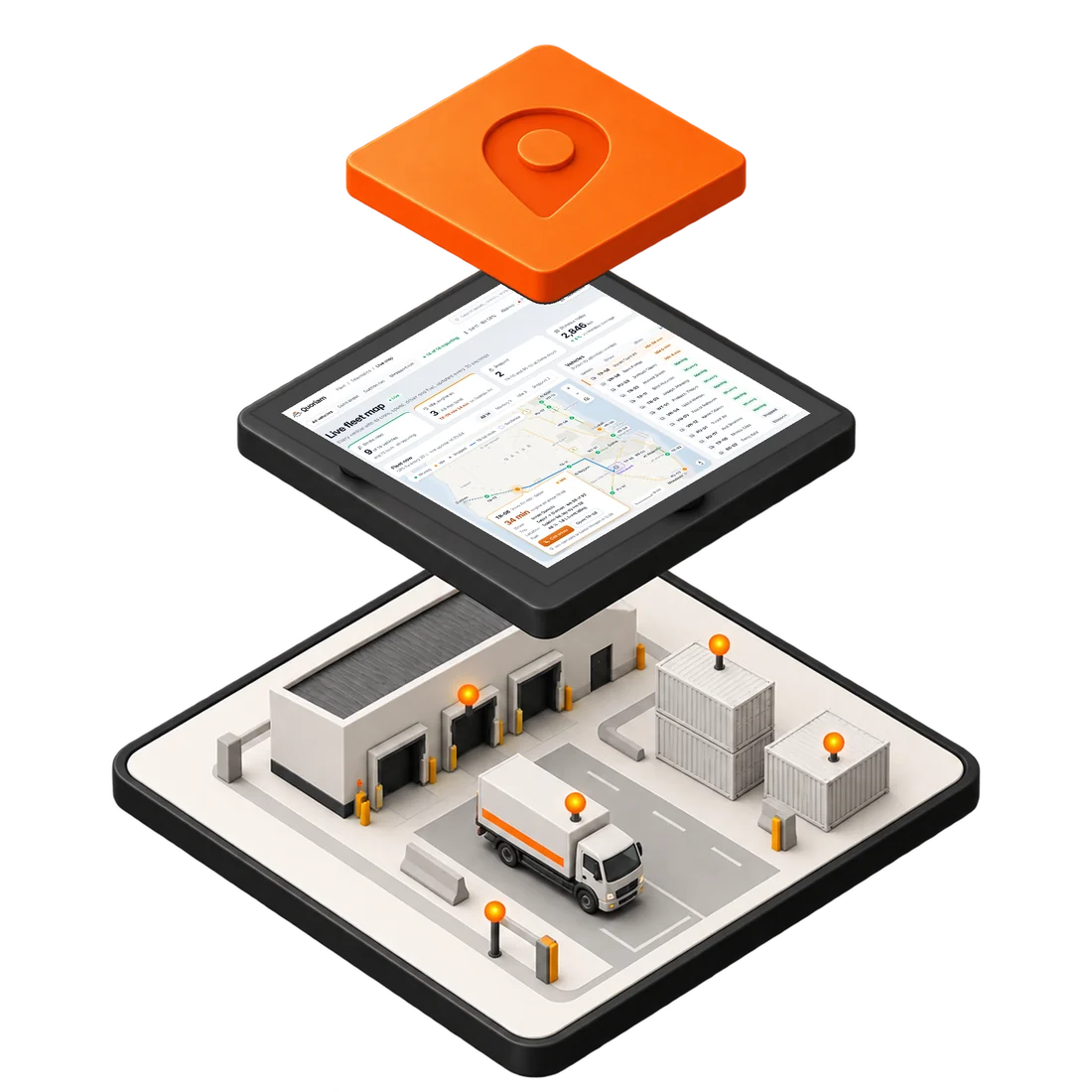
For IT, OT and security reviewers: where the data goes, and how.
- On the containerBattery GPS tracker with motion and shock sensing; door sensor where needed
- In the yardZones on the yard plan; a gateway where cellular signal is weak
- NetworkCellular from each tracker, such as LTE-M, encrypted in transit
- Quoriam platformOn your premises or cloud hosted in Qatar
- Your team and systemsApp, SMS and email alerts; moves and events to your yard system or ERP
What your team sees.
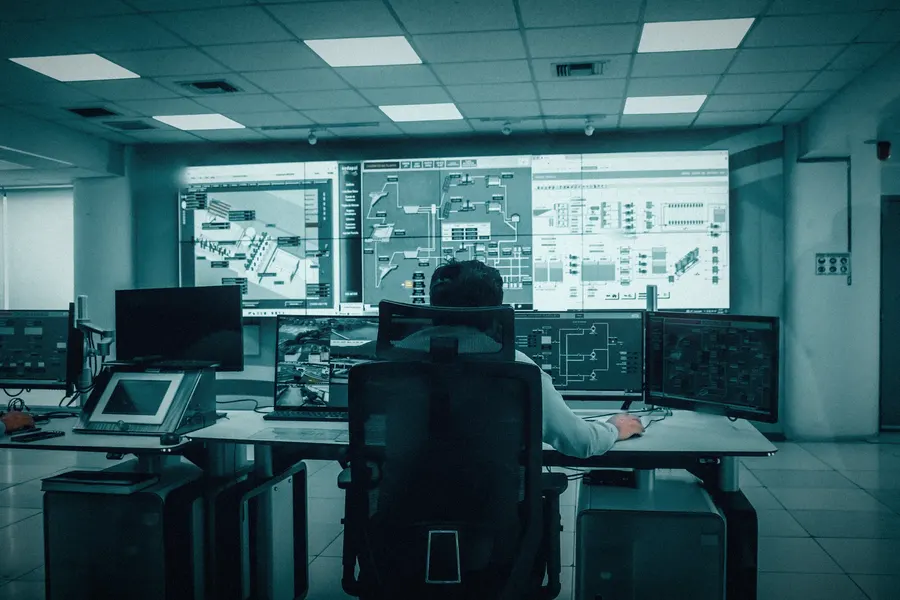
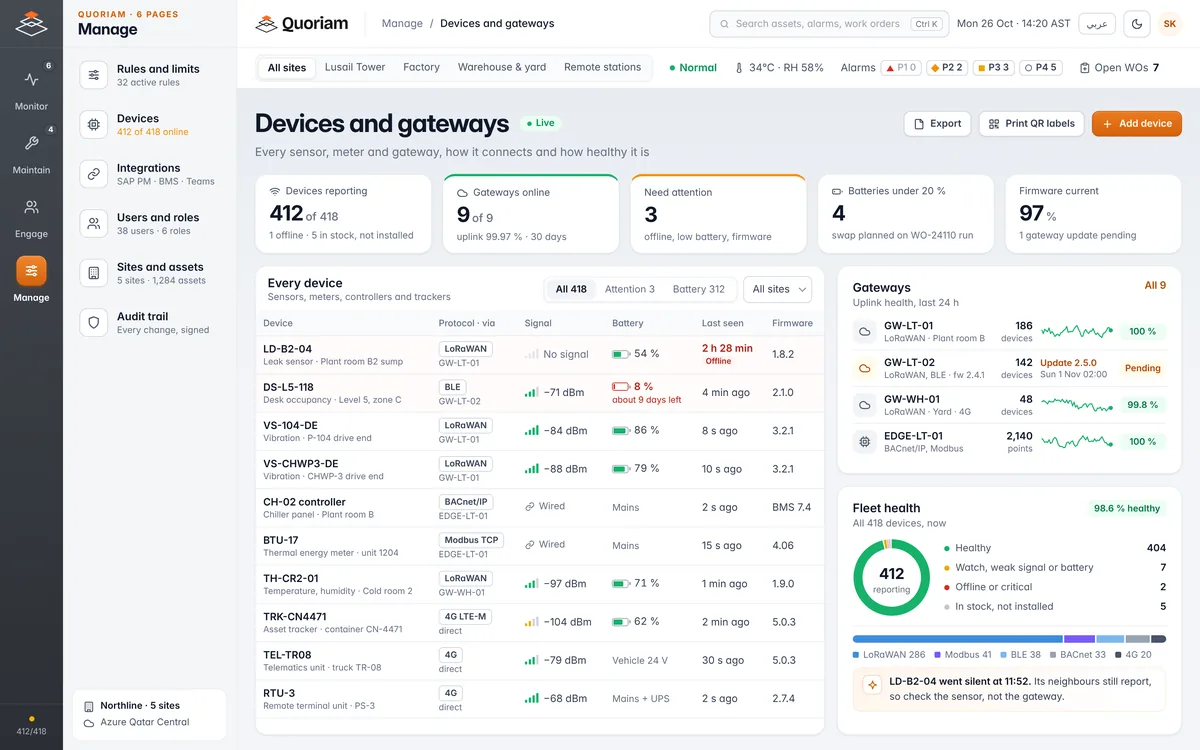
The zone, the rule and the evidence for every container in the yard.
Where it's used in Qatar.
Wherever containers sit for weeks between moves.
Container yards and depots
Import, export and empties stacks in the logistics parks, with gate-outs checked against bookings.
Logistics and warehousingConstruction and project sites
Site offices, stores and material containers moved between projects and laydown areas.
ConstructionOil, gas and energy
Equipment containers and flat racks in laydown yards at Ras Laffan and Mesaieed during shutdowns and projects.
Oil, gas and energyTrailer fleets
Trailers parked at customer sites and staging bays, with time on site logged.
Fleet telematics
Questions buyers ask.
Something else? Ask us during the free assessment.
How does a container GPS tracker work?
It takes a GPS fix and sends it over the cellular network to the platform, which checks it against your zones and rules. To save battery it reports less often while the container is parked and more often while it moves. A motion sensor can wake it as soon as the container is lifted.
How long does a tracker battery last?
It depends on how often the tracker reports and how hot it runs. A tracker on a steel container in the July sun runs much hotter than the air around it, and heat shortens battery life. We size the reporting interval to the job, and Quoriam lists low batteries before they run out.
What hardware do you fit?
A battery-powered GPS tracker with motion and shock sensing on each container, and a door sensor on the containers where the contents matter. Trailers can use a battery tracker or one wired to the trailer's power. Our engineers fit and test every tracker before handover.
Does it work at remote yards and on the road?
Yes, wherever there is cellular coverage. Ooredoo launched LTE-M in Qatar in April 2026, a low-power network for IoT devices that it says covers tracking of vehicles and shipments, and plans to extend it nationwide (Ooredoo). We check signal at each yard during the assessment.
How many trackers do we need?
One per container or trailer you want to see, plus door sensors on the ones whose contents matter. Many yards start with their own and leased boxes and the trailers that sit at customer sites. The free assessment counts them with you.
Can it connect to our yard system or ERP?
Quoriam can send positions, zone moves and dwell events to your yard system or ERP, and read move orders and gate bookings back so it knows which moves were planned. Until an integration is live, your team can book planned moves in Quoriam itself.
What does a pilot cost?
It depends on how many containers you track and how many yards you cover. The free three-week assessment ends with a scope and a fixed price for a pilot on one yard. Most pilots start with the boxes that move most or cost most when they go missing.
Related.
Container tracking is part of asset tracking on the Quoriam platform.
- Asset tracking and geofencing
Know where equipment, tools and containers are, and get an alert the moment one leaves its zone.
- Tool and equipment tracking
BLE tags on tools and mobile equipment, found by zone across sites and stores.
- Fleet telematics
Track vehicles, fuel and driver behaviour, with servicing scheduled from the same data.
Know where every box is.
A free three-week assessment. We review your container list, yards and gate process with your team, then deliver a plan: which boxes to track, the zones to draw and the rules to set.
We take on two assessments a month.Quoriam is designed to pay back within six months. How we calculate payback